
Space research
NASA uses Maxon motors on Mars
In two years' time, the US space agency NASA will be sending a new rover to Mars. It will include a helicopter that will take aerial photographs. The rotors will be controlled by DC motors from Maxon Motor.
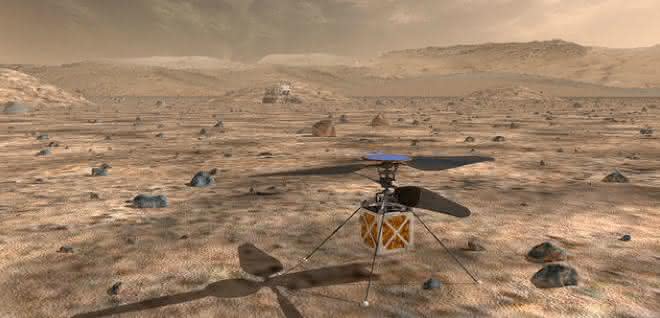
The US space agency NASA's Jet Propulsion Laboratory (JPL) is sending a helicopter to the Red Planet as part of the next Mars 2020 rover mission. It is scheduled to land on Mars in February 2021 and undertake several autonomous flights lasting up to 90 seconds in the first 30 days of the mission. The helicopter promises groundbreaking insights for future scientific and exploratory journeys to Mars. For example, the drone could serve as a flying eye for rovers in the future, exploring the surroundings and finding the best route in each case.
Energy-efficient components for extreme conditions
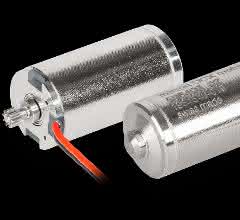
It takes an enormous feat of engineering to make the drone fly. This is because the thin atmosphere on Mars is roughly comparable to the conditions that prevail on Earth at an altitude of 30 km. The helicopter is therefore particularly light (1.8 kg) and can only carry small batteries. This requires the components used to be extremely energy-efficient. The drives from Maxon Motor have already proven themselves in several Mars missions and are also used in the JPL helicopter. Six small motors from the DCX series with a diameter of 10 mm are responsible for controlling the inclination of the rotor blades and thus the steering.
The helicopter propulsion system is designed and built by AeroVironment, an expert in the construction of small aircraft. The specialists are working closely with Maxon engineers. After a year-long development phase, the recent NASA approval for the helicopter project is an additional motivation. "Being part of another pioneering Mars project makes us incredibly proud and happy," says Eugen Elmiger, CEO of Maxon Motor.
Temperature measurement of Mars with the aid of a DC motor
Maxon is currently involved in several Mars projects: for example, the European Space Agency's ExoMars rover - with more than 50 drives, including in the wheels, the drill head, the analysis unit and the camera mast. This project will also start in 2020, but much earlier - on November 26, 2018 - NASA's stationary InSight unit will land on the Red Planet to investigate seismic activity and the planet's core temperature. A powerful and robust DC motor from Maxon will drive the InSight measuring probe almost five meters deep into the Martian soil.


You might also be interested in
BS Rollen Strengthens Its Presence in North Rhine-Westphalia
With the groundbreaking ceremony, BS Rollen is launching the construction of a new company facility in Hückeswagen. The new building will house administrative offices, an assembly line, and a high-bay warehouse, and is intended to facilitate further...
 read more...
Micro motors as the driving force behind intralogistics
Suitable transport structures in intralogistics are a prerequisite in all industries in order to withstand competitive pressure in the future. The basis for this is comprehensive automation, which would be inconceivable without an armada of powerful...
read more...E-scooter with customizable damping
The startup Scuddy has significantly improved the flexibility, performance, customizability and ergonomics of its second-generation foldable e-scooter of the same name - thanks in part to damping technology from ACE.
read more...Electric multidirectional counterbalanced...
360-degree steering on three wheels
Hubtex has given its FluX electric multidirectional counterbalanced truck an update: The new generation for the three-ton capacity class.
read more...New FLUX: 360-degree steering on 3 wheels
HUBTEX presents the new generation of the FLUX 30 electric multidirectional counterbalanced truck (load capacity 3 t). The innovative 2-in-1 stacker is both a front and sideloader. With its patented 360-degree HX steering, it transports both long...
read more...Norelem supports VDI Racing Camp
Mastering the challenges of e-mobility
Promoting young talent has been a priority at Norelem for many years: the company supports young talents with components and the necessary know-how and provides schools with illustrative material.
read more...igus:bike honored with German Design Award 2023
A wide, angular frame made of plastic, black wheels with Y-spokes: The futuristic look of the bicycle designed by Dutch bicycle developer mtrl with motion plastics from Igus can look forward to the prestigious German Design Award 2023.
read more...Floating garbage trap cleans up the Rhine
Every day, a ton of garbage flows down the Rhine. To catch some of it, the Cologne-based Krake association has now inaugurated a floating garbage trap. One of the sponsors of the so-called Rhine octopus is the plastics specialist Igus.
read more...Torwegge presents FlexO rollers
Visitors to the FMB - Supplier Fair for Mechanical Engineering can once again look forward to a new product at the Torwegge stand this year: the FlexO rollers.
read more...