
Lubrication of industrial rolling bearings
Lubricate like the pros
The aim of digitalization and networking is to achieve maximum operational efficiency through the most comprehensive automation possible. However, a company must never neglect the fundamentals of production - for example its lubrication media and techniques. Otherwise, production can easily come to a standstill. By Dietmar Seidel
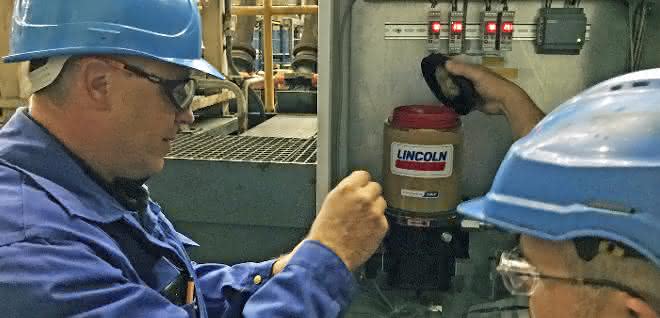
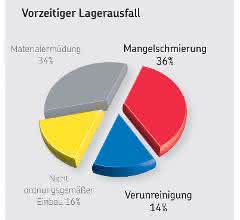
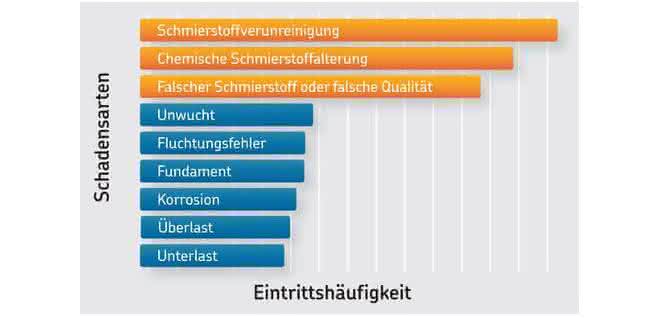
Experience shows that around half of all premature bearing failures are due to inadequate lubrication and contaminated lubricants. The failure of individual bearings can be really expensive if it brings the entire production to a standstill. "And this is all the more annoying when you know that lubricants usually only account for one to three percent of total maintenance and repair costs," says lubrication expert Jens Beck from Technology Business Management at SKF in Schweinfurt.

However, as Beck has often experienced, many factories are downright adventurous in their handling of the material that is supposed to result in the smoothest possible production: You can find greases well past their expiry date, completely incorrectly stored lubrication supplies or heavily contaminated oils. "If you like, lubrication media and technologies are often in a state similar to that of the first industrial revolution," reports the STLE and ICML-certified and listed lubrication specialist with a wink. "Yet there are now plenty of ways to make the lubrication sector fit for the Industry 4.0 era."
Analyze the current situation
As you would expect, the first step is to collect data. To do this, the SKF experts use a structured questionnaire to record the current status of the customer's lubrication management - they create a customer needs analysis. From this, existing strengths and, of course, initial optimization potential can be derived. The top priority here is to deliver the right lubricant in the right quantity to the right place at the right time using the right lubrication process.
With this goal in mind, the focus is now shifting to the existing infrastructure: the "Lubrication Audit" is a detailed as-is analysis of all relevant lubrication, application and machine component conditions. "This is important so that the individual conditions on site can be reflected in their respective ideal states," emphasizes Beck.
This comparison is so important, for example, because it is quite easy to get used to certain bearing life cycles in day-to-day operations and therefore consider them normal at some point. This often turns out to be a mistake: "We find time and again that the service life can sometimes be drastically extended by using ideal lubricants and techniques."
From over 25 years of experience in lubrication technology, Beck cites improper handling of oils as a typical example of carelessness when dealing with lubricants: "Anyone who literally leaves their drums out in the rain or uses one and the same container for different oils will sooner or later damage the lubricant. This naturally impairs the performance of the oil so that it can no longer fulfill its actual task - namely to ensure maximum service life of the machine components."
Coordinate, implement and adapt improvements
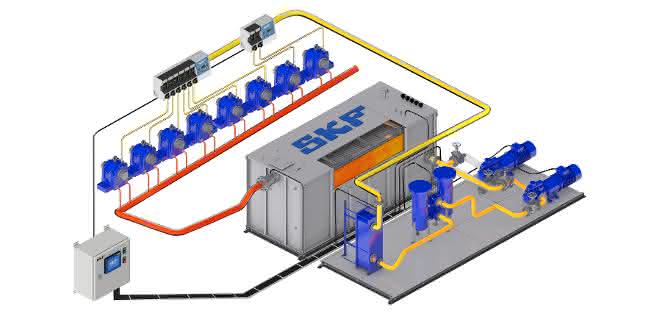
After the experts have examined the entire path of all lubricants in the company - from the specific lubricant selection including suppliers, storage and its control through to consumption and disposal - the identified potential for improvement is discussed together. The most sensible measures can then be put into practice. "Last but not least, it is important to get the employees involved on board," emphasizes Beck. "And the best way to do this is to make them aware of the particular added value of the audit and the personal benefits it brings."
For this reason, among others, certain key performance indicators are recorded in a fifth step, which provide an insight into the success of the measures implemented to date. The corresponding findings also provide starting points for additional "fine-tuning". In addition, the regular reassessments make it possible to create a kind of "ranking list" with further useful measures. "And that's really helpful," adds Beck, "because not all the optimization potential discovered can usually be put into practice in one fell swoop."
The lubrication expert is convinced that there will be noticeably fewer premature failures and downtimes if the appreciation of lubrication management increases in companies. "Ultimately, this saves costs, and our advisory program can make a significant contribution to this," concludes Jens Beck. He is not alone in this assessment: according to the "Tribology Action Handbook" published by the British engineering company IMechE - similar to the VDI - investing in a good lubrication program offers a return on investment of up to 400 percent. What's more, such a program can also be used to prepare for future increases in the performance of production systems in terms of lubrication technology, so that everything really does run like clockwork in the age of Industry 4.0.
Dietmar Seidel, Head of Technical Press Germany, SKF / am


You might also be interested in
Predictive maintenance in retrofit
Predictive maintenance pays off. This is because early detection of impending failures means that systems can be serviced in a targeted manner before production downtime occurs. But how complex is it to integrate such a maintenance concept into an...
 read more...
Maintenance instead of replacement
The circular economy starts with the machinery
Sustainability in industry starts with machines, says our guest author from Deguma: How maintenance, modernization and the 5R strategy save resources, energy and CO₂.
read more...3D printing for unplanned requirements
The material fails and the machine suddenly stops? Then you need to take the right measures to be able to resume production quickly. Material failure in the form of faulty components or material wear in the frame are a risk for any production.
read more...High demands in terms of safety, application and robustness
Demanding work in the electrical trade and energy supply as well as smooth processes in production require innovative and customized measurement technology that scores points for safety, ease of use and resilience.
read more...Car meets e-bike: riding with lubrication-free polymer bearings
Studies show that the proportion of pedestrian and bicycle traffic is increasing in urban areas. With the JetBike, JetBike GmbH from Braunschweig presents a mixture of e-bike and car and relies on lubrication-free polymer bearings from Igus.
read more...Hydraulic hub for more efficient servicing
Bosch Rexroth presents a digital toolbox for service and maintenance. With a comprehensive range of digital services, the Hydraulic Hub simplifies and accelerates the service and maintenance of hydraulic products and increases machine availability.
read more...Arnold Umformtechnik expands after-sales...
Faster help with VR glasses
Arnold Umformtechnik is expanding the after-sales service for its machines to include digital remote services. The focus is on data security, simple operation and clear processes.
read more...147,000 euros per hour: high costs for German companies due to unplanned downtime
According to the "Value of Reliability" study, 67% of industrial companies in Germany experience unplanned downtime at least once a month. This costs the German economy 147,000 euros per hour. Nevertheless, reactive maintenance concepts are not...
read more...Maintenance starts with a maintenance planner
Legal requirements stipulate that machines and systems must be serviced regularly. The maintenance work serves to ensure occupational safety and economic efficiency.
read more...