
Know-how
Testing electrical devices and systems
Testing. No technological device can function without these systems. They must therefore function reliably and safely as intended in the approved environment during their service life.

In addition to their careful manufacture and maintenance, testing must ensure that this objective is achieved. This includes the quality-compliant routine test at the end of production after the preceding type test, which must be repeated in the event of modifications and, if necessary, at certain intervals. After commissioning, a repeat test is carried out at specified intervals.
Basic information
Tests at every stage (inspection, testing, measurement), preferably of their safety-relevant functions and protective devices, serve to confirm the calculation/project planning, i.e. to prove the desired functionality, expected quality/reliability/lifetime and to guarantee their safety in order to protect persons and material. Risks must be recognized at the latest at the time of testing, and the safe use of the test specimen is bindingly proven until the next test if it is used correctly under approved environmental conditions. Reliable protection is provided against damage caused by electrical energy such as electric arcs, electric shocks, fires and mechanical effects. The test-friendly design of the product and documentation make testing easier.
All test stages are characterized by an algorithmic, computer-friendly nature. The degree of automation possible is usually determined by the production volume. They are based on specifications and laws that must be complied with and are often reflected in checklists. Results are documented as a report or label.
The organization of electrotechnical employees plays a key role (cf. legal sources Industrial Safety Ordinance, Energy Industry Act, etc. as well as VDE regulations VDE 0105-100, VDE 1000-10). The associated responsibility for the safety and health of employees is expressed in the designations entrepreneur/plant manager, electrician (various levels), qualified and instructed person. The person responsible for the system is responsible for assessing the risk. He ensures that the competence with regard to legal disputes is clearly and transparently formulated.
Production test
Exemplary production testing includes preliminary testing, functional testing of prefabricated components and complete testing of the entire product
- Incoming goods, wiring and insulation test (circuits to earth and to each other)
- Endurance test
- Testing of all protective measures including PE connection.
Commissioning and maintenance
These sections correspond proportionally to steps in the production test. They are laid down by the supplier/producer in binding documentation and troubleshooting instructions (formalized with event networks and program flow charts). The focus here is on on-line diagnostics (Fig.). It enables preventive damage detection. Essentially, these phases mean a repeat test in which anomalies are eliminated.
Repeat testing
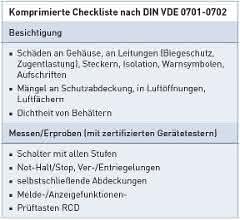
The basis is the risk analysis with the individual determination of their intervals. These intervals (usually between 3 and 24 months) depend on factors such as system/device characteristics, employee qualifications, information in the operating instructions, ambient conditions and the failure rate established in the past for comparable test specimens. In addition, authorities or insurance companies may require further tests. The objectives correspond to steps for the measurement categories CAT0 - CAT IV according to IEC 61010-1. Technical details are mainly laid down in VDE regulations. The most important of these include VDE 0105-100 - periodic tests, DIN VDE 0100 - electrical installations up to AC 1000 V or DC 1500 V (including protection type and class) and DIN VDE 0701-0702 appliance testing (table).
Outlook
Legal/administrative regulations and contracts require the application of the VDE regulations as "generally recognized rules of technology". Violations of this obligation may lead to considerable subsequent improvements and compensation payments, as well as the risk of consequences under civil and criminal law.
In addition, these principles must be constantly monitored in order to update them. Documented test results must not only enable efficient troubleshooting, but also serve to further develop the product.
Joachim Krause


You might also be interested in
Predictive maintenance in retrofit
Predictive maintenance pays off. This is because early detection of impending failures means that systems can be serviced in a targeted manner before production downtime occurs. But how complex is it to integrate such a maintenance concept into an...
 read more...
Maintenance instead of replacement
The circular economy starts with the machinery
Sustainability in industry starts with machines, says our guest author from Deguma: How maintenance, modernization and the 5R strategy save resources, energy and CO₂.
read more...3D printing for unplanned requirements
The material fails and the machine suddenly stops? Then you need to take the right measures to be able to resume production quickly. Material failure in the form of faulty components or material wear in the frame are a risk for any production.
read more...High demands in terms of safety, application and robustness
Demanding work in the electrical trade and energy supply as well as smooth processes in production require innovative and customized measurement technology that scores points for safety, ease of use and resilience.
read more...Car meets e-bike: riding with lubrication-free polymer bearings
Studies show that the proportion of pedestrian and bicycle traffic is increasing in urban areas. With the JetBike, JetBike GmbH from Braunschweig presents a mixture of e-bike and car and relies on lubrication-free polymer bearings from Igus.
read more...Hydraulic hub for more efficient servicing
Bosch Rexroth presents a digital toolbox for service and maintenance. With a comprehensive range of digital services, the Hydraulic Hub simplifies and accelerates the service and maintenance of hydraulic products and increases machine availability.
read more...Arnold Umformtechnik expands after-sales...
Faster help with VR glasses
Arnold Umformtechnik is expanding the after-sales service for its machines to include digital remote services. The focus is on data security, simple operation and clear processes.
read more...147,000 euros per hour: high costs for German companies due to unplanned downtime
According to the "Value of Reliability" study, 67% of industrial companies in Germany experience unplanned downtime at least once a month. This costs the German economy 147,000 euros per hour. Nevertheless, reactive maintenance concepts are not...
read more...Maintenance starts with a maintenance planner
Legal requirements stipulate that machines and systems must be serviced regularly. The maintenance work serves to ensure occupational safety and economic efficiency.
read more...