

Interview with Stephan Stammberger
"Products cannot be sold without data"
On first contact with Misumi, you might think you were dealing with a traditional distributor. A misjudgement. How did this come about?
We are often pushed into the distribution corner, which was probably also due to the two catalogs: 4,000 pages long and weighing 4 kg. For many people, a catalog is synonymous with distributor. However, Misumi is a manufacturer with 19 production sites worldwide, mainly in Asia, but also in Europe and North America. Misumi products form the core business in Europe: From screws and drive systems to automation solutions, we have everything that machine builders need in our range. At the heart of this is our configurator, which our customers can use to configure over 100,000 items online for specific applications. At the end, they receive an offer from batch size 1 and the delivery time.
What configurations can users make and how long does it take for the finished component to reach the customer?
You can configure the entire component, starting with the geometry, material, surface, degree of hardness, thread and so on. You can therefore design the component exactly as you need it. After production, every single component undergoes a quality check. We have an average delivery time of 7.3 days - from order to arrival at the customer.
Automation technology is a broad and complex field. What solutions do you offer in addition to the drive technology already mentioned?
Our core business is mechanical components. We therefore offer everything in the field of mechanical automation technology. Due to the distribution articles, our portfolio is also slowly beginning to include electromechanical products such as connectors, cables and the like. Electronics as such or software and control systems are not part of our expertise.
Electromechanical systems are also becoming increasingly intelligent. Doesn't this inevitably push you towards digitalization?
Our expertise clearly lies in the mechanical sector. As things stand today, we will not be moving away from this area. We differentiate ourselves strongly through our fast delivery times and high quality - we are market leaders in this area. In addition, we do not serve the mass market. We offer "low volume, high mix": Mechanical engineers always have new technical and geometric requirements, so they always have to design different components, and we can cater to that. Our catalog contains almost 20 million items worldwide. No matter what they need, they can find it with us. In addition to the standard products, he can also adapt his component to his requirements using the configurator. This gives them virtually endless possibilities.
However, digitizing the design process, procurement and maintenance for our customers is right at the top of our agenda.
You also work together with toolmakers. What does this collaboration look like?
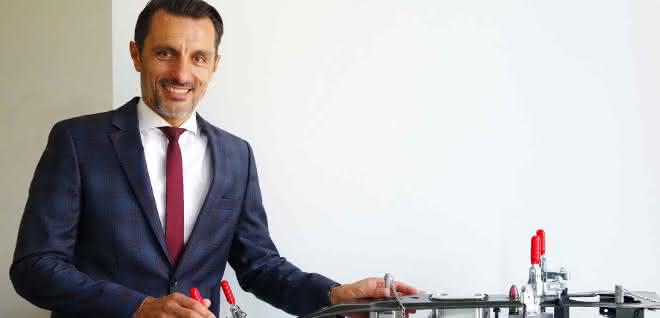
We are in good contact with toolmakers in the automotive production sector. Among other things, they produce holders that are used, for example, for welding car seats or for the quality inspection of sheet metal components. These tools are very special and have to be adapted to each sheet metal part. Our customers in this sector use the configurator to keep their process costs low. Normally, the components would be drawing parts, i.e:
A designer would have to draw these first. However, as up to 70 percent of this component consists of Misumi items, he can easily adapt it to his application using our configurator. This turns his design part into a purchased part with little administrative effort.
What are the advantages for the user?
A major advantage lies in the area of maintenance: if such a component needs to be reordered, the customer simply enters the product code of the component and we can simply reproduce it. It is then on site within seven days, anywhere in the world. For drawing parts, the process is much more time-consuming and cost-intensive. Process costs are a big issue in every company, and we help to minimize them by streamlining your design process.
Then, in principle, you are also a contract manufacturer.
We manufacture a component according to our customers' wishes, but not according to their drawings. At the moment, the customer configures our standard products and then receives the 3D data in 40 selectable formats. In addition to the real product, they also receive its digital twin for simulation and planning purposes. In future, we would also like to manufacture according to our customers' 3D data.
If you provide your customers with the drawings, are you not afraid that they will take them and have their component manufactured elsewhere?
The risk exists, of course. But a designer can't work without 3D data; it's the ticket to the game, so to speak. I can no longer sell products without data. But our entire production and logistics concept is so sophisticated that we are not afraid to face up to the competition. And the area with small quantities of up to 300 and constantly changing products is of no interest to contract manufacturers.
Small quantities and constantly varying components are a challenge for any production facility. How do you master this challenge?
The level of automation in our production facilities is very high. Although we are not yet fully automated, we are experimenting heavily with Industry 4.0. Around three years ago, we won a prestigious prize in Japan, the "Good Factory Award". This is awarded by the Japan Management Association, an organization that is roughly comparable to the Chamber of Industry and Commerce in Germany, to companies that have very good production processes.
The high diversity of customer-specific products also places high demands on your production facilities. Can all products be manufactured at every production site?
As a rule, we have redundant factories for the most important product areas, i.e. two production facilities that can manufacture these products. Each product area also requires special machines and expertise, for example for toolmaking or drive technology. But there is also redundancy in the machines within the production facilities: if one breaks down, another takes over its tasks. This is how we ensure delivery times and quality. A larger batch can also be produced on several machines. So if a fault occurs, we can ensure that it only affects a small batch.


You might also be interested in
Helu makes its first trade fair appearance under a new brand name
Helu Kabel will be presenting itself as Helu for the first time at Hannover Messe 2026, showcasing system solutions, Heluchain cables and new industrial luminaires.
 read more...
Strategic realignment with brand relaunch
In future, Helukabel will trade as Helu
The Helukabel Group is parting with part of its name: in future, the company will only operate under the Helu brand. With this step, the specialist for electrical connection technology is underlining its strategic development from a classic cable...
read more...Modular plant construction for corrugated board
Insight into the production of corrugators at BHS Corrugated: Automated, modular and equipped with Helukabel components.
read more...Best quality for the steel
Conditions in the steel industry are harsh and inhospitable. The machines used must be able to withstand the demanding environmental conditions in order to deliver the best quality at all times.
read more...If the standard cable is not sufficient
Lapp offers cables for countless applications - but not for all of them. From time to time, the developers have to modify a standard cable or develop a special cable.
read more...Slight decline in sales, strong investments
The Lapp Group has not been spared from the weakening global economy. However, the company only recorded a slight loss in the past 2024 financial year.
read more...Electrical connection technology
Cables and wires for industrial automation
Heukabel offers system solutions for cable routing from a single source. The subsidiary EKD Systems specializes in tailor-made cable drag chains made of steel, stainless steel and plastic, which are used in moving machines and systems as well as in...
read more...Lapp relies on Ultramid from BASF
Mobile charging of electric vehicles
The automotive industry is currently undergoing the biggest transformation in its history. The boom in battery electric vehicles in particular is presenting the industry with major challenges. Lapp, as a supplier of cables and connection...
read more...Cable handling application
At this year's Motek, ArtiMinds Robotics is showcasing a robot-based automation solution for the sensor-assisted assembly of flexible cables in connector housings.
read more...