

Hexapods for positioning
Hexapods position optical components
When multi-axis solutions are required for precise positioning tasks in automation technology, parallel kinematic systems are often the ideal solution. One example of this is hexapods, which can position loads extremely accurately with different travel ranges. Possible applications range from mechanical engineering and robotics to medical technology, research and high-precision measurement of optical components.
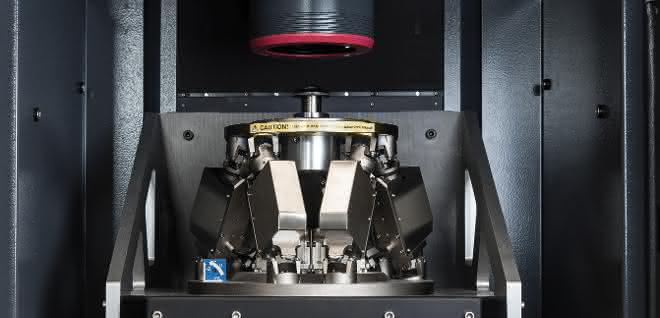
In principle, there are two options for the design of multi-axis positioning systems: Serial and parallel kinematics. As a stacked or nested system, serial kinematics is simpler in design and the control of individual axes is less complex. However, it has a number of disadvantages compared to parallel kinematics systems, which include hexapods.
Parallel kinematics and its advantages
In a serial kinematic multi-axis system, each actuator is assigned to exactly one degree of freedom of movement. If position sensors are integrated, these are also assigned to one actuator each and only measure the movement in the degree of freedom of the corresponding positioning axis. All unwanted movements in the other degrees of freedom, for example due to guidance errors in the individual axes, cannot be detected and corrected. As all six actuators in hexapods act directly on the same platform, guiding errors cannot add up.
In addition to the considerably more precise movement, the moving mass is lower, as only the platform is moved. This results in higher dynamics, significantly better path fidelity and repeat and sequence accuracy for all movement axes. Because there are no trailing cables, precision is not limited by friction or torques. The hexapods are also very compact.
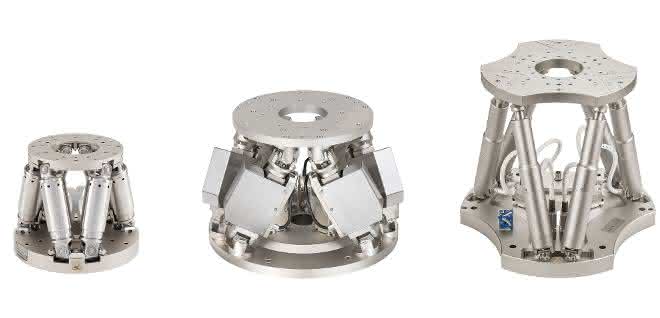
Hexapod systems from the Karlsruhe-based company Physik Instrumente have proven their efficiency. The measurement technology specialist Mahr uses hexapods in a new non-contact process to measure optics, in particular aspheres, precisely, quickly, flexibly and directly in the production line, without any CGH (computer-generated holograms) or classic stitching.
Fast and flexible analysis of aspherical lenses
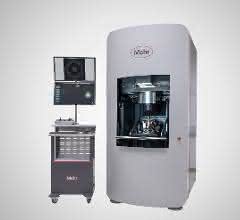
"In contrast to existing systems, which require a measurement time of several minutes, the MarOpto TWI 60 makes it possible to measure entire surfaces in 20 to 30 seconds," explains Dr. Jürgen Schweizer, Product Manager at Mahr. The next test specimen can already be measured during the evaluation of a test specimen, which typically takes around two minutes. The system is also very flexible. In addition to aspheres, other optics with geometries that deviate from the standard shapes, so-called freeforms, can also be measured. The system is so robust that it can be set up directly in production.
The new measuring system works in a similar way to a normal interferometer, but does not optically capture the test specimen completely in one image, but in many sub-apertures that are active at different times. In the case of aspheres and free-form optics with their relatively steep surfaces, capturing the test specimen "all at once" would cause the interference patterns to run into each other, which could then no longer be resolved. If the individual subapertures are now activated in a geometrically distributed manner, differently tilted wavefronts hit the test optics in such a way that the resulting interference patterns do not overlap. In this way, an undisturbed interference pattern of a local part of the test specimen surface is ultimately obtained from each sub-aperture. The individual interference patterns are then added together to form an overall pattern. This represents the surface of the test specimen and can be evaluated accordingly.
Referencing, calibrating and measuring
Like every measuring device, the TWI must also be referenced and calibrated. To do this, a high-precision manufactured sphere of known geometry is moved to a number of positions in the measuring volume for each sub-aperture and its surface is measured with the respective sub-aperture. Finally, the individual measurements are evaluated and a correction algorithm is created for each sub-aperture. "As lateral positioning errors of the calibration sphere affect the correction algorithm of the respective sub-aperture, the calibration sphere must be precisely positioned in space and its position must be kept stable during the measurement. This calibration process must cover the measurement volume and is therefore carried out at a large number of positions in the measurement volume. As every calibration error is included in the subsequent measurement process, each individual position must be approached very precisely. A maximum lateral positioning error of 5 µm with a repeatability of less than 0.5 µm is required," emphasizes Schweizer. "In order to ensure the high demands on the positioning mechanism in the TWI, we opted for the Hexapod H-824 from Physik Instrumente after careful testing." During the actual measuring process, this hexapod must then also position the test specimen stably in five degrees of freedom. The target and actual positions must match very precisely. For example, the deviations during tilting must not exceed 60 µrad.
The Hexapod clearly meets this requirement. It is suitable for travel ranges of up to ±22.5 mm along the translational axes X and Y and up to ±12.5 mm in the Z direction and achieves up to ±7.5° around the rotational axes θX,θY. The actuator resolution is 7 nm, and the smallest increment is 0.3 μm in the direction of the X, Y and Z axes with a repeat accuracy of up to ±0.1 μm or ±2 μrad over the entire travel range.
The Hexapod is controlled by the C-887 digital controller, which enables simple commanding with user-friendly software. The positions are specified in Cartesian coordinates and all transformations to the individual drives are performed by the controller. As an option, the Hexapod controller communicates with the higher-level controller via EtherCAT and can therefore be easily integrated into existing systems. This opens up many more possibilities in automation technology and robotics.
Dipl. Geogr. Doris Knauer, Global Campaign Manager Industrial Automation at Physik Instrumente, Ellen-Christine Reiff, M.A., Redaktionsbüro Stutensee / am


You might also be interested in
Helu makes its first trade fair appearance under a new brand name
Helu Kabel will be presenting itself as Helu for the first time at Hannover Messe 2026, showcasing system solutions, Heluchain cables and new industrial luminaires.
 read more...
Strategic realignment with brand relaunch
In future, Helukabel will trade as Helu
The Helukabel Group is parting with part of its name: in future, the company will only operate under the Helu brand. With this step, the specialist for electrical connection technology is underlining its strategic development from a classic cable...
read more...Modular plant construction for corrugated board
Insight into the production of corrugators at BHS Corrugated: Automated, modular and equipped with Helukabel components.
read more...Best quality for the steel
Conditions in the steel industry are harsh and inhospitable. The machines used must be able to withstand the demanding environmental conditions in order to deliver the best quality at all times.
read more...If the standard cable is not sufficient
Lapp offers cables for countless applications - but not for all of them. From time to time, the developers have to modify a standard cable or develop a special cable.
read more...Slight decline in sales, strong investments
The Lapp Group has not been spared from the weakening global economy. However, the company only recorded a slight loss in the past 2024 financial year.
read more...Electrical connection technology
Cables and wires for industrial automation
Heukabel offers system solutions for cable routing from a single source. The subsidiary EKD Systems specializes in tailor-made cable drag chains made of steel, stainless steel and plastic, which are used in moving machines and systems as well as in...
read more...Lapp relies on Ultramid from BASF
Mobile charging of electric vehicles
The automotive industry is currently undergoing the biggest transformation in its history. The boom in battery electric vehicles in particular is presenting the industry with major challenges. Lapp, as a supplier of cables and connection...
read more...Cable handling application
At this year's Motek, ArtiMinds Robotics is showcasing a robot-based automation solution for the sensor-assisted assembly of flexible cables in connector housings.
read more...