

Drum motors
Butter precisely packaged
The machine manufacturer WAL relies on robust but precise and hygienic drum motors for its butter packaging machines.
Since the company was founded, everything at WAL Mess- und Regelsysteme has been butter in the truest sense of the word. The company develops systems for the automation of butter production. It began with solutions for measuring the water content in butter. Later, automated butter churns and packaging machines for large containers were added. The latter are now one of the company's core products and are used worldwide, including by Irish and New Zealand butter producers. The target customers are dairies and international butter producers who use 25 kilo bulk packs for long-term storage in cold stores and for onward transportation to local packing plants. These ultimately produce the small packets of butter that consumers find in retail outlets. Large food producers such as croissant manufacturers are also among the buyers of such packs.
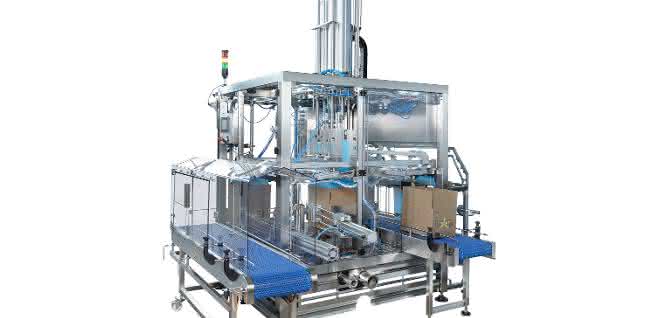
When it comes to measuring water content and packaging machines for large containers, WAL is one of the world's leading companies in the industry and can therefore be considered a hidden champion in these specific market niches. However, a company is not born with such an outstanding position. Like every company, it has to earn its reputation. Detlef Wölbern, Managing Director at WAL, is particularly proud of two points. Firstly, the packaging machine has a modular design. This means that the packaging machine can be connected to butter churns of different sizes. The range of machines in use on the market extends from 1 ton to 20 tons of butter per hour. All these different designs can be scaled to meet requirements with just one single machine design. Up to five of the so-called filling station heads, each packing a maximum of 4 tons per hour, can be operated in parallel.
99.98 percent precision
The second outstanding feature is the particularly precise filling technology. WAL guarantees its customers that it always packs at least 25 kilos and keeps weight fluctuations above this weight within an average corridor of less than 5 grams, which corresponds to a deviation of 0.02 percent and is therefore very precise. According to Wölbern, the competition produces deviations that are 5 to 20 times higher, i.e. an average deviation of around 0.1 to 0.4 percent . With machines that run around the clock, the difference quickly pays for itself, because within a year, the deviation at the competition amounts to 35 to 140 tons, while Wal only has 7 tons of variance to report, meaning that WAL's machines quickly pay for themselves thanks to their high quality.
High quality standards for all components
WAL places similarly high quality demands on all components in use, which must meet the highest hygiene requirements - in line with food safety standards. They must also be protected against water, as it is common practice in dairies for the machines to be cleaned regularly with a water hose. For drives for the infeed and outfeed conveyor belts, WAL therefore relies on drum motors with a particularly high IP protection class against the ingress of water. Classic steel geared motors, which are flange-mounted on the side, are not an alternative for WAL. For one thing, these motors are visually disruptive, whereas a drum motor integrates much better and almost invisibly into the system. But also mechanically, they would only get in the way of these conveyor belts and take up unnecessary space. In addition, the standard version of these motors is usually made of steel and painted, which in a dairy environment would mean that such motors would be completely rusted within a very short time - if they are not regularly maintained and repainted. They also always have cooling fins and removable covers for the fan.
Hygiene is the top priority
In a design with a side-mounted geared motor, there are therefore no smooth surfaces but many corners that are difficult to clean. Over the years, dirt can accumulate and mold can form, which nobody wants in food production as it poses a bacteriological risk and could contaminate the butter. There is none of this with the drum motor because it is integrated into the deflection drum, which is needed for the construction anyway. There is only one cable. Otherwise, the motor is hermetically sealed and offers a high degree of protection - up to IP66/69plus - to withstand even the most intensive cleaning methods with grease solvents. Thorough cleaning at least twice a week is common practice for packaging machines, which are usually operated 24/7.
WAL has also found another field of application for drum motors in handling the film that is wrapped in the cardboard boxes before the butter is pressed into these 25 kg containers. It has to be fed into the machine from a roll and then cut to length before being folded around the filling head and pressed into the carton. The film is fed into the machine by means of a fully rubberized drum motor and a pressure roller that clamps the film like an old typewriter.
Less is more
There is a reason for separating the unwinding of the film from the feeding into the machine: without this, the 100 kilogram film rolls would have to be accelerated and stopped again extremely quickly, which would require much more powerful drive and braking technology or would take too long with simple means. This is why the drum motor feeds one piece of film at a time. The film is then fed in a fraction of a second using servomotor-driven pneumatic grippers. The film is then cut and fed to the subsequent rewinding process, while the drum motor feeds new film relatively slowly. The drum motor also impresses in this application with its all-in-one design, which is extremely easy to clean and is therefore also ideal for CIP (clean in place) processes in compliance with HACCP and meets all the requirements of regulations such as EU Regulation 2020/45 (10/2011) and the FDA, USDA, 3-A and EHEDG hygiene standards.
Drum motors with the decisive plus
WAL uses stainless steel drum motors from Rulmeca, which the company supplies in the exact configuration for the application: The 80 mm motor for unwinding the film has a full-surface NBR rubber coating. The 113 motor for feeding and guiding the cartons has a feather key for mounting slip-on sprockets, which are used to drive the modular belts from the manufacturer Unichains. The latter motor configuration is equipped with an elbow gland that enables a cable connection at a 90 degree angle, which reduces the risk of cable breakage in this design. Incidentally, sprockets are always used when the modular belt is too narrow for a full-surface molded rubber coating. Another unique feature of Rulmeca drum motors is the IP66/69plus protection class. The decisive advantage of this protection class is the fact that the IP66/69 protection class has also been tested during operation with the belt tensioned, whereas normal protection classes without plus are purely static when the motor is switched off and, above all, without one-sided tension on the seal, which is a small but significant difference, as the tension can make simple seals less tight.
The technology is decisive
Rulmeca relies on a comparatively simple friction seal made of high-quality PTFE. The surface of the shaft journal in the sealing area has been hardened and tempered by roller burnishing. With normal turned seals, very fine thread grooves are created through which liquids can migrate during rotation, like a pickup over a record. This effect does not occur with Rulmeca drum motors, making them particularly resistant to the ingress and escape of liquids and therefore even more hygienic.


You might also be interested in
Helu makes its first trade fair appearance under a new brand name
Helu Kabel will be presenting itself as Helu for the first time at Hannover Messe 2026, showcasing system solutions, Heluchain cables and new industrial luminaires.
 read more...
Strategic realignment with brand relaunch
In future, Helukabel will trade as Helu
The Helukabel Group is parting with part of its name: in future, the company will only operate under the Helu brand. With this step, the specialist for electrical connection technology is underlining its strategic development from a classic cable...
read more...Modular plant construction for corrugated board
Insight into the production of corrugators at BHS Corrugated: Automated, modular and equipped with Helukabel components.
read more...Best quality for the steel
Conditions in the steel industry are harsh and inhospitable. The machines used must be able to withstand the demanding environmental conditions in order to deliver the best quality at all times.
read more...If the standard cable is not sufficient
Lapp offers cables for countless applications - but not for all of them. From time to time, the developers have to modify a standard cable or develop a special cable.
read more...Slight decline in sales, strong investments
The Lapp Group has not been spared from the weakening global economy. However, the company only recorded a slight loss in the past 2024 financial year.
read more...Electrical connection technology
Cables and wires for industrial automation
Heukabel offers system solutions for cable routing from a single source. The subsidiary EKD Systems specializes in tailor-made cable drag chains made of steel, stainless steel and plastic, which are used in moving machines and systems as well as in...
read more...Lapp relies on Ultramid from BASF
Mobile charging of electric vehicles
The automotive industry is currently undergoing the biggest transformation in its history. The boom in battery electric vehicles in particular is presenting the industry with major challenges. Lapp, as a supplier of cables and connection...
read more...Cable handling application
At this year's Motek, ArtiMinds Robotics is showcasing a robot-based automation solution for the sensor-assisted assembly of flexible cables in connector housings.
read more...