
Practical tip
Criteria for choosing the right servo clutch
In order to find the right clutch for a drivetrain, a number of factors must be taken into account. The required torque range, the offset and the ambient temperatures of the clutch are particularly important.
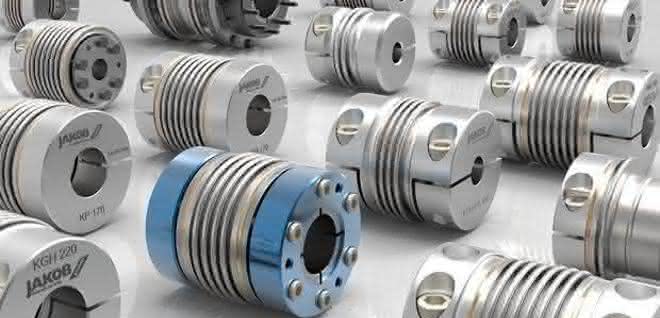
A coupling initially connects two shaft journals. However, even a minimal offset of the shafts or fluctuations in the ambient temperature can lead to uneven running.
Bellows couplings are very torsionally rigid in the direction of rotation, i.e. they hardly twist on themselves. Laterally, on the other hand, they are flexible, which allows them to compensate for misalignments. Low restoring forces, absolutely backlash-free torque transmission and flexible application options make them an indispensable component in mechanical engineering today. Metal bellows couplings are particularly suitable for high speeds and precise applications.
Select the right servo coupling
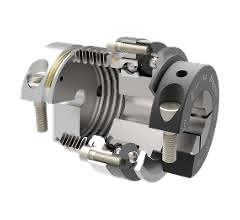
Elastomer couplings have a damping effect on vibrations instead of passing them on to the next component. With this type of compensating coupling, it is also important to ensure the most precise alignment possible, but the risk of damage is much lower. Depending on the application, combinations of metal bellows couplings, safety couplings, elastomer couplings and spacer couplings are also possible.
To find the right servo clutch for a specific application, it is important to first determine the required maximum torque. The coupling should then be selected accordingly, as it must never operate permanently with an overload or in the absolute limit range. A possible misalignment goes hand in hand with the possible service life, because the greater the misalignment, the greater the wear and the shorter the life expectancy of the clutch. It is therefore essential to ensure that the alignment is as accurate as possible. The compensable lateral misalignment ranges from around 0.15 to 0.3 mm. This also depends heavily on the number of bellows shafts. For example, a four-shaft coupling achieves several times higher possible misalignment values than a two-shaft coupling.
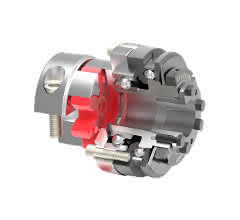
In principle, however, lateral displacement is one of the most important factors to consider after torque, as it has a major impact on possible power transmission. As mentioned above, a high offset can also lead to uneven running and thus to increased wear, greater noise generation or even damage to the entire drivetrain.
When measuring the maximum operating temperature, it is also important to take into account any heat generated by the machine and its components during operation. The choice of material for the couplings is also important in this context. Aluminum, which is often used due to its low weight, is replaced by stainless steel components at very high maximum temperatures, for example.
According to documents from Jakob Antriebstechnik / am


You might also be interested in
Plagiarius 2024 negative prize
On January 26, 2024, the Plagiarius campaign awarded its dreaded "Plagiarius" negative prize for the 48th time to manufacturers and retailers of particularly brazen counterfeits and fakes.
 read more...
Ivalua honors winners of the Generative AI...
AI-supported "add-ons" for buyers within 48 hours
Ivalua, provider of cloud-based spend management solutions, announced the winners and innovations of the first Generative AI Innovation Cup. The competition took place in December 2023. It was open to all Ivalua partners and employees - more than...
read more...Efaflex celebrates 50 years of high-speed...
The emphasis is on "fast"
Since day one, Efaflex has wanted to use new technologies as early as possible and drive progress in the industry. This year, the family business is celebrating its 50th anniversary under the motto "Fast Forward".
read more...Security of supply even during power outages
In the winter of 2022, Germany was worried about energy shortages. The drugstore retailer dm did not paint any horror scenarios, but nevertheless saw the possibility of controlled, temporary, regional power cuts (brownouts).
read more...Safety technology in mechanical engineering
Modules with new functions
Euchner's product highlights at EMO 2023 include the communication-capable solenoid interlocks.
read more...Transforming the paper industry towards climate neutrality
Together with partners from industry and research, Voith is developing a project for the optimization of energy and material flows in paper production. The aim of the research project is to develop a digital framework that enables effective process...
read more...Up to 95 percent less flue gas thanks to direct extraction
The requirements for occupational safety measures and safety technology are also constantly increasing in welding technology. The Technical Rules for Hazardous Substances (TRGS) stipulate that welding fumes and harmful substances must be extracted...
read more...Competitive advantages with large machines
Whether 3D-printed components for machines and systems, prototypes or aids for design: additive manufacturing is almost indispensable for modern companies in mechanical and plant engineering and automation if they want to play in the premier league.
read more...Transport technology from the modular system
Many transport tasks can be realized with the help of linear technology. Pre-configured solutions are available to simplify the interaction between the linear unit, motor, gearbox and controller. This minimizes the effort required for research and...
read more...