
Robot cell
Welding in modular cells
Drying systems specialist Stela Laxhuber has commissioned a new cell for welding Kuka fans at its Massing plant.
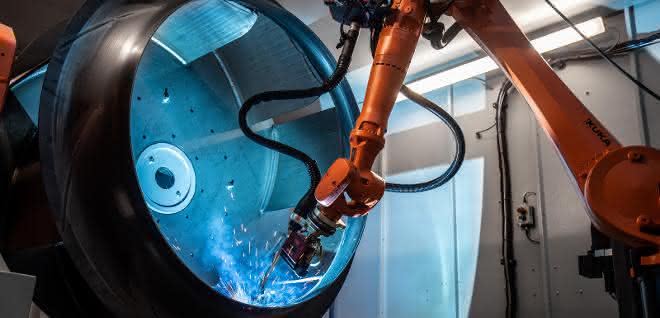
Welding is a fine art in plant engineering. Stela Laxhuber, a "hidden champion" in industrial drying technology, has been a master of both for three generations. Now a Kuka "cell4_production" robot cell is taking the welding of fans for drying systems to new heights at its plant in Massing, Lower Bavaria. This proves that even small and medium-sized companies can benefit from automation.
The family business Stela Laxhuber, now managed by Thomas Laxhuber in the third generation, is a "hidden champion" among plant manufacturers. Stela - named after its founder Stefan Laxhuber - designs and manufactures sophisticated drying systems in all conceivable sizes and fields of application for customers from all over the world with 235 employees in Massing, Lower Bavaria. Customers come from all over the world, including the agricultural sector, wood-based materials processing, the food, animal feed, pulp and paper industries and water management.
Drying in large dimensions
At the heart of such drying systems are huge fans that set off a stream of warm air to extract moisture from products such as grain, corn, wood or recycled plastic. This preserves them and creates the conditions for further processing. The fan wheels in the dryers can have a diameter of 1.60 meters and weigh half a ton. When such a colossus is accelerated to up to 3,000 revolutions per minute, flawless processing of all assembled components is an absolute must.
"The special feature of Stela is the high level of vertical integration," emphasizes Thomas Laxhuber, who took over the management of the company in the third generation from his father Stefan, the son of the company founder of the same name, in 2014. "In order to continue producing world-leading drying technology, we want to manufacture the key components of our machines ourselves as far as possible. We see this as an essential prerequisite for the best possible quality and a long service life of the systems." This is particularly true for highly stressed components such as the fan wheels. These radial fans are comparable to a rotating drum. With their curved blades, they draw in the air via the motor axis and blow it out again at an angle of 90 degrees.
Missed early start
25 years ago, Stela was already looking for automation solutions for fan assembly. "Back then, we wanted to reorganize our welding shop with robots of a different design," reports Thomas Laxhuber. "But the experiment was a resounding failure. The robots couldn't really help us with demanding welding tasks, created more problems than they solved and were hardly accepted by the workforce. The idea was good, but the time was not right. We got rid of the robots again."
Today, Andreas Utz stands with a "smartPAD" in front of a container-like enclosure measuring around 40 square meters in the middle of the production hall and looks inside through the dark green protective glass pane. The production manager for fan construction at Stela controls the brand new "cell4_arc" robotic cell from Kuka. Inside it flashes and sparkles blue, it crackles, white smoke rises. The six-axis Kuka KR Cybertech arc welding robot rhythmically moves its slender orange arm and guides the sensor-controlled torch to the fan drum.
Andreas Utz had previously attached the blades to the housing by hand using spot welds and bolted the steel construction to the positioner. Once the positioning unit had swung into the interior of the cell, an intelligent line laser first scanned the component using the so-called "Kuka SeamTech Finding" and determined the optimum starting point for the torch. Then the dicey millimeter work could begin. Seam by seam - always with the same precision choreographed by the Kuka ArcSense software.
Time is money
In around 50 minutes, the radial fan is welded and ready for balancing and painting. As the finished workpiece is driven out, the next workpiece, which Andreas Utz had previously screwed onto the other side, is already turning into the cell. "Work in progress," says Utz with a smile. "Welding by hand takes around a day. With the robot cell, we are now in the fast lane in production. In terms of time and quality. This is because the weld seams are so perfect in such a short time that they can't be done by hand. We are now producing in quantities that we would never have dreamed of and have been able to cope with the order situation again."
The path to making such work easier was less straightforward than operating the cell. Sven Pietsch still remembers the dismissive reactions of robot suppliers when Stela's Purchasing Manager and Managing Director Thomas Laxhuber set out to find a new approach to automation after 25 years. "We were under pressure," recalls Pietsch. "The order books were full and at the same time it was becoming increasingly difficult to find suitable skilled workers for our demanding but also comparatively monotonous welding work in large-scale production."
The Lower Bavarians had looked for suitable solutions for their requirements at various trade fairs and were repeatedly rebuffed. "Apparently, as a medium-sized company, we were considered too insignificant," says Sven Pietsch with a grin. "Until we met the Kuka experts at the Euroblech trade fair stand in Hanover. We very quickly got talking about a customized solution for our challenge. It was an intensive exchange at eye level." And a learning experience for everyone involved, as Thomas Laxhuber adds. In Kuka's TechCenter for welding applications, they soon immersed themselves in Stela's production processes and configured the "cell4_arc" robot cell, which was perfectly tailored for fan production, from various available standard modules - including all hardware and software. "At all times, we had the feeling that we were dealing with the right people and the right technology at the right time and in the right place," says Thomas Laxhuber.
A cell concept made to fit
The robot cell for Stela also describes a new path to customized, modular automation steps for Kuka. "With our intelligent Kuka cell4_production concept, we can work with our customers to combine optimally coordinated components and proven standards from the field of arc welding to create ideal welding automation solutions. With the right application software, handling and programming the welding parameters are as simple as possible and help to meet the highest production requirements," says Mathias Klaus, responsible for Solution Sales Modular Cell Business at Kuka. "The robot cell that we developed together with Stela is impressive proof of this."
Thomas Laxhuber also likes this. "For almost 100 years now, it has been part of Stela's DNA to be guided by quality in the world of drying and to always be one step ahead technologically. The future can be built on this. At all times." Even if a good idea has to mature for 25 years in order to unfold its full power and strength in the right partnership at the right time.


You might also be interested in
Housing and inserts for plenty of power
Lapp presented the expansion of its Epic Power series at SPS 2023: four new M23 circular connector inserts and three new M23 housings. The special feature: all housings can be combined with any of the four inserts.
 read more...
News and product updates from Smartgas
Portable gas analyzers for outdoor use
Smartgas is starting the second half of the year with a series of updates to existing products and a number of new products. Portable analyzers expand the range of applications, while new accessories such as protective housings and heating modules...
read more...Everything accurate in switch cabinet construction
To ensure smooth work processes, tools for processing enclosures and housings must function flawlessly and reliably. Häwa rounds off its punching range with the Multi-Press 500.
read more...Shafts and conversion parts
The Rodriguez range includes ball bushings including matching housings, shaft brackets, crossbars and supports.
read more...Cooling and temperature control units
Hygienic packaging sells safely
In few industries are the requirements for hygiene in the production process as strict as in the food sector - the health of consumers has top priority. This results in enormous challenges for all machines and components involved, especially in...
read more...Simple tool change in seconds
With the CMS, Schunk is launching a user-friendly, manual change system for quick component replacement. In addition to its simple and convenient operation, the CMS also stands out with its extensive range of optional modules and complementary end...
read more...Motion controller for small drives
Medium power range covered
Faulhaber has another housing-less and compact motion controller in its range, which is particularly suitable for integration in device construction and medical technology applications.
read more...Welding solutions in the name of resource efficiency
At the Welding & Cutting trade fair in Essen (September 11-15), Fronius will be focusing on the major drivers in welding technology. Quality requirements are increasing in all industries, but the required welding specialists are scarce. In...
read more...Safe solutions for cable installations
From thick power cables to thin sensor lines, cables and lines must be routed safely through systems and machines. A challenge that should not be underestimated, explains Jörg Sokat, Head of Product Management at Pflitsch.
read more...