
Laser and welding technology
3D laser welding system and more
TRUMPF will be presenting the TruLaser Station 7000 3D laser welding system and the TruArc Weld 1000, an automated system for arc welding, to visitors at Intec/Z connect 2021.
According to Trumpf, the developers have significantly increased the productivity of the TruLaser Station 7000 compared to older machine generations. This is thanks to lasers with up to four kilowatts of power and a 150 percent larger installation space. This combination makes it possible to weld larger components and deeper seams. As the system achieves higher feed rates, it produces components faster and more productively.
According to Trumpf, the TruLaser Station 7000 processes all common metals - such as mild steel, stainless steel, copper, aluminum or titanium. Thanks to a new rotary changer, the machine replaces the fixture on which it welds the component with an empty fixture at the end of the process. The machine is suitable for all industries that want to process small and medium-sized welded assemblies. The company also sees advantages in the automotive and electronics industries, as the system welds very conductive materials such as copper in high quality, as required for electromobility, for example.
Automated arc welding
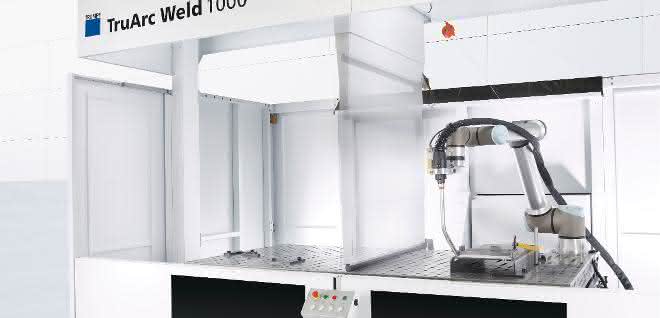
Trumpf will also be showcasing an automated system for arc welding at Intec/Z connect 2021. The TruArc Weld 1000 is equipped with a collaborative robot, known as a cobot. After the operator has guided it manually over a component, the cobot then carries out the weld seam automatically. In doing so, it is significantly more efficient than would be possible manually. According to Trumpf, this system is a response to the increasing shortage of skilled workers and makes it easier for companies to get started with automated welding.
Trumpf has equipped the cobot with a control unit that allows the user to save waypoints and start and end points of the weld seam and thus create the program. There is also a partition inside the TruArc Weld 1000 that can be raised and lowered. This allows users to divide the work area and weld either one large part (one-station operation) or several smaller parts (two-station operation).


You might also be interested in
Plagiarius 2024 negative prize
On January 26, 2024, the Plagiarius campaign awarded its dreaded "Plagiarius" negative prize for the 48th time to manufacturers and retailers of particularly brazen counterfeits and fakes.
 read more...
Ivalua honors winners of the Generative AI...
AI-supported "add-ons" for buyers within 48 hours
Ivalua, provider of cloud-based spend management solutions, announced the winners and innovations of the first Generative AI Innovation Cup. The competition took place in December 2023. It was open to all Ivalua partners and employees - more than...
read more...Efaflex celebrates 50 years of high-speed...
The emphasis is on "fast"
Since day one, Efaflex has wanted to use new technologies as early as possible and drive progress in the industry. This year, the family business is celebrating its 50th anniversary under the motto "Fast Forward".
read more...Security of supply even during power outages
In the winter of 2022, Germany was worried about energy shortages. The drugstore retailer dm did not paint any horror scenarios, but nevertheless saw the possibility of controlled, temporary, regional power cuts (brownouts).
read more...Safety technology in mechanical engineering
Modules with new functions
Euchner's product highlights at EMO 2023 include the communication-capable solenoid interlocks.
read more...Transforming the paper industry towards climate neutrality
Together with partners from industry and research, Voith is developing a project for the optimization of energy and material flows in paper production. The aim of the research project is to develop a digital framework that enables effective process...
read more...Up to 95 percent less flue gas thanks to direct extraction
The requirements for occupational safety measures and safety technology are also constantly increasing in welding technology. The Technical Rules for Hazardous Substances (TRGS) stipulate that welding fumes and harmful substances must be extracted...
read more...Competitive advantages with large machines
Whether 3D-printed components for machines and systems, prototypes or aids for design: additive manufacturing is almost indispensable for modern companies in mechanical and plant engineering and automation if they want to play in the premier league.
read more...Transport technology from the modular system
Many transport tasks can be realized with the help of linear technology. Pre-configured solutions are available to simplify the interaction between the linear unit, motor, gearbox and controller. This minimizes the effort required for research and...
read more...