

SPS - Smart Production Solution
"The future of our industrialized nation"
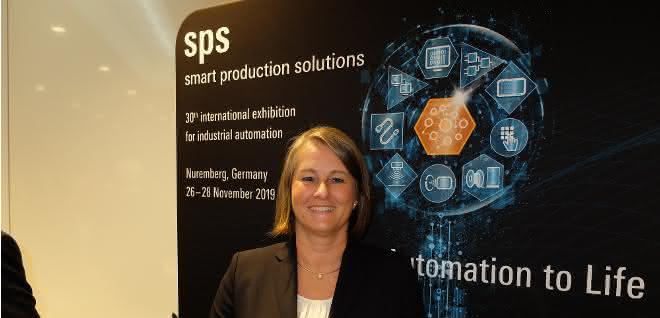
The SPS trade fair is 30 years old this year and is giving itself a new look. What can exhibitors and visitors expect this year?
Nothing has changed in the concept with the new look. The new name merely illustrates the development that the industry, and therefore also the trade fair, has undergone in recent years. The increasing convergence of IT and production has been reflected in the trade fair for some time. Ultimately, we considered which areas of OT (Operational Technology), i.e. production, and IT should be represented. This resulted in the new name: SPS - Smart Production Solutions.
During the press conference on the new orientation of SPS IPC Drives towards SPS - Smart Production Solutions, you explained that SPS now also clearly claims to reflect the digitalization opportunities for industrial production. How exactly is this reflected in the trade fair?
The name SPS IPC Drives has long since ceased to reflect the content of the trade fair. For years now, the trade fair has been more than just the three eponymous components of electrical automation; it has shown its entire spectrum. This also included interface technology and industrial communication. The development of the industry and the trade fair could be seen in the adapted product groups and the changing subtitle: Electrical automation eventually became industrial automation. The advent of digitalization has opened up new opportunities for industrial automation in production. We are now also making this clear with our name.
Are you not worried that application-specific trade fairs such as EMO Hannover or Automatica will overtake the PLC in the course of digitalization and the convergence of OT and IT?
There have always been application-specific industry trade fairs and horizontal trade fairs such as SPS. I don't believe that anyone will decide to go specifically to industry trade fairs in the course of digitalization when there is a trade fair like SPS that offers a much larger, broader and more detailed range of solutions and products for their production issues. This is in the nature of things: industry trade fairs are geared towards their industry sector, while the SPS as a trade fair for automation shows its entire range of services regardless of industry sector. At the SPS you will find innovations that can later also be seen at industry trade fairs. The past has shown that the trade fair sets and accompanies trends and that the direction of travel is discussed there. It is more focused on automation technology than industry trade fairs can be.
The SPS also has a reputation as a job fair. What do you think about this title?
This is a very special characteristic that distinguishes our SPS: The user comes to the trade fair with a specific request, has detailed discussions about the challenges facing his company, about ideas and solutions. They don't just pick up a brochure at a trade fair stand. Everyone is talking about digitalization, but can the machine manufacturer really imagine what this means for his company? What steps he can take without having to make a major, high-investment change to his automation and production? How can they manage to implement digitalization in their company? This is exactly what SPS is all about: These visitors will find experts on the trade fair stands who can actually answer these questions for them in full. There are not only sales managers, but also application engineers and application technicians on site who can answer detailed questions. This is why these discussions usually last much longer.
Some trade fairs are struggling with their profile and focus and are losing themselves in the process. How do you manage to keep the SPS on track in the face of rapid changes in the industry?
We are in close contact with our exhibitor advisory board, which also has a great interest in keeping the SPS profile clear and clean. The profile must meet the requirements of the industry. This means that our trade fair showcases topics that are relevant to the industry. We don't want a vendor's tray of products. Of course, we could always sell a few more stands, but that would change the face of the event. We actually reject companies as well: To keep the SPS profile sharp, no one will exhibit who doesn't fit the show. However, this does not mean that we freeze the profile; it is always readjusted and adapted to changes in the industry: Does it still meet the requirements that technological change and further developments present? This is why we have always adapted the product groups and expanded them to include IT, for example - but only those parts of IT that actually fit in with our focus. This does not include ERP systems, for example. For us, everything revolves around the store floor.
Do you also approach companies and ask them to exhibit at the SPS?
We actually do that. If we get to know a company that really suits us, we approach them. IT companies don't necessarily have SPS on their radar, especially when it comes to cybersecurity; there are many different solutions under this buzzword, for example for healthcare, municipalities or industry. We then ask the cybersecurity companies whether they are active in the field of industrial security. If so, SPS is the right place for them, because machine manufacturers are always on the lookout for solutions to secure their data.
The SPS opens its doors on November 26. What are you personally looking forward to the most?
It's the same moment every year: Tuesday morning, 9 o'clock, the doors open and the fair starts! It's like clapping your hands and the crowds are right in the halls! I really enjoy this feeling, which is why I'm always in the door area when the fair starts. From the very first moment you experience what our trade fair is all about: visitors and exhibitors put their heads together, discuss and struggle together to find the best solution. And it is the awareness that the future of our industrial nation is also taking place during these three days in Nuremberg. That's great!


You might also be interested in
ebm-papst is growing again thanks to AI and data centers
ebm-papst returned to a growth trajectory in fiscal year 2025/26. Air Technology, data center applications, and artificial intelligence are driving revenue and investment.
 read more...
SPE on the Verge of a Market Breakthrough
Single Pair Ethernet (SPE) has moved beyond the conceptual phase and is increasingly being implemented in industrial settings. The focus here is not only on higher data rates and simplified cabling, but above all on the issue of system integration...
read more...More than 900 exhibitors already registered
Around six months before the start of the trade fair, more than 900 companies have registered for SPS 2026 in Nuremberg. The trade fair focuses on industrial AI, cyber security and digital transformation.
read more...Virtual PLCs in practice: How vPLCs make production systems more flexible and scalable
The increasing networking of IT and OT is fundamentally changing industrial automation. The IT/OT Integration Summit shows how modern technologies can make production environments more efficient, flexible and future-proof. The event will focus on...
read more...Sales growth in a turbulent market environment
Thanks to innovations and a focus on strategic industrial markets, Sick was able to moderately increase its sales in the 2025 financial year. In a turbulent market environment, the company was able to maintain its position and gain market share with...
read more...Siemens presents new AI agent
Siemens is launching 'Eigen Engineering Agent', an AI for automation technology. The solution is integrated into the TIA Portal, has been tested with over 100 companies and is designed to significantly accelerate engineering processes.
read more...Schaeffler keeps sales almost stable
Schaeffler generated revenue of EUR 23.5 billion in 2025 and increased EBIT before special items to EUR 936 million. At 266 million euros, free cash flow was significantly above the prior year and forecast. Net income remained negative due to high...
read more...Advancing artificial intelligence together
Helukabel is stepping up its activities in the field of artificial intelligence and is now a member of the IPAI. The innovation and collaboration platform for companies, research facilities, institutions and administration has set itself the goal of...
read more...New impetus for ifm sales
Two new positions were filled at ifm at the start of 2026: Markus Wolf becomes Managing Director Sales Germany, Sven Quant takes over the position of Central Managing Director in the Process Sensors division within the ifm Group.
read more...