
Simulation with digital twin
Simulation reduces production time
In order to increase the production volume in the same area with the same personnel resources, the plant manufacturer Homag Group wanted to be able to test the machines to be produced extensively before they were commissioned. A hardware-in-the-loop simulation solution combines real components with virtual ones. The "digital twin" thus enables virtual commissioning. By Jessica Baum
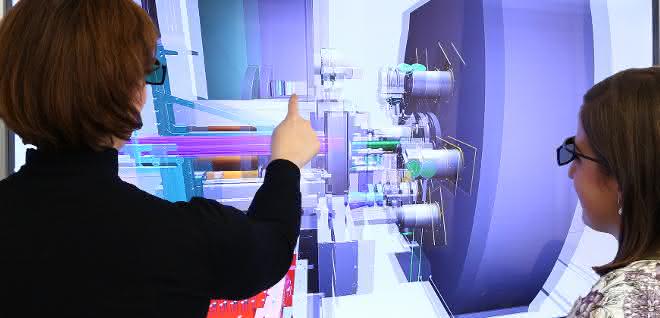
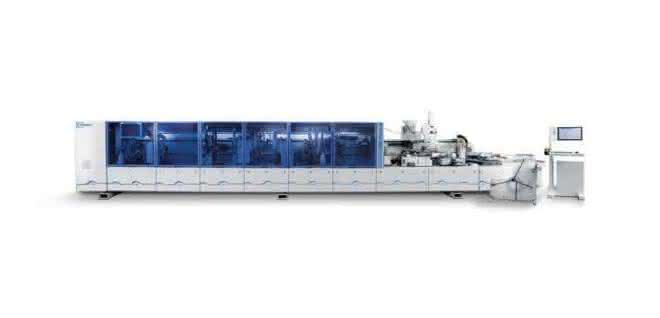
Founded in 1960 as "Hornberger Maschinenbaugesellschaft" by Eugen Hornberger and Gerhard Schuler, Homag today has over 6,000 employees and is a global manufacturer of machines and systems for the woodworking industry and trade. Headquartered in Schopfloch, Baden-Württemberg, the company has over 23 sales and service companies in all important and growing regions worldwide. The Homag Group produces machines and systems for customers in the home and office furniture, kitchens, parquet and laminate flooring, windows, doors, staircases and even complete timber system houses. In addition to individual machines for smaller workshops, the company also manufactures fully networked production lines for highly industrialized individual furniture production. It also provides services and control software.
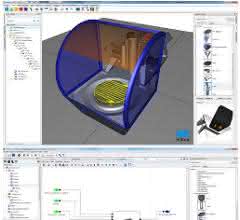
Whereas kitchens used to be produced in series and the corresponding parts for cabinets had to be stored, today production is "just in time". The demands of wood processors, who want to deliver their products to their customers as quickly as possible, are increasing. Against this background, Homag is faced with the challenge of shortening production times. In addition, it is important to marry all the components of a system. This not only requires a lot of space, but also a lot of time and personnel. In addition, production is now much more tightly scheduled, so the company had to make changes to the control and programming of its systems. Last but not least, it is necessary to develop virtual simulation models of external assemblies from suppliers, such as drive controllers, using real components and then make these available to the suppliers. To accomplish this task, Homag needed a software solution for virtual commissioning. The advantages: Virtual commissioning reduces the time required and makes processes more efficient, which ultimately lowers costs. The plant and machine manufacturer found the ideal tool in ISG-virtuos. This is a hardware-in-the-loop simulation solution that can be used to test the functionality of a system before it is commissioned. "Our customers expect customized solutions and very short processing times from us," says Michael Zetzsche, Senior Manager Control Development Edge Processing in the Edge business unit at Homag. "They value our innovative strength and naturally hope that we will speed up processes so that they benefit from correspondingly shorter production times." Homag had to look at how to speed up the commissioning of the machines without having to build new systems or invest more time and money in resources.
Virtuality and reality: no noticeable difference
Assigning a system for test purposes is very time-consuming and delays production enormously. With ISG-virtuos, Homag can now try out all test scenarios virtually. "We can run through virtual commissioning without feeling any restrictions between the real world and the virtual process," explains Zetzsche. The company benefits not only from integration tests, which can be used to analyze the interaction of the individual systems, but also from a complete system test that includes the real components. It is also possible to combine real control systems with virtual components via fieldbuses. This makes it possible to simulate real assemblies and virtually commission even very complex systems. "I looked at various simulation solutions 15 years ago, but I wasn't convinced by their handling and they didn't have the option of connecting control modules from different manufacturers such as Siemens or Bosch," says Zetzsche. "ISG-virtuos was also the only solution that came into question for us because of its high level of user-friendliness."
Homag was already using ISG-virtuos in some areas, such as engineering. The challenge now was to roll out the software across the entire group of companies. "Thanks to our long-standing collaboration, we knew we had a reliable partner at our side in ISG, who also mastered the somewhat complicated integration of the simulation solution into our IT infrastructure," reports Zetzsche. "It was clear to us that in ISG-virtuos we had found a solution that offers an incredibly high level of simulation detail," he continues.
Homag and ISG met for initial discussions in the fall of 2016, and the project for the company-wide rollout of ISG-virtuos began in the spring of 2017, allowing Homag to present the first results at the end of May at Ligna, the leading trade fair for machines, systems and tools for woodworking and wood processing. There was no specific project schedule. "Our teams already know each other very well from previous projects and are therefore closely connected," says Zetzsche. "What we particularly appreciate about working with ISG is the company's visionary thinking and high level of consulting expertise. When we have a new idea, we are sure that ISG will implement it to our complete satisfaction." Several business units at different locations are now working with ISG-virtuos. In order to drive development forward within the company, Homag has set up a core competence team which, independently of the business units, promotes further development in line with requirements and develops its own set of rules.
Needs-based configuration
ISG-virtuos is so user-friendly that you can learn how to use the software as part of a two-day basic training course. The uncomplicated handling is a clear advantage given the fact that the hardware-in-the-loop solution is a closed system that already contains all the necessary functions. The solution consists of various standard modules that can be combined as required. A simulation library contains all the basic elements, which can be individually adapted and integrated via interfaces. Simulations for all assemblies are stored in Homag's own technology library, which can then be configured as required.
On this basis, Homag has now realized numerous developments without having to produce prototypes in advance. Instead, it is now possible to check mechanical designs in advance. Do the layouts, dimensions and transportation fit? If the manufacturers install or order the wrong components, Homag notices this error immediately thanks to ISG-virtuos.
In order to be able to produce furniture in the kitchen segment "just-in-time", for example, a production system has to process many different pieces of wood in different dimensions one after the other. If there is a workpiece whose dimensions have not been taken into account in advance, this could lead to a collision and thus to a production stop. Thanks to virtual commissioning, in which the real and virtual machines behave identically - differences in the behavior of both are less than a millisecond - Homag can even test running systems without disrupting production. In doing so, the plant manufacturer uses differential analysis to detect software or wiring errors in the control cabinet, for example, and can even identify defective parts such as motors or drive shafts. "In the past, drives were usually idealized in simulations," explains Zetzsche. "Today, our drive manufacturers supply their drive models and we transfer them to the digital twin of the system. The deviation of the models in the virtual drives is then less than one percent. So we no longer have a mere simulation, but an extremely realistic digital twin of the system. The virtual drive can also be configured like a real drive."
Further cooperation planned
Homag has proven that production time can be significantly reduced. Further cooperation between ISG and Homag is therefore definitely planned. "ISG is a strong, dynamic development partner for us," says Michael Zetzsche. Homag not only wants to integrate further assemblies into ISG-virtuos and use new interfaces for further tests, but also invest in technology in the future to be able to automatically create simulation models - the basis for fully automated production scenarios.

The company is working towards the goal of being able to run through the entire process virtually so as not to interfere with ongoing operations. A virtual cloud connection is also planned so that the simulations can be run from any location and the business units can be networked with each other worldwide. In addition to the connection of a "virtual operator" who carries out recurring tasks, a solution is also being considered that carries out all tests automatically. Industry 4.0 is already a reality for Homag.
Jessica Baum, freelance editor from Offenbach / am


You might also be interested in
ESTIA aims to strengthen Europe's cloud
New tech alliance for EU sovereignty
Twelve companies, including Dassault Systèmes, are founding the European Sovereign Tech Industry Alliance (ESTIA). The initiative aims to strengthen Europe's technological independence and define requirements for sovereign cloud services. The start...
 read more...
Deutsche Telekom and Nvidia launch one of Europe's largest AI factories
With the Industrial AI Cloud in Munich, Deutsche Telekom and NVIDIA are creating one of the largest AI factories in Europe. Companies can train AI models, carry out simulations and access 10,000 GPUs.
read more...Leveraging data potential with AI and streaming
Huge data treasures are still lying dormant in many manufacturing companies. And yet it is high time that these treasures were unlocked. There is often a lack of resources and capacity to make data usable in real time. Streaming production data can...
read more...More awareness of noise
Dematic offers solutions that are tailored to different cloud environments and reduce environmental impact through reduced material consumption and improved energy efficiency.
read more...Generative AI in the automation environment
The mechanical engineering and automation industry is undergoing profound change. This transformation is being driven by more volatile global trade, geopolitical crises and increasing market pressure, which demands greater agility, technological...
read more...Rigid data structures have had their day
The traditional data center is no longer the center of data. A hybrid cloud storage approach enables manufacturing companies to both meet the current requirements of data-intensive processes and future-proof their infrastructure.
read more...Software as a service in three stages
CIM Database Cloud is a new out-of-the-box solution from Contact for end-to-end digital product development.
read more...How production can benefit from AI
Together with AI technology, IIoT networking makes it possible to better control machine parameters and optimize quality with predictive quality. Downtimes and set-up times can also be further minimized. Cloud platforms also make these technologies...
read more...More expertise for digital engineering
Altair, a computational science and artificial intelligence (AI) company, has acquired OmniV, a technology from Michigan, USA-based software company XLDyn.
read more...