

Matrix cell
The line was yesterday
Stecher Automation realizes the Smart Factory with the Matrix cell. Various manufacturing processes can be integrated. The cell links the processes in such a way that several products can be manufactured simultaneously and flexibly. An example of intelligent automation for SMEs.
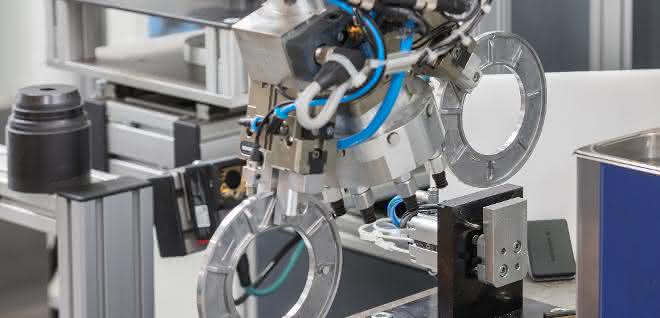
Generated orders make their own, flexible way through production. Work equipment, such as the robot, sets itself up. Autonomous transport systems supply and link the production stations. This is no longer a vision - but it requires a new segmentation of production to ensure smooth interaction between robot cells, vehicle solutions and leading ERP systems. It is de facto the implementation of the Industry 4.0 concept - and the end of line production. With a modular system for robot cells, Stecher Automation enables the flexible automation of various process steps in industrial production. The modular system comprises the parameterizable control system, the modular cell structure, the modular cell equipment, the automated and flexible component feed and the system and process networking using automated guided vehicles (AGVs).
The cell equipment can be individually designed and combined for process steps such as turning, milling, cleaning, measuring or marking. The modular system also includes various test procedures and component deburring. The system is freely scalable and can cover almost any component size and type in different design variants. The robot sets itself up for the products commonly used in medium-sized companies: It can change its own tool via an automatic gripper change and change part-specific components, for example clamping devices, fully automatically. For maximum flexibility, all components are equipped with standardized interfaces for software, cable management and mechanical attachment of the cell equipment; each matrix cell can be expanded, redesigned and adapted for future changes.
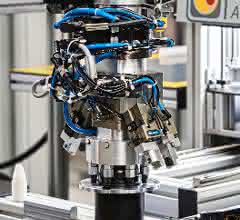
The control system records both the robot's program changes and the sequence controls and component specifications of the products. It is therefore not necessary to retrofit the software. Even operators without programming experience can change the sequence program. The program is automatically adapted via an interface to the merchandise management system and quality assurance when the operating order is created; all necessary changes are transferred to the respective matrix cell via the parameter transfer. By automating the flow of goods between matrix production and the warehouse, the user can manage complex logistics. Blanks, components, tools and set-up materials are fed to the cells according to requirements and production planning. All feed modules can be loaded via an AGV. In this way, production flexibility is realized as a whole.
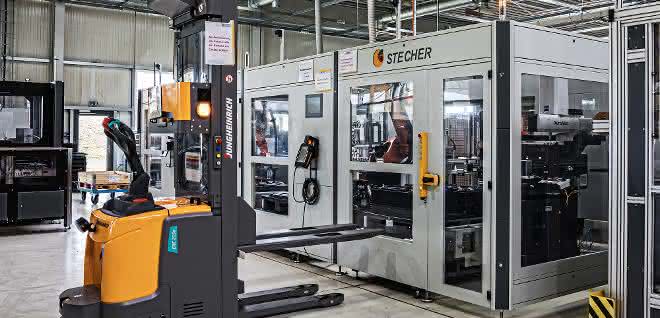
"Nothing is rigid or fixed anymore," confirms Simon Stecher, grandson of company founder Adolf Stecher, project engineer and member of the company administration. "The merchandise management system is directly connected to production, components find their own way through the manufacturing process, autonomous transport systems link all stations. With our matrix cells, we are putting Industry 4.0 into practice." When it comes to robotics, Stecher works with different robot manufacturers - depending on the requirements of the customer application. Stecher is also flexible in its choice of autonomous transport systems - for example, the Leo Locative from Bito, a pallet truck from Jungheinrich or shuttles from Mobile Industrial Robots. Stecher Automation has entered the Matrix cell for this year's Baden-Württemberg Innovation Award - the Dr. Rudolf Eberle Prize.


You might also be interested in
Helu makes its first trade fair appearance under a new brand name
Helu Kabel will be presenting itself as Helu for the first time at Hannover Messe 2026, showcasing system solutions, Heluchain cables and new industrial luminaires.
 read more...
Strategic realignment with brand relaunch
In future, Helukabel will trade as Helu
The Helukabel Group is parting with part of its name: in future, the company will only operate under the Helu brand. With this step, the specialist for electrical connection technology is underlining its strategic development from a classic cable...
read more...Modular plant construction for corrugated board
Insight into the production of corrugators at BHS Corrugated: Automated, modular and equipped with Helukabel components.
read more...Best quality for the steel
Conditions in the steel industry are harsh and inhospitable. The machines used must be able to withstand the demanding environmental conditions in order to deliver the best quality at all times.
read more...If the standard cable is not sufficient
Lapp offers cables for countless applications - but not for all of them. From time to time, the developers have to modify a standard cable or develop a special cable.
read more...Slight decline in sales, strong investments
The Lapp Group has not been spared from the weakening global economy. However, the company only recorded a slight loss in the past 2024 financial year.
read more...Electrical connection technology
Cables and wires for industrial automation
Heukabel offers system solutions for cable routing from a single source. The subsidiary EKD Systems specializes in tailor-made cable drag chains made of steel, stainless steel and plastic, which are used in moving machines and systems as well as in...
read more...Lapp relies on Ultramid from BASF
Mobile charging of electric vehicles
The automotive industry is currently undergoing the biggest transformation in its history. The boom in battery electric vehicles in particular is presenting the industry with major challenges. Lapp, as a supplier of cables and connection...
read more...Cable handling application
At this year's Motek, ArtiMinds Robotics is showcasing a robot-based automation solution for the sensor-assisted assembly of flexible cables in connector housings.
read more...