

Raspberry Pi
Compact computer for industry
As a versatile and compact computer, the Raspberry Pi is also interesting for industry. However, appropriate adaptations to the harsh production environment are necessary to bring the Raspberry Pi world into factories.
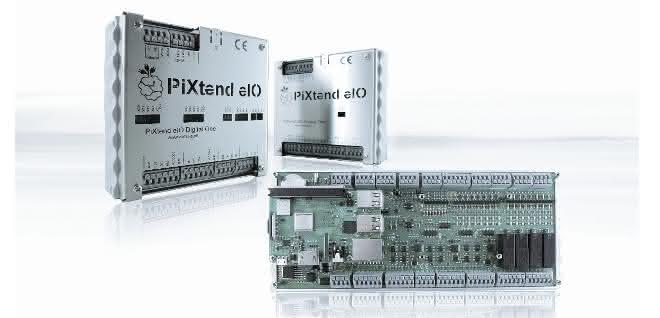
The Raspberry Pi hobbyist computer has established itself in education in recent years. Younger developers in particular rely on the British single-board computer for their work and feel at home in the platform's large open source software community. To enable industry to benefit from this expertise, electronics manufacturer Kontron has developed an industrial-grade product line based on the Raspberry Pi and is currently working on solutions for the new Compute Module 4.
There is a clear trend in the demand for the single-board computer: younger developers tend to have already worked with Raspberry Pi during their studies or are already involved in this community as hobbyists from the maker scene. The widespread use is also due to the price: the small computer only costs around 35 euros. However, the price advantage falls flat due to the additional effort involved in industrial applications, as the processor's protective mechanisms would temporarily reduce the computer's performance in hotter environments, causing it to fluctuate. It is therefore crucial to have a cooling concept that enables robust use in industrial temperature ranges in the first place.
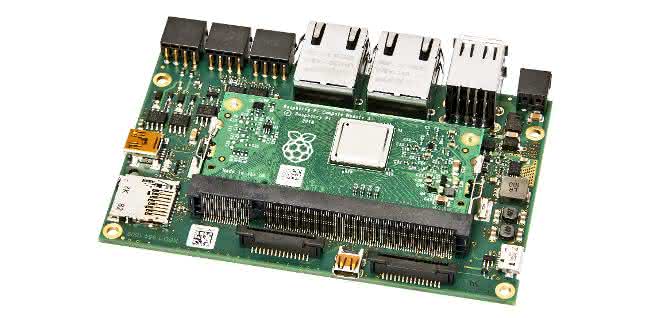
With the Pi-Tron, Kontron supplies an industrial baseboard to be able to use the Raspberry Pi software community. The performance of the computer leads to a corresponding heat loss, which is dissipated by attaching heat sinks to the CPU and thermally coupling them to the housing. The small compact controller has various communication interfaces as well as several connections for sensors and actuators; a 24-volt connection, which is important for control cabinet applications, is also integrated. When selecting components, strict attention was paid to ensuring that only those components were used that are supported by the community software.
Compact control unit for the control cabinet
The Kontron PiXtend product line is particularly suitable for machine and plant construction, as it is predestined for use in control cabinets. It can be used for control applications in which sensors and actuators can be easily integrated thanks to the high number of I/O ports. PLC-oriented programming is guaranteed by the integration of Codesys: The integrated development environment for programmable logic controllers based on IEC 61131-3 is considered an important standard for application development in industrial automation. Codesys is already included with PiXtend as a free test license.
The boards are available in different versions with more or fewer I/O ports. Here too, developers coming from the Raspberry Pi world may opt for a product such as PiXtend, which functions as a PLC like a small computer with many connections for sensors and actuators. The mini PLC is also suitable for Industry 4.0 scenarios in which the focus is on networking machines and systems, as well as intelligent devices.
Universally applicable
Opinions in the industry are still divided, and the computer platform is certainly viewed with ambivalence. However, from Kontron's point of view, there is no indication that the Raspberry Pi variant is less reliable than traditional platforms such as NXP or ST processors - not even in 24/7 operation. The computers are already being used in the food industry or in mechanical engineering for the woodworking and metalworking industries to control logistics processes in the factory. Nevertheless, there are some locations - such as in power plants or in very hot environments, for example near ovens - for which the variant is not suitable.
In some areas of industry, for example, MS Windows continues to be used for historical reasons and because of its compatibility with existing applications. Nevertheless, there is a clear shift towards open source. Where users are free to make their own decisions, Linux-based systems are generally chosen. The broad software pool of the community also makes the Raspberry Pi particularly interesting for industry: in some cases, almost finished projects can already be downloaded and adapted. This often results in considerable time advantages in the development project, reducing the time-to-market, especially in innovation-driven areas.
Focus on the fourth generation
Kontron is currently working on industrial solutions for the new Compute Module 4. The fourth generation comes with all the interfaces required for IIoT and Industry 4.0. These include connections for Ether-net and USB, an HDMI interface for the monitor, a DSI interface to connect a display directly and CSI interfaces for cameras. A WLAN and Bluetooth module ensures good connectivity.
In the future, automation options relating to AI (Artificial Intelligence) will continue to grow in the industry, driven by topics such as predictive maintenance and visual quality inspections. In the future, Raspberry Pi products could be supplemented with an additional AI chip. Although some companies are already testing corresponding applications, Kontron's experience is that the market is not yet ready. However, the electronics manufacturer assumes that deep learning will play an increasingly important role in the future and has already expanded its expertise in this area: the aim is to support customers in generating ideas wherever AI methods promise greater efficiency and automation.
Holger Wußmann, Managing Director Kontron Electronics


You might also be interested in
ebm-papst is growing again thanks to AI and data centers
ebm-papst returned to a growth trajectory in fiscal year 2025/26. Air Technology, data center applications, and artificial intelligence are driving revenue and investment.
 read more...
SPE on the Verge of a Market Breakthrough
Single Pair Ethernet (SPE) has moved beyond the conceptual phase and is increasingly being implemented in industrial settings. The focus here is not only on higher data rates and simplified cabling, but above all on the issue of system integration...
read more...More than 900 exhibitors already registered
Around six months before the start of the trade fair, more than 900 companies have registered for SPS 2026 in Nuremberg. The trade fair focuses on industrial AI, cyber security and digital transformation.
read more...Virtual PLCs in practice: How vPLCs make production systems more flexible and scalable
The increasing networking of IT and OT is fundamentally changing industrial automation. The IT/OT Integration Summit shows how modern technologies can make production environments more efficient, flexible and future-proof. The event will focus on...
read more...Sales growth in a turbulent market environment
Thanks to innovations and a focus on strategic industrial markets, Sick was able to moderately increase its sales in the 2025 financial year. In a turbulent market environment, the company was able to maintain its position and gain market share with...
read more...Siemens presents new AI agent
Siemens is launching 'Eigen Engineering Agent', an AI for automation technology. The solution is integrated into the TIA Portal, has been tested with over 100 companies and is designed to significantly accelerate engineering processes.
read more...Schaeffler keeps sales almost stable
Schaeffler generated revenue of EUR 23.5 billion in 2025 and increased EBIT before special items to EUR 936 million. At 266 million euros, free cash flow was significantly above the prior year and forecast. Net income remained negative due to high...
read more...Advancing artificial intelligence together
Helukabel is stepping up its activities in the field of artificial intelligence and is now a member of the IPAI. The innovation and collaboration platform for companies, research facilities, institutions and administration has set itself the goal of...
read more...New impetus for ifm sales
Two new positions were filled at ifm at the start of 2026: Markus Wolf becomes Managing Director Sales Germany, Sven Quant takes over the position of Central Managing Director in the Process Sensors division within the ifm Group.
read more...