

Smart sensor profiles for IO-Link sensors
Integrate IO-Link devices easily
IO-Link has established itself on the market faster than almost any other communication technology. This is demonstrated by the total number of installed IO-Link devices of 11.4 million at the end of 2018. Edition 2 of the Smart Sensor Profiles will make the wide variety of devices even easier to handle. They help to implement IO-Link sensor technology even faster and more flexibly in automation applications and in the Industry 4.0 environment.

The electrical and mechanical connection of an IO-Link device is already a simple routine task for system planners and designers. The specification ensures a simple connection. In addition to the electrical and mechanical characteristics, the IODD (IO Device Description) also provides detailed information on the manufacturer, serial number, article number, operating states and much more. However, integration into the control system has so far been associated with increased programming effort. The reason: process data, parameters and functions for sensors that could actually be the same are hardly standardized.
Even tasks as simple as teaching a sensor - i.e. setting switching points - are usually still manufacturer-specific. The challenge is even greater when looking at pressure sensors, for example. Depending on the manufacturer or sensor design, they generate different raw values for identical pressures. In order to determine and check how the raw values must be interpreted and converted in order to obtain the value in the required unit, it is still necessary to consult the manual. Smart sensor profiles will provide a remedy in future. They continue the standardization begun in the IODD and make the integration and handling of sensors much easier.
Standardization across manufacturers
A start was made many years ago with the so-called Common Profile. Various parameters were defined for parameterization and diagnostics. However, these parameters were only optional and not binding. The recently adopted device-independent Smart Sensor Profiles (SSP) of Edition 2 now go a significant step further. The profiles define the data semantics of the IO-Link information model in an even more detailed and standardized way across manufacturers. Setting values now have the same meaning for parameterization, and process values can be interpreted in a uniform manner, which in turn significantly simplifies data processing and increases data quality.
This standardization helps to noticeably minimize the integration effort. Profile function blocks can be used for integration instead of many individual function blocks, which drastically minimizes the effort involved. This also simplifies the interchangeability of components across manufacturers, which in turn increases the flexibility, availability and efficiency of systems and machines.
Capturing diversity through similarities
It helped that, despite the large number and variety of IO-Link sensors, there are still numerous similarities in terms of functionalities, such as identification, diagnostics, teach-in, process data variables and switching signal channel. The sensor profiles make this diversity more manageable. From a control system perspective, the prerequisites for this are a consistent process data interface and standardized use of additional functions such as diagnostics or identification. The smart sensor profile, which is based directly on IO-Link communication, meets these requirements and provides all the information on how to implement the process data interface and functions.
The first version from 2012 defined the mandatory function classes as in a toolbox with identification, diagnostics and process data, while the current version from 2019 also defined the combination of tools and their characteristics. The IO-Link community has agreed on the following cross-technology classification of device classes:
Binary sensors with a fixed switching point (Fixed Switching Sensors - FSS)
Binary sensors with adjustable switching point (Adjustable Switching Sensors - AdSS)
Measuring sensors (Digital Measuring Sensors - DMS)
The most important advance: there is now a manufacturer-independent process data format for both switching and measuring devices. This means that all measured variables of a sensor follow the same structure and can therefore be addressed using standardized function blocks. Even if different sensors with different resolutions are used, this results in an identical display of all process values in the control system.
Simplified sensor replacement and principle change

This ensures that the devices are interchangeable without any engineering effort. In addition, the different profile classes are also characterized by a fixed range of functions, which makes it very easy to switch to a different sensor principle within an application. It does not require any additional project planning effort. The smart sensor profile provides all the information on how the process data interface and functions are to be implemented. This leads to more flexibility. For example, a proximity switch can be replaced with a fill level sensor or an optical distance sensor with an ultrasonic sensor without any changes to the control program.
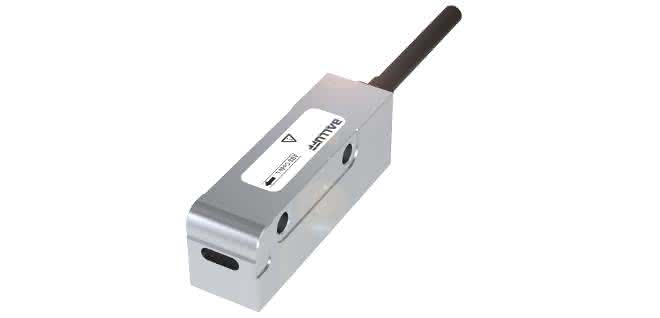
The new BMP magnetic field position measuring system and the BML SL1 absolute magnet-coded position measuring system with IO-Link interface from Balluff, for example, have been developed in accordance with the Smart Sensor Profile. They have an extremely standardized data structure and can therefore be easily integrated into existing systems. In addition, they offer various predefined functions to improve preventive or predictive maintenance strategies.
Use special functions quickly
Special functions such as an "out of range" error message can also be easily implemented with little effort. This also applies to information such as status, overflow and underflow etc. generated by a device. Once you have invested some time in programming a function block, you can also use it with other sensors of the same profile. Reference implementations and standardized function blocks help the application programmer to easily implement such previously rarely used functions and promote their distribution. The profiles described above are just the beginning. The IO-Link community is currently discussing the combination of switching and measuring sensors as well as multi-process value sensors. Standardization of actuators is also being planned.
Dr. Elmar Büchler, Industry Manager at Balluff / am


You might also be interested in
Predictive maintenance in retrofit
Predictive maintenance pays off. This is because early detection of impending failures means that systems can be serviced in a targeted manner before production downtime occurs. But how complex is it to integrate such a maintenance concept into an...
 read more...
Maintenance instead of replacement
The circular economy starts with the machinery
Sustainability in industry starts with machines, says our guest author from Deguma: How maintenance, modernization and the 5R strategy save resources, energy and CO₂.
read more...3D printing for unplanned requirements
The material fails and the machine suddenly stops? Then you need to take the right measures to be able to resume production quickly. Material failure in the form of faulty components or material wear in the frame are a risk for any production.
read more...High demands in terms of safety, application and robustness
Demanding work in the electrical trade and energy supply as well as smooth processes in production require innovative and customized measurement technology that scores points for safety, ease of use and resilience.
read more...Car meets e-bike: riding with lubrication-free polymer bearings
Studies show that the proportion of pedestrian and bicycle traffic is increasing in urban areas. With the JetBike, JetBike GmbH from Braunschweig presents a mixture of e-bike and car and relies on lubrication-free polymer bearings from Igus.
read more...Hydraulic hub for more efficient servicing
Bosch Rexroth presents a digital toolbox for service and maintenance. With a comprehensive range of digital services, the Hydraulic Hub simplifies and accelerates the service and maintenance of hydraulic products and increases machine availability.
read more...Arnold Umformtechnik expands after-sales...
Faster help with VR glasses
Arnold Umformtechnik is expanding the after-sales service for its machines to include digital remote services. The focus is on data security, simple operation and clear processes.
read more...147,000 euros per hour: high costs for German companies due to unplanned downtime
According to the "Value of Reliability" study, 67% of industrial companies in Germany experience unplanned downtime at least once a month. This costs the German economy 147,000 euros per hour. Nevertheless, reactive maintenance concepts are not...
read more...Maintenance starts with a maintenance planner
Legal requirements stipulate that machines and systems must be serviced regularly. The maintenance work serves to ensure occupational safety and economic efficiency.
read more...