
Basic research into human-robot cooperation
Psychosocial aspects under the microscope
Together with the Federal Ministry of Education and Research (BMBF) and the German Sport University, Kuka is evaluating a robotic assistance system that supports the handling of heavy objects.
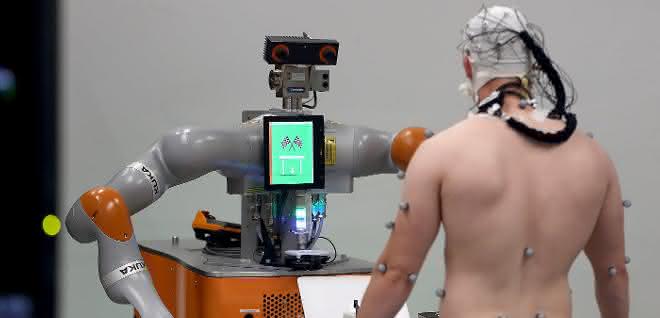
After more than three years of research, Kuka has tested a robot-based system for neuromuscular training. The automation expert emphasized psychosocial findings such as acceptance of technology and trust. The project is being carried out jointly with the Federal Ministry of Education and Research and the German Sport University in Cologne.
How do people react to working directly with robots? What psychosocial aspects come into play during the interaction? Kuka has been involved in the RoSylerNT research project (interactive robotic training systems for physical and cognitive stimulation) for more than three years. While the Sports University under the direction of Prof. Dr. Kirsten Albracht focuses primarily on physical parameters when testing robot-based systems for neuromuscular training, Kuka is investigating psychosocial aspects such as technology acceptance, fear and trust. Nadine Bender, Senior Analyst Social Impacts of Robotics in Group Research at Kuka, says: "We are changing the world of work with our products, so we have to look at the effects of this change on people. We are aware of this social responsibility."
As part of the research project, various devices were developed as executable test systems to investigate their effects on the test subjects: a robotic leg press, an automated walking and running trainer - for patients who have suffered a stroke, for example - and a robot-based carrying aid that provides support when handling heavy objects. The latter was developed by Kuka and consists of a mobile autonomous platform and two LBR iiwa. The system has now been tested by 15 test subjects. Every day, the test subjects, aged between 18 and 49, answered questions and completed tasks with the HRC system. For example, they were asked to carry a table - sometimes with a human, sometimes with the robot. "When carrying with the robot, it was clear that the human was in control and the robot only did what it was supposed to do. This avoided communication difficulties," said one of the test subjects after his assignment. "Overall, the communication was clear."
In addition to sensors and a Roboception camera, the system is also equipped with a tablet that provides visual feedback. The test subjects have no robot-specific training. The system also contains maps of the surroundings to control navigation and a photo database. Thanks to the integrated face recognition, the robot greets its counterpart personally. All three systems, including the leg press and the walking trainer, are able to perceive the posture, movement and strain of people and thus adapt to them and the respective situation. In this way, the robots ensure that users and patients are not overloaded or even endangered.
Kuka is conducting basic research in a network with the Sport University in Cologne and the BMBF. Although there are already isolated studies on human-robot interaction, Kuka's experiments focus on the psychosocial aspects. These findings will then be transferred to other products. "Collaboration with robots is becoming increasingly important, especially in the care sector. But people and intelligent machines are also increasingly working together in close proximity in industry," emphasizes Nadine Bender. pb


You might also be interested in
Intelligent sensor technology for the packaging industry
At Interpack 2026, Sick will be showcasing its portfolio of sensor, automation and AI-supported solutions for secure and digitally networked packaging processes in the consumer goods, healthcare and pharmaceutical industries.
 read more...
Sales growth in a turbulent market environment
Thanks to innovations and a focus on strategic industrial markets, Sick was able to moderately increase its sales in the 2025 financial year. In a turbulent market environment, the company was able to maintain its position and gain market share with...
read more...Photonic microchips with 3D connector
How a 3D system makes photonic chips industrially viable
A research team from Heidelberg is developing a 3D-printed "connector" for photonic microchips. The solution promises a low-loss, standardized coupling of glass fibre and chip - and could fundamentally simplify the production of photonic integrated...
read more...Advanced material retrieval system
Steute shows nexy wireless network with extended connectivity
Steute's Leantec division is presenting an enhanced version of the nexy wireless network with improved connectivity and additional cybersecurity functions. The background to the further development is the increasing use of automated guided vehicles...
read more...Detecting air bubbles in liquids
EBE is launching a capacitive bubble sensor on the market that reliably detects air bubbles and liquid breakages, regardless of the liquid and the condition of the hose.
read more...Miniature acceleration sensors
Structural tests on printed circuit boards
The Z22198 family consists of very small triaxial accelerometers from Kistler that measure vibrations in three orthogonal axes.
read more...Positive development in sensor and measurement technology
In the first quarter of 2025, the sensor and measurement technology industry recorded sales growth of three percent compared to the previous quarter - according to the results of the quarterly member survey conducted by the AMA Association for...
read more...Sick extends contract with CEO
The Supervisory Board of Sick has extended the contract of CEO Dr. Mats Gökstorp by 5 years. The company also announced that Feng Jiao has resigned from his position as Chief Sales Officer at his own request. Markus Scaglioso has been appointed to...
read more...Kistler and Keller Pressure deepen partnership in China
The Kistler Group is intensifying its cooperation with Keller Pressure. By signing the agreement, the two companies are reaffirming their commitment to strengthening synergies and developing the Chinese market in a targeted manner.
read more...