
Corona pandemic
Kuka robots manufacture laboratory products
At Ritter, Kuka robots work in the production of medical laboratory products made of plastic. Demand has increased due to the coronavirus pandemic. Seven more injection molding systems with robots from the manufacturer are now being added at a rapid pace.
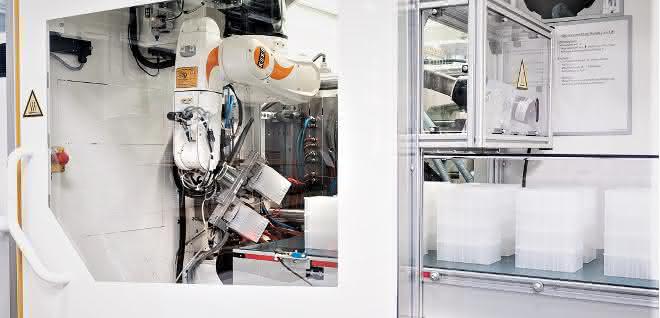
"We produce to the highest hygiene standards. Nothing must be allowed to adhere to our products that could falsify the tests in the laboratory. That was one of the reasons for us to use robots in our production," says Ralf Ritter, who, together with his brother Frank Ritter, is the second generation to run the Schwabmünchen-based company.
In their injection molding systems, the plastics specialists produce medical consumables that are used in laboratories, for example, when liquids such as blood need to be analyzed. The robot unloads the system, places the finished molded part in a testing system and then onto the conveyor belt. So-called microtiter plates and pipette tips are produced to handle the test liquids. "The demand for our products has increased incredibly in recent weeks. We are now increasing our capacity in order to be able to supply German and European laboratories and specialist retailers with sufficient material," says Ritter.

Seven more systems are now being added. This is only possible because the company decided in 2019 to strategically focus on the medical sector and build a 6,500 square meter production hall. All systems should be up and running by mid-June. Under normal circumstances, a project like this takes around 30 weeks to complete. Now it was completed in just three weeks. "This fast pace was only possible because the Kuka robots were available quickly and the SAR Group created additional capacity through a high degree of flexibility in the supply chain in order to design and implement the systems so quickly," says Ritter, who employs more than 300 people in his company. as


You might also be interested in
Schutzausrüstung in Norditalien
Kuka: Mit 3D-Druck gegen Corona
Alle fünf Minuten drucken Kuka-Roboter in Norditalien Kopfhalterungen für Gesichtsschutzschilder. Mehr als 1.000 kommen so täglich zusammen. Einen Teil der Produktion spendet die italienische Firma Caracol-AM.
 read more...
Kuka hilft beim Umbau von Montagelinien
Bestehende Montagelinien umzubauen ist zeitkritisch. Kuka unterstützt im Rahmen von zwei neuen Aufträgen Automobilhersteller beim effizienten Umbau von Anlagen. Zusätzlich gewinnt das Unternehmen einen Auftrag zur Umsetzung einer neuen...
read more...Robotik-Industrie hilft, die Coronakrise zu überstehen
Zur Bewältigung der Corona-Pandemie helfen Robotik- und Automationsspezialisten mit neuen Ideen: Roboter schulen auf Corona-Testverfahren um oder holen Familienmitglieder virtuell ins Pflegeheim, und Automatisierer starten...
read more...Plagiarius 2024 negative prize
On January 26, 2024, the Plagiarius campaign awarded its dreaded "Plagiarius" negative prize for the 48th time to manufacturers and retailers of particularly brazen counterfeits and fakes.
read more...Ivalua honors winners of the Generative AI...
AI-supported "add-ons" for buyers within 48 hours
Ivalua, provider of cloud-based spend management solutions, announced the winners and innovations of the first Generative AI Innovation Cup. The competition took place in December 2023. It was open to all Ivalua partners and employees - more than...
read more...Efaflex celebrates 50 years of high-speed...
The emphasis is on "fast"
Since day one, Efaflex has wanted to use new technologies as early as possible and drive progress in the industry. This year, the family business is celebrating its 50th anniversary under the motto "Fast Forward".
read more...Security of supply even during power outages
In the winter of 2022, Germany was worried about energy shortages. The drugstore retailer dm did not paint any horror scenarios, but nevertheless saw the possibility of controlled, temporary, regional power cuts (brownouts).
read more...Safety technology in mechanical engineering
Modules with new functions
Euchner's product highlights at EMO 2023 include the communication-capable solenoid interlocks.
read more...Transforming the paper industry towards climate neutrality
Together with partners from industry and research, Voith is developing a project for the optimization of energy and material flows in paper production. The aim of the research project is to develop a digital framework that enables effective process...
read more...