
Predictive maintenance
WZL guidelines for the development of predictive maintenance systems
To enable companies to develop and offer predictive maintenance systems and services in the field of predictive maintenance, the Laboratory for Machine Tools and Production Engineering (WZL) at RWTH Aachen University has developed a generic guideline.
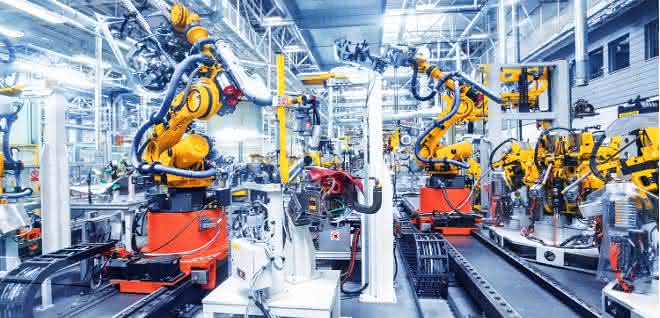
Production downtime - the worst-case scenario for every series producer. Just five minutes of downtime in automotive production is associated with average costs of 100,000 euros. To prevent such downtimes, machines, systems or means of transportation must be serviced in good time before critical components fail and production losses occur. A few years and decades ago, this only seemed possible in science fiction films. Thanks to improved and cheaper sensor, transmission and data storage technology, the predictive maintenance of production processes is already a reality in some sectors and shows great potential in the context of Industry 4.0.
To enable companies to independently develop and offer predictive maintenance systems and services in the field of predictive maintenance, the Corporate Development department of the Chair of Production Systems at the Laboratory for Machine Tools and Production Engineering WZL at RWTH Aachen University has developed a generic guideline for action in collaboration with various series producers and toolmaking companies. For the successful application of predictive maintenance, a close and cooperative partnership between series producers and toolmaking companies is essential in order to synergistically combine the advantages of tool and process knowledge in series production.
The guideline's target group includes, in particular, companies that are experiencing increased tool-related failures in their series production due to repeated, unforeseen disruptive influences. Predictive maintenance can help them to predict malfunctions such as tool failure and derive specific measures based on this. This gives tool manufacturers the opportunity to expand their existing service portfolio with predictive maintenance solutions in order to significantly increase customer benefits over the entire life cycle of the tool and open up additional business areas.
Procedure for company-specific implementation
The functionality of predictive maintenance is based on the collection, transmission, storage and near-real-time utilization of large volumes of data. Based on complex analysis procedures and algorithms, deviations in the recorded operating parameters of a machine-tool system can be identified and necessary maintenance can be anticipated. As both the technical implementation and the embedding of the technical solutions in the existing product and service portfolio often represent major challenges for series producers and toolmaking companies, the guideline is based on a comprehensive study which, in addition to concrete research results, is also based on the expert knowledge of the participating partners from industry.
The generic guideline presents a systematic procedure for developing predictive maintenance solutions in three phases with a total of six steps. As part of the analysis phase, all relevant prerequisites and requirements for a predictive maintenance solution are first recorded. In the design phase, these are translated into tool, infrastructure and service solutions. Finally, the implementation phase involves commissioning, teaching the algorithm and defining interaction points and workflows.
The results of the study show that the use of a predictive maintenance solution offers great potential for increasing machine availability by significantly reducing unplanned downtime while at the same time reducing maintenance costs through more predictable, condition-based maintenance in series production. By providing appropriate services, toolmaking companies have the opportunity to expand their offering, effectively differentiate themselves from the competition and increase their profitability. By cooperatively developing predictive maintenance solutions, both sides can benefit equally from corresponding service concepts.


You might also be interested in
"We are clearly different from the competition"
The IT company 21unity offers a range of hardware and software services, as well as traditional services. Andreas Mühlbauer spoke to Managing Director Anja I. Gondolf about the company's appearance at the Hannover Messe, its services and future...
 read more...
Think digital, act local
When it comes to industrial damping technology, on-site advice is often very valuable for engineers and designers.
read more...Plagiarius 2024 negative prize
On January 26, 2024, the Plagiarius campaign awarded its dreaded "Plagiarius" negative prize for the 48th time to manufacturers and retailers of particularly brazen counterfeits and fakes.
read more...Spindel Full Service records second-best...
Maintenance as an economic success factor
Spindel Full Service, the spindle repair specialist from Baden-Württemberg, can look back on its second-best financial year in its history - with 15% growth compared to the previous year. And the further forecast also looks good.
read more...Thyssenkrupp and Novelis cooperate
Platform for the circular economy
With a platform for the circular economy in the automotive industry, the two companies Thyssenkrupp Materials Services and Novelis want to set new standards for the recycling of used materials. The open platform will enable access to larger...
read more...How production can benefit from AI
Together with AI technology, IIoT networking makes it possible to better control machine parameters and optimize quality with predictive quality. Downtimes and set-up times can also be further minimized. Cloud platforms also make these technologies...
read more...Marco Ghirardello takes the lead
Fanuc has appointed Marco Ghirardello (48) as the new President and CEO of Fanuc Europe. Ghirardello succeeds Shinichi Tanzawa, who has led the company since 2016 and will take on a new role at Fanuc's headquarters in Japan.
read more...Efficient robot monitoring
Microchips are installed almost everywhere - whether in smartphones, washing machines or cars. With increasing digitalization, the demand for semiconductors has been growing rapidly in all areas of the economy for years.
read more...Everything on one platform
Functional and powerful tools are essential for professional work on the construction site, in the workshop or when carrying out repairs.
read more...