
Workplace design
Ergonomics and efficiency work hand in hand
The performance of a logistics system is defined by the interaction between people, software and technology. The workstations of logistics employees should therefore be planned just as carefully as the material flow.
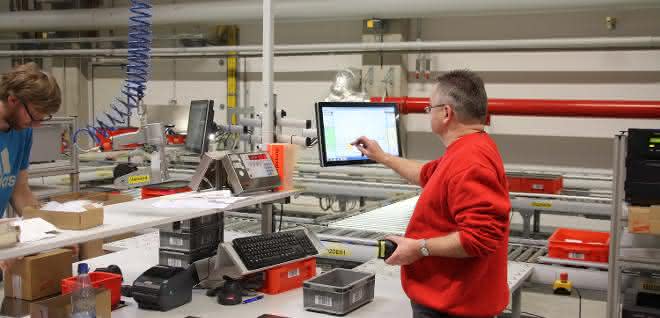
The intuitive and ergonomic design of workstations is an important prerequisite for workers to be able to cope with the volume of orders. Packing and picking stations that are ergonomically optimized offer high productivity potential and ensure the long-term performance of employees. The result is more efficient processes and a healthy workforce. The increasing proportion of older people in particular requires adjustments to work processes. But what aspects should companies pay particular attention to when planning workstations?
As soon as the conveyor technology, storage systems and order picking have been planned, the next step is to design the workstations: The design depends on the picking or packing process and the type of items stored. If the employee is moving heavy loads, for example, load handling devices make the work easier. If such mechanical support is not taken into account in the planning process, bottlenecks can occur when the workstations are reconfigured later. The height of conveyor lines, work tables and shelving should take into account the range of body heights. Sufficient headroom and ergonomic working heights must also be taken into account. Height adjustability of conveyor technology, work tables or floor platforms should be planned for at an early stage.
Different requirements for the planning of workstations result from the type of picking, depending on whether the goods are actively delivered to the employees (goods-to-person principle) or whether they are provided in shelf compartments (person-to-goods principle). An individually tailored warehouse management system (WMS), for example UniWare from Unitechnik, has a major influence on the ergonomics of the workstations. For example, it optimizes the ergonomic process for person-to-goods picking: The WMS guides employees through the warehouse in a route-optimized manner, thus shortening the walking distances required to assemble orders. Based on historical data, the WMS also suggests a shelf layout in which the fast-moving items are placed at a good reach height, as employees pick from these compartments particularly frequently.
An important factor for ergonomics is the workstation height. Ideally, in material flow concepts based on the goods-to-person principle, this can be adapted to the height of the employee. The decisive factor is whether the workers carry out an activity standing up or sitting down. This has an impact on the working movements and the height required to pick up containers and items. Gripping heights that are above the shoulders or below the knees, for example, are not very ergonomic. The provision of work equipment also plays an important role: if all materials such as containers, cartons and label printers are accessible and available in sufficient quantities at the packing station, long and time-consuming walking distances are eliminated. For the implementation of value-added services, a process-reliable arrangement of additional elements, such as assembly parts or labels, provides further added value. For example, it makes sense to arrange the work equipment in the order in which it is required by the employee. Ideally, rotational movements should be limited to around 45 degrees. When moving particularly large and heavy goods, suitable means of transport such as suction pads also provide ergonomic and, above all, safe support. In the future, cooperation between robots and humans will play an increasingly important role here.
In addition to the physical aspects, the intuitive operation of the technical elements also influences work efficiency and ergonomics. Visual signals such as pick-by-light displays help employees to carry out work processes without errors, even at high frequency. The light signals indicate which goods are to be picked, in what quantity and where, and into which target container they need to be picked. Making the validation process as simple as possible also reduces the workload for employees. The automatic confirmation of the goods movement by a light barrier at the removal compartment and the weight check of the target container prevent additional work. The intuitive design of the input screens in the warehouse management system simplifies the work of logistics staff. A touch screen makes operations more efficient: Employees do not waste time picking up the keyboard and mouse and there is no need to move the mouse pointer on the screen; instead, warehouse workers select the correct operating element via a finger point. The use of images and symbols also makes operation easier - even for people with limited language skills. pb


You might also be interested in
"We are clearly different from the competition"
The IT company 21unity offers a range of hardware and software services, as well as traditional services. Andreas Mühlbauer spoke to Managing Director Anja I. Gondolf about the company's appearance at the Hannover Messe, its services and future...
 read more...
Think digital, act local
When it comes to industrial damping technology, on-site advice is often very valuable for engineers and designers.
read more...Plagiarius 2024 negative prize
On January 26, 2024, the Plagiarius campaign awarded its dreaded "Plagiarius" negative prize for the 48th time to manufacturers and retailers of particularly brazen counterfeits and fakes.
read more...Spindel Full Service records second-best...
Maintenance as an economic success factor
Spindel Full Service, the spindle repair specialist from Baden-Württemberg, can look back on its second-best financial year in its history - with 15% growth compared to the previous year. And the further forecast also looks good.
read more...Thyssenkrupp and Novelis cooperate
Platform for the circular economy
With a platform for the circular economy in the automotive industry, the two companies Thyssenkrupp Materials Services and Novelis want to set new standards for the recycling of used materials. The open platform will enable access to larger...
read more...How production can benefit from AI
Together with AI technology, IIoT networking makes it possible to better control machine parameters and optimize quality with predictive quality. Downtimes and set-up times can also be further minimized. Cloud platforms also make these technologies...
read more...Marco Ghirardello takes the lead
Fanuc has appointed Marco Ghirardello (48) as the new President and CEO of Fanuc Europe. Ghirardello succeeds Shinichi Tanzawa, who has led the company since 2016 and will take on a new role at Fanuc's headquarters in Japan.
read more...Efficient robot monitoring
Microchips are installed almost everywhere - whether in smartphones, washing machines or cars. With increasing digitalization, the demand for semiconductors has been growing rapidly in all areas of the economy for years.
read more...Everything on one platform
Functional and powerful tools are essential for professional work on the construction site, in the workshop or when carrying out repairs.
read more...