

Workpiece carrier transport systems
Flexible mounting from flashing light to pasture fence
The specialists at Horizont rely on a workpiece carrier transport system from Stein Automation for the final assembly of pasture fencing devices and lights - with success: twice as many components are now assembled per shift as before, and the ergonomics for the employees have improved.
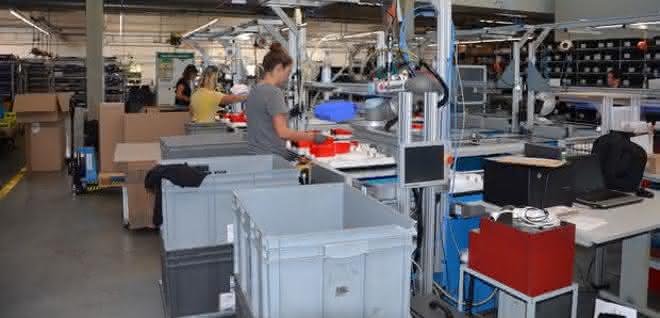
Pasture fencing technology can be used to keep elephants in check and protect flocks of sheep from wolves. Such solutions may be exotic, but they are part of Horizont's regular product range. In addition to pasture fence technology, the company manufactures flashing lights for authorities and advance warning signs for the traffic sector. Horizont was founded in 1945, is family-run and employs 500 people worldwide, 300 of whom work at its headquarters in Korbach, Hesse. Everything from design, toolmaking and plastics production to final assembly takes place in-house.
In order to manufacture these and other products efficiently, the company has set itself the goal of optimizing its production processes. This is because customers are demanding ever shorter delivery times. "To be fast, we have to optimize production and adapt processes. We try to automate and remain flexible at the same time," outlines Guido Kersting, Team Leader Production Engineering at Horizont. The Korbach-based company also has to cope with fluctuating batch sizes. There are peaks in the spring, in the fall more is produced for stock. In this context, those responsible also set their sights on the final assembly of pasture fencing devices and flashing lights. "We were looking for a system with a modular design that also improves ergonomics for the employees," says Kersting.
These requirements were also in the specifications that the team leader sent to several manufacturers of assembly systems. The choice ultimately fell on a workpiece carrier transport system from Stein Automation in Villingen-Schwenningen. "We first designed an assembly station and clarified further details together with Horizont," explains Jochen Wurm, Deputy Sales Manager at Stein: this included material provision, the number of workpiece carriers required and travel speeds. In Villingen-Schwenningen, a customized system was created with modules from the Stein modular system, which was tested and approved by Horizont. The system was set up in Korbach within two days and then put into operation without a hitch.
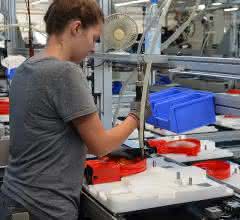
"The interface issue, for example, was a tricky one because of the high control requirements," explains Jochen Wurm. It was also necessary to implement variable belt speeds with energy-efficient operation. The ergonomics of the workstations have also been solved very well. Stein has installed a height compensation unit. This can be infinitely adjusted between 780 and 1,160 millimetres. The system is controlled by Stein Control. "Horizont can freely select and deselect workstations - depending on the product variant. We started with a manual version. Automated stations are to be added later," explains Jochen Wurm. The company is completely satisfied with the performance of the system, which has been in operation for a year now. "It runs absolutely smoothly," says a delighted Guido Kersting. He also praises the high level of flexibility. "We can install batten lights and pasture fencing devices at the same time and decide which product is processed at which stations depending on the batch." The system also incorporates the Softmove system developed by Stein. This enables the components to be transported gently and quickly at the same time. Another plus point from Guido Kersting's point of view. "Softmove is important because the stations have to be approached precisely for ergonomic processing without components slipping," he says.
The investment in the new system has paid off for Horizont. The cycle times per work step are the desired 25 seconds. Throughput times have improved significantly. "For example, we used to assemble 360 lights per shift, now it's 720," calculates Kersting.
The cooperation is to be continued in the future. The plan is to expand the approximately eight-metre-long and four-metre-wide system by four workstations for the production of flashing lights. This is currently still running at individual workstations. Horizont hopes that such a measure will bring additional benefits. "According to our calculations, we could increase productivity by 30 to 40 percent," says Kersting. as


You might also be interested in
Plagiarius 2024 negative prize
On January 26, 2024, the Plagiarius campaign awarded its dreaded "Plagiarius" negative prize for the 48th time to manufacturers and retailers of particularly brazen counterfeits and fakes.
 read more...
Ivalua honors winners of the Generative AI...
AI-supported "add-ons" for buyers within 48 hours
Ivalua, provider of cloud-based spend management solutions, announced the winners and innovations of the first Generative AI Innovation Cup. The competition took place in December 2023. It was open to all Ivalua partners and employees - more than...
read more...Efaflex celebrates 50 years of high-speed...
The emphasis is on "fast"
Since day one, Efaflex has wanted to use new technologies as early as possible and drive progress in the industry. This year, the family business is celebrating its 50th anniversary under the motto "Fast Forward".
read more...Security of supply even during power outages
In the winter of 2022, Germany was worried about energy shortages. The drugstore retailer dm did not paint any horror scenarios, but nevertheless saw the possibility of controlled, temporary, regional power cuts (brownouts).
read more...Safety technology in mechanical engineering
Modules with new functions
Euchner's product highlights at EMO 2023 include the communication-capable solenoid interlocks.
read more...Transforming the paper industry towards climate neutrality
Together with partners from industry and research, Voith is developing a project for the optimization of energy and material flows in paper production. The aim of the research project is to develop a digital framework that enables effective process...
read more...Up to 95 percent less flue gas thanks to direct extraction
The requirements for occupational safety measures and safety technology are also constantly increasing in welding technology. The Technical Rules for Hazardous Substances (TRGS) stipulate that welding fumes and harmful substances must be extracted...
read more...Competitive advantages with large machines
Whether 3D-printed components for machines and systems, prototypes or aids for design: additive manufacturing is almost indispensable for modern companies in mechanical and plant engineering and automation if they want to play in the premier league.
read more...Transport technology from the modular system
Many transport tasks can be realized with the help of linear technology. Pre-configured solutions are available to simplify the interaction between the linear unit, motor, gearbox and controller. This minimizes the effort required for research and...
read more...