
Rosenberger assembly center
The roof ensures greater flexibility of use
For roof constructions, the Kielsteg system is suitable for particularly flexible room concepts, as the self-supporting timber roof elements can span up to 27 meters as single-span beams.
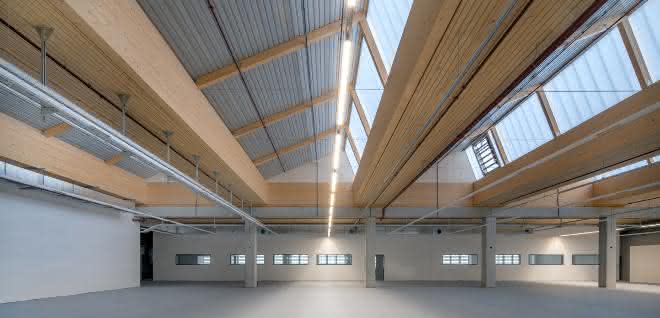
When planning a production hall for punching technology and assembly at Rosenberger, the focus was also on a floor plan that could be used as freely as possible. Rosenberger Hochfrequenztechnik, a medium-sized, family-owned industrial company, was founded in 1958 and is now one of the world's leading providers of connection solutions in high-frequency, fiber optic and high-voltage technology, including for the automotive and telecommunications industries, medical and industrial electronics and industrial measurement technology. More than 2,000 employees work at the headquarters in Fridolfing, and the Rosenberger Group employs around 10,000 people worldwide at numerous production and assembly sites and sales offices in Europe, Asia and North and South America.
Adaptable layout sought
The new assembly center in Fridolfing needed to offer maximum space for the production machines and allow an efficient material flow. What is stamped on the first floor of the production building is to be assembled into finished connectors one floor above in the assembly hall. A versatile layout was important here in order to be able to react quickly to future production changes.
These requirements had to be harmonized with an appealing architecture, as the new building is part of a corporate architecture concept for a completely new part of the plant, consisting of various office, production and logistics buildings. The concept was developed and implemented by the architects of industrial construction specialist Hinterschwepfinger, who were able to reconcile all aspects and meet the various requirements with the Kielsteg elements.
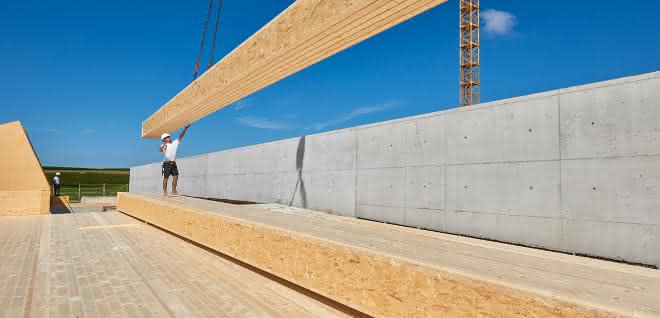
The roof of the hall was constructed using 2,300 square meters of timber construction elements. Elements up to 19.7 meters long were used as single-span beams, so that the three-bay hall, measuring approx. 56 by 53 meters, only requires two rows of central columns. As the components are only 61 centimetres high despite their enormous structural capacity, the planners were able to construct the two-storey building as a comparatively flat structure that blends in perfectly with the overall appearance of the existing site.
What is coherent from the outside has a balanced effect on the inside. For large halls where many people have to carry out different tasks, not only is logistical planning essential, but also a well thought-out visual and acoustic spatial effect from the outset. Here, the surface-forming roof components prove to be an advantageous design element, as they create a pleasant atmosphere in both respects with their closed timber soffit.
The two outer bays, designed as a single-span system, are each spanned by up to 19.70 meter long, slightly elevated elements of type KSE 610/57/93. While an office complex was installed on one side, the area at the other end of the hall is reserved for various purposes. The middle section, in which a large assembly area has been created, was designed with a shed roof system for intelligent daylight utilization.
Sprinkler system on timber components
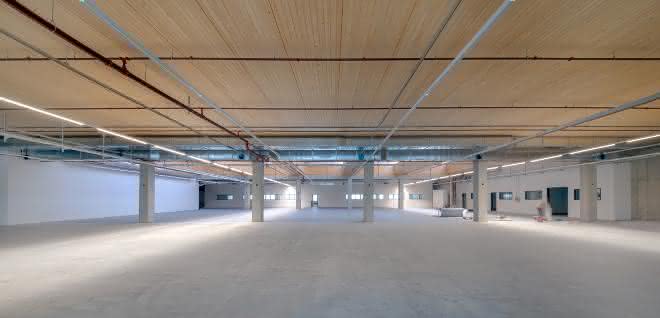
A fire protection novelty in this project is the sprinkler system mounted directly on the timber components. Wood has gained in importance with increased climate protection requirements and is regarded as the building material of the future. Acceptance is increasing because compliance with the high fire protection safety level is also possible in timber construction. Here, a sprinkler system could be attached directly to the Kielsteg ceiling with individual approval. The prerequisite was proof that the sprinkler system could be securely fastened to the solid wood of the bottom chord of the construction elements in the event of a fire. This was verified with pull-out tests and certified by the VdS.
Another advantage of the chosen solution is particularly evident with regard to the other supply technology. The flat wooden ceiling allows for freer MEP planning, as there is no need for complex construction around beams. The cable routes, lighting and ventilation system could be installed directly on the elements and planned exclusively according to the primary requirements.
Kielsteg is a high-load-bearing, uniaxially aligned prefabricated timber component. It consists of an upper and lower chord made of sawn timber and webs made of plywood or OSB. The characteristic curvature of the webs in the shape of a boat keel gives the construction element its name. The surface-forming timber construction elements are typically used as roof structures for halls that require a large column grid. For example, up to 27 meters can be built over directly as a single-span system. The usual column grids in hall construction can thus be considerably enlarged and the primary structure greatly reduced. The areas can thus be used more flexibly. as


You might also be interested in
Helu makes its first trade fair appearance under a new brand name
Helu Kabel will be presenting itself as Helu for the first time at Hannover Messe 2026, showcasing system solutions, Heluchain cables and new industrial luminaires.
 read more...
Strategic realignment with brand relaunch
In future, Helukabel will trade as Helu
The Helukabel Group is parting with part of its name: in future, the company will only operate under the Helu brand. With this step, the specialist for electrical connection technology is underlining its strategic development from a classic cable...
read more...Modular plant construction for corrugated board
Insight into the production of corrugators at BHS Corrugated: Automated, modular and equipped with Helukabel components.
read more...Best quality for the steel
Conditions in the steel industry are harsh and inhospitable. The machines used must be able to withstand the demanding environmental conditions in order to deliver the best quality at all times.
read more...If the standard cable is not sufficient
Lapp offers cables for countless applications - but not for all of them. From time to time, the developers have to modify a standard cable or develop a special cable.
read more...Slight decline in sales, strong investments
The Lapp Group has not been spared from the weakening global economy. However, the company only recorded a slight loss in the past 2024 financial year.
read more...Electrical connection technology
Cables and wires for industrial automation
Heukabel offers system solutions for cable routing from a single source. The subsidiary EKD Systems specializes in tailor-made cable drag chains made of steel, stainless steel and plastic, which are used in moving machines and systems as well as in...
read more...Lapp relies on Ultramid from BASF
Mobile charging of electric vehicles
The automotive industry is currently undergoing the biggest transformation in its history. The boom in battery electric vehicles in particular is presenting the industry with major challenges. Lapp, as a supplier of cables and connection...
read more...Cable handling application
At this year's Motek, ArtiMinds Robotics is showcasing a robot-based automation solution for the sensor-assisted assembly of flexible cables in connector housings.
read more...