
Study by Item
Opportunities through digitalization for SMEs
The digital transformation is shaking up the mechanical engineering industry. For SMEs, this raises questions such as: What are the specific effects of the new technologies and workflows? How will this change the work of design engineers? The study "What will the mechanical engineering of the future look like?" by Item.
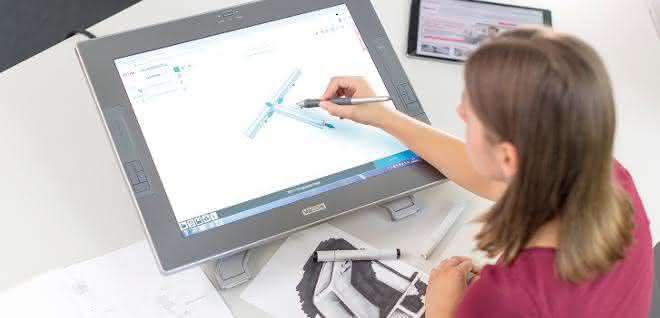
Digitalization holds enormous potential for companies in the mechanical engineering sector. However, small and medium-sized companies in particular are often unable to assess the specific impact this will have on them. What they lack is a digitalization strategy. In a recent study, Item examines the challenges and opportunities that digitalization holds for SMEs. In addition to evaluating current studies and publications, the main focus here was on practical experience. Experts from the areas of management, purchasing and construction were surveyed, followed by 141 online interviews. The results showed that digitalization is not a threat, especially for SMEs, but an opportunity to increase efficiency, as Item explained.
Accepting the challenge, becoming more efficient
Trends such as Industry 4.0 have become firmly established in mechanical engineering. The respondents also agree on the further development of digitalization: 68.8% agree with the statement that processes and workflows in equipment and mechanical engineering will become increasingly digital over the next five years. Despite this clear sentiment, the digitalization trend has not yet led to uniform industry standards. Accordingly, there is a lack of an urgently needed guideline for the industry in this area. Mechanical engineering companies that are already active in this area are often guided by their customers' specifications. This is particularly often the case in design.
A major challenge currently needs to be overcome here: Construction is increasingly becoming a time factor due to high capacity utilization and rising customer expectations with regard to short project lead times. Frequent outsourcing is the result. However, specialized service providers for operating resources and customer solutions will not be able to cope with this work using conventional means. There is no doubt that mechanical engineering must find an answer to this.
Innovative online configurators offer a solution that can significantly reduce time and costs. As a result, not only are standard tasks processed more quickly, but intuitive user interfaces also eliminate the need for extensive training.
Digitalization strategy mostly non-existent
The majority of study participants see digitalization as a fundamental factor for the future of mechanical engineering. However, only 9.2 percent say that their companies have a concrete strategy for digitalization. This is primarily due to the highly differentiated nature of mechanical engineering: Each company represents such an individual combination of different factors (industry, company size, market conditions) that a standardized approach to digital transformation does not apply.
This is why an interdisciplinary perspective is particularly important: All areas of the company must be involved, as digitalization is not a process that only applies to certain areas. If there are any concerns on the part of employees, these can be specifically addressed with training courses or workshops. The interviewees were in complete agreement on this.
Item has developed a checklist for companies wondering where they currently stand in terms of digitalization. Using six basic questions and three possible answers for each, companies can determine their current level of digitalization. as


You might also be interested in
Plagiarius 2024 negative prize
On January 26, 2024, the Plagiarius campaign awarded its dreaded "Plagiarius" negative prize for the 48th time to manufacturers and retailers of particularly brazen counterfeits and fakes.
 read more...
Ivalua honors winners of the Generative AI...
AI-supported "add-ons" for buyers within 48 hours
Ivalua, provider of cloud-based spend management solutions, announced the winners and innovations of the first Generative AI Innovation Cup. The competition took place in December 2023. It was open to all Ivalua partners and employees - more than...
read more...Efaflex celebrates 50 years of high-speed...
The emphasis is on "fast"
Since day one, Efaflex has wanted to use new technologies as early as possible and drive progress in the industry. This year, the family business is celebrating its 50th anniversary under the motto "Fast Forward".
read more...Security of supply even during power outages
In the winter of 2022, Germany was worried about energy shortages. The drugstore retailer dm did not paint any horror scenarios, but nevertheless saw the possibility of controlled, temporary, regional power cuts (brownouts).
read more...Safety technology in mechanical engineering
Modules with new functions
Euchner's product highlights at EMO 2023 include the communication-capable solenoid interlocks.
read more...Transforming the paper industry towards climate neutrality
Together with partners from industry and research, Voith is developing a project for the optimization of energy and material flows in paper production. The aim of the research project is to develop a digital framework that enables effective process...
read more...Up to 95 percent less flue gas thanks to direct extraction
The requirements for occupational safety measures and safety technology are also constantly increasing in welding technology. The Technical Rules for Hazardous Substances (TRGS) stipulate that welding fumes and harmful substances must be extracted...
read more...Competitive advantages with large machines
Whether 3D-printed components for machines and systems, prototypes or aids for design: additive manufacturing is almost indispensable for modern companies in mechanical and plant engineering and automation if they want to play in the premier league.
read more...Transport technology from the modular system
Many transport tasks can be realized with the help of linear technology. Pre-configured solutions are available to simplify the interaction between the linear unit, motor, gearbox and controller. This minimizes the effort required for research and...
read more...