
Industrial LED lighting
The right light at the table
At the workplace, optimum lighting has a positive effect on employee concentration and reduces the error rate. Ergonomic aspects also speak in favor of selecting suitable LED luminaires.
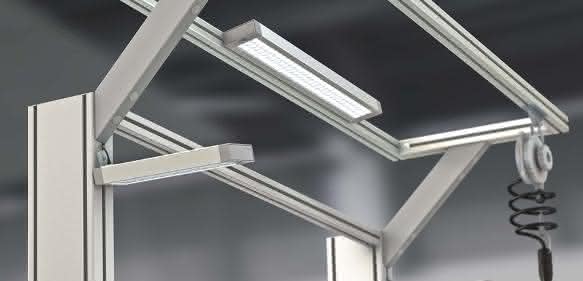
Various aspects need to be considered to ensure ideal workplace lighting. First of all, an analysis of the current situation at the workplace should be carried out - taking into account the ambient lighting, as this is usually not sufficient. In cooperation with the employees, the planner analyzes the visual task in relation to the activity. This is followed by the selection of the light source with the required illuminance. For rough work on machine tools, for example, an illuminance of 300 lux is sufficient. To carry out fine and difficult tasks, such as in the electronics workshop, employees need at least 1,500 lux.
Too bright can also be harmful
Bright light with high illuminance increases the risk of harmful glare. Direct glare reduces the employee's ability to concentrate because the eye has to constantly adapt to different lighting conditions. Appropriate shielding and alignment of the luminaires provides a remedy. "To virtually eliminate harmful glare, we use parabolic mirror louvres in our Item LED luminaires," explains Marius Geibel, expert for workplace systems and product manager at Item. "Conventional LED lights often have a high level of brightness. However, the decisive factor is not that the luminaire appears bright, but the workplace to be illuminated." Employees hardly notice the Item lights when they are switched on, but the work area is fully illuminated.
In addition to direct glare, indirect glare also strains the eyes due to strong reflections. In order to adapt the light to individual needs and the respective work task, the industrial luminaire must be adjustable. Thanks to the articulated function of the LED luminaires and the combination with other components from the MB modular system, Item enables targeted use of the light.
Flickering light causes restlessness and stress. Sensitive people notice the flickering even at a frequency of 50 Hertz. The frequency of LED luminaires should therefore be significantly higher. The light color also has an influence on performance at workplaces. While warm white light (approx. 2,500 Kelvin) has a calming effect, cool white light (approx. 6,000 Kelvin) has a stimulating effect. A light color of 4,000 Kelvin is recommended in industrial environments.
LED lights score points with their high performance and low energy consumption. The service life of up to 50,000 operating hours enables low-maintenance operation. For complex and demanding lighting scenarios, a modular lighting design often makes sense. The Item modular system enables shadow-free illumination of a work area from three sides. Simple plug-in devices reduce the installation effort. as


You might also be interested in
Plagiarius 2024 negative prize
On January 26, 2024, the Plagiarius campaign awarded its dreaded "Plagiarius" negative prize for the 48th time to manufacturers and retailers of particularly brazen counterfeits and fakes.
 read more...
Ivalua honors winners of the Generative AI...
AI-supported "add-ons" for buyers within 48 hours
Ivalua, provider of cloud-based spend management solutions, announced the winners and innovations of the first Generative AI Innovation Cup. The competition took place in December 2023. It was open to all Ivalua partners and employees - more than...
read more...Efaflex celebrates 50 years of high-speed...
The emphasis is on "fast"
Since day one, Efaflex has wanted to use new technologies as early as possible and drive progress in the industry. This year, the family business is celebrating its 50th anniversary under the motto "Fast Forward".
read more...Security of supply even during power outages
In the winter of 2022, Germany was worried about energy shortages. The drugstore retailer dm did not paint any horror scenarios, but nevertheless saw the possibility of controlled, temporary, regional power cuts (brownouts).
read more...Safety technology in mechanical engineering
Modules with new functions
Euchner's product highlights at EMO 2023 include the communication-capable solenoid interlocks.
read more...Transforming the paper industry towards climate neutrality
Together with partners from industry and research, Voith is developing a project for the optimization of energy and material flows in paper production. The aim of the research project is to develop a digital framework that enables effective process...
read more...Up to 95 percent less flue gas thanks to direct extraction
The requirements for occupational safety measures and safety technology are also constantly increasing in welding technology. The Technical Rules for Hazardous Substances (TRGS) stipulate that welding fumes and harmful substances must be extracted...
read more...Competitive advantages with large machines
Whether 3D-printed components for machines and systems, prototypes or aids for design: additive manufacturing is almost indispensable for modern companies in mechanical and plant engineering and automation if they want to play in the premier league.
read more...Transport technology from the modular system
Many transport tasks can be realized with the help of linear technology. Pre-configured solutions are available to simplify the interaction between the linear unit, motor, gearbox and controller. This minimizes the effort required for research and...
read more...