
CI machine from Emag ECM
Effective deburring of complex components
The new CI ECM machine from Emag guarantees fast and perfect electrochemical machining processes for deburring and machining ("ECM broaching"). It also requires only a minimal footprint.
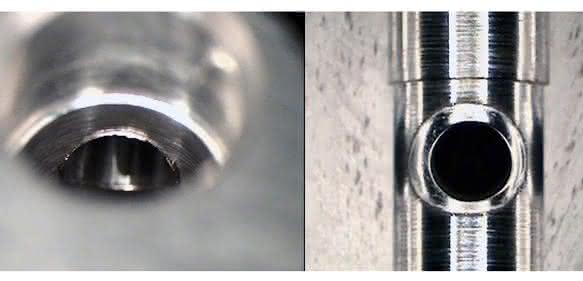
In automotive engineering, components must leave the production line without defects. Otherwise, for example, the autonomous braking system could fail at crucial moments. This is where component deburring plays a crucial role - electrochemical metal processing (ECM) ensures the required surface perfection. Many planners are currently looking for lean production systems to replace conventional deburring processes.
The first glance at complex components such as pump housings makes it clear just how challenging deburring is: these components often have a veritable network of holes through which the hydraulic oil or fuel, for example, later flows at high pressure. It is not easy to remove the existing burrs, especially if there are several bore intersections inside such a housing. Sometimes a lengthy manual process is required, which can take an hour or more for large hydraulic bodies for the aviation or commercial vehicle industry and is therefore cost-intensive. "In addition, manual processing naturally involves a risk of error," emphasizes Richard Keller, member of the management team at Emag ECM. "If employees overlook a burr, it can come loose during subsequent use and obstruct the flow. This is unacceptable in view of the high safety requirements in aircraft or automobile construction."
It therefore comes as no surprise that electrochemical deburring has become established for many components in recent years. Errors are largely eliminated here and the processing speed is rapid: During electrochemical metalworking, an electrolyte solution flows between the workpiece (the positive anode) and the tool (the negative cathode). This causes metal ions to detach from the workpiece. The shape of the cathode or the tool with the active, current-conducting areas is selected in such a way that the material removal from the workpiece leads to the desired component contour. This not only leads to surfaces with maximum quality - without thermal damage to the material structure - but also to completely consistent and reproducible results.
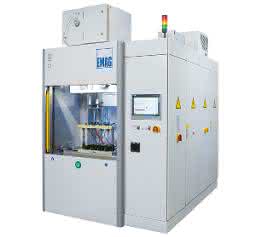
The ECM specialists at Emag, based in Gaildorf near Schwäbisch Hall, are constantly developing the process with a view to new materials, component geometries and quality requirements. For the new CI machine series available since spring 2017, the engineers have, among other things, revised the basic frame of the CI system and optimized the size of the control cabinet and the electrolyte management system in order to save expensive working space in their customers' production facilities. "It is obvious that, in view of technological developments, deburring and ECM clearing, for example when a component is already hardened, are becoming increasingly important. We wanted to develop a solution for this that, on the one hand, fully guarantees users the outstanding benefits of electrochemical metalworking and ensures reliable processes and, on the other hand, can be offered at an extremely attractive price-performance ratio."
Users then benefit from flexible technology with high-quality components throughout. The cycle time can be changed precisely using scalable devices, several components can be processed simultaneously during one process step depending on requirements, and upgrading to full automation is no problem with the CI machine. All parameters during the ECM process are fully and reproducibly monitored and documented. Last but not least, the CI machine only requires a footprint of around 7.5 square meters including filtration.
E-mobility is also moving into focus
The new CI machine is already in use at a North American aerospace supplier and an Italian commercial vehicle supplier. In both cases, deburring is carried out on very complex housings. Despite a large number of holes on the component, the cycle times are less than 60 seconds - a quantum leap in view of the lengthy manual processes previously carried out. "These examples show that we are on the right track with our development approach: We were able to prevail against national and international competitors because the CI machine has outstanding performance values, while at the same time being cost-effective. The enormous cost pressure among users calls for effective mechanical engineering, such as we offer with the CI machine," explains Keller.
There is much to suggest that this cost-benefit argument will gain even more attention from users in the future, as many components in electric and hybrid engines also require ECM broaching, drilling and deburring processes. In addition, there is another argument that should not be underestimated in view of the current discussion about theCO2 footprint in automotive production: Compared to many alternative processes, electrochemical metal processing takes place much faster. This saves many tons of carbon dioxide. as


You might also be interested in
Atlas Copco takes over long-standing sales partner
Atlas Copco has taken over Heide-Pumpen. The specialist for mobile pumps has been working closely with Atlas Copco in sales and service for a long time, especially for surface pumps for construction site dewatering and wastewater detour or in the...
 read more...
Lutz Pumpen at the Achema 2024
New mobile drum pump with battery drive
The new B3 Battery from Lutz Pumpen promises mobile and safe working with aggressive liquids without having to compromise on pumping performance compared to wired versions. The battery-powered drum pump will be on display at Achema, the world's...
read more...Maintenance and Pumps&Valves in February
Final preparations are underway in Dortmund: On February 21, 2024, maintenance will start as the leading trade fair for industrial maintenance and with it Pumps&Valves as the trade fair for industrial pumps, fittings and valves.
read more...Liquid separator keeps pumps dry
Vacuum clamping minimizes distortion and enables five sides to be machined in one clamping operation. The use of cooling lubricants poses a challenge: If they get into the vacuum generator, they can cause serious damage.
read more...Spring clutches for construction machinery
Spring clutches from Torsion Control Products (TCP) are ideal for use in construction machinery where modern diesel engines are used.
read more...Protection against cooling lubricant
Liquid separator from Schmalz keeps pumps dry
Anyone clamping with a vacuum during CNC machining must protect the pump from cooling lubricant. The NLS liquid separator from Schmalz separates the cooling lubricant and returns it to the running process - without interrupting the vacuum.
read more...Which clutch for what?
Mechanical engineering and its applications are multifaceted. Every application is special and requires a perfect machine design. Individual components in the system must also be optimally designed.
read more...Energy efficiency needs electrical engineering and IT
The energy crisis makes one thing clear: it is not enough to simply screw a photovoltaic system onto your roof or purchase green electricity. Industry is faced with the challenge of reducing consumption in order to counter the rise in energy prices,...
read more...Solutions for a networked and climate-neutral industry
At the world's leading trade fair for industry, around 4,000 companies from the mechanical engineering, electrical and digital industries as well as the energy sector will be showcasing solutions for the production and energy supply of the future.
read more...