

Motek 2022
Customized assembly stations
Not every product can be manufactured fully automatically. Automated production is often not practical, especially for complex, varied products in small quantities.
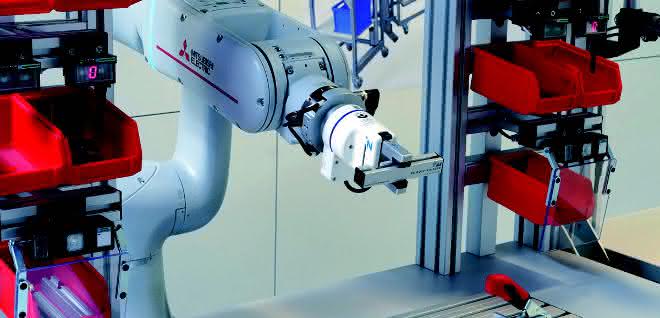
This calls for modern, ergonomic assembly workstations that free workers from physically strenuous or monotonous tasks and can be integrated into the digital world of work. Equipped with software-supported assistance systems or collaborative robots, they ensure an efficient, error-free production process and assembly safety even when employees change - both important factors in terms of quality assurance.
One provider is RK Antriebs- und Handhabungs-Technik (RK-AHT) from Bienenbüttel, a subsidiary of RK Rose+Krieger and therefore part of the Phoenix Mecano Group. With around 30 specialists in robotics, process engineering and hardware and software development, it develops customer-specific system solutions in the fields of automation and production technology. The aim is to supply customers with ready-to-use assembly workstations fully tailored to their products from a single source.
One contact for everything
The tedious task of putting together the various components of a workstation should be a thing of the past. Suppliers should also benefit from this, according to Andreas Kebbel, Managing Director of RK-AHT: "The individual workstation modules are difficult to market on their own. Our experience shows that customers clearly want a contact partner who understands their problems and can offer them a ready-made solution."
"The design of every customized assembly workstation begins with an intensive, detailed analysis of the product to be manufactured and the customer's requirements," says Kebbel. Once the specifications have been drawn up, teamwork is required. In this team, RK Rose+Krieger supplies the mechanical workstation components. Mitsubishi Electric and other cooperation partners contribute assistance systems and robots, among other things.
Finally, RK-AHT provides the software and engineering expertise, takes care of the planning and combines all components into a workstation at which the component in question can be manufactured as cost-effectively, quickly and flawlessly as possible to a high standard of quality. Whether this is a purely manual, semi-automatic or fully automatic, static or height-adjustable assembly workstation or even a robot cell depends solely on the customer's requirements and the product to be manufactured. "Our workstations can be used to produce both tiny and large parts weighing up to 50 kilograms. We ensure this by equipping the workstations with the appropriate additional equipment," says Kebbel.
Robust base
All workstations are based on the standard mechanical components of the RK Easywork modular system from RK Rose+Krieger. Even lean workstations and "one-piece flow" solutions can be easily implemented with its help. As the components are fully compatible with the entire product portfolio of linear, profile and tube connection technology, there are virtually no limits to the design possibilities. For example, it is possible to use linear technology to extend the robot's radius of action in cobot-supported assembly workstations so that it can connect several workstations together.
The integration of various assistance modules ensures that the worker always assembles the components in the correct sequence. This eliminates errors and guarantees high product quality. RK-AHT cooperates with Mitsubishi Electric to equip the assembly workstations with robots or poka-yoke systems. The supplier provides motors, sensors, controllers, robots and visualizations for the digitalized assembly workstations. In addition, assistance systems such as Pick-to-Light from Setago or "Smart Klaus" are also used.
Kebbel explains: "Basically, we always integrate exactly the assistance system that best supports the production process - regardless of whether the customer only wants to manufacture one product or frequently changing components." For example, a poka-yoke workstation can be used to manufacture up to 100 different products, provided that the necessary "recipes" are stored in the workstation control system. The respective order variant is called up by the worker at the start of each production process via the operator terminal. It guides him step by step through the assembly process and also controls the integrated cobot. RK-AHT is responsible for programming these recipes. They are then usually loaded onto the work table by the customer's work preparation department.
Intelligent linking of all components
However, the specialists from Bienenbüttel are not only responsible for designing the assembly workstations and programming the recipes. They also take on the intelligent linking of all components through cabling and control programming as well as the integration of the assembly workstation solution into any customer system.
For example, a workshop for people with mental and physical disabilities was looking for a semi-automated assembly workstation for the production of flow sensors. The basis of the sensors, an approximately 200 mm long stainless steel tube (diameter 10 mm) with an adjustable flap inside, has so far been manufactured using a conventional, manual standard workstation.
The problem with this is that the employee has to reach into the pipe by hand to guide the flap's axis of rotation through various bearings and nuts. This work step is not only very time-consuming, but also carries a high risk of injury. To protect the workers and make the process more efficient, RK-AHT therefore developed a robot-based assistance system for pre-assembling the sensors. The big plus: the customer does not have to completely replace their existing assembly workstations, but can upgrade them with the new assistance system.
Hall 3, Stand 3202


You might also be interested in
Motors, gearboxes and encoders: Faulhaber expands Ø 16 mm portfolio
Faulhaber is expanding its portfolio with new DC motors from the SXR and GXR family, a 16 mm planetary gearbox and the IEX3 magnetic encoder for compact drive solutions.
 read more...
New drive solutions for industrial automation and robotics
Faulhaber presents drive solutions with the new GXR and SXR motor family, which offer high efficiency and flexibility in combination with powerful gearboxes and encoders. These optimized components open up new possibilities for applications in...
read more...Marco Altherr becomes new Chief Financial Officer
The Supervisory Board of Ziehl-Abegg has appointed Marco Altherr as the company's new Chief Financial Officer (CFO). Altherr will take up his post in May 2025.
read more...Hydrogen storage in metal hydride
With its focus on storage systems for green hydrogen in solid form (metal hydride), GKN Hydrogen presents itself as a pioneer in safety and efficiency for the industry. GKN Hydrogen offers safe storage systems for green hydrogen and focuses on two...
read more...INDUSTRIAL Production Products of the year...
2nd place, Robotics category: EGS Automation
The SUMO automation systems from EGS Automation - economical standard solutions for automating a wide range of processes in plastics and metalworking - took second place in the robotics category in the competition for Product of the Year 2024.
read more...More productivity with Drive Intelligence
The trends in automation are productivity, sustainability and connectivity. Baumüller is launching new products on the market that address these trends, including new tools for smart energy monitoring, condition monitoring in the drive and new...
read more...Intelligence in Motion
At SPS, Koco Motion will be showcasing its expertise in customized drive solutions based on DC and BLDC motors, stepper motors, servo motors, linear drives and controllers.
read more...Nomination Products of the Year 2024
EGS Automation: SUMO automation systems
The SUMO automation systems from EGS Automation, economical standard solutions for automating a wide range of processes in plastics and metalworking, have been nominated in the Robotics category in the competition for Product of the Year 2024.
read more...Transport technology from the modular system
Many transport tasks can be realized with the help of linear technology. Pre-configured solutions are available to simplify the interaction between the linear unit, motor, gearbox and controller. This minimizes the effort required for research and...
read more...