
Components in feeding technology
Requirements for modern assembly systems
In assembly technology, the relevance of flexibility, efficiency and technical cleanliness continues to increase. Deprag offers components for parts feeding.
1908 was an important year for both motorized passenger transport and industrial assembly: Ford launched the Model T, the first automobile that could be produced in large numbers at an affordable price. This marked the birth of the age of mass-produced individual transportation, and the first flow assembly also gave the starting signal for industrial series production in automotive engineering. Progressive rationalization - including a high degree of division of labour - made assembly increasingly efficient enough to later produce up to 9,000 cars a day.
Despite enormous increases in performance, the basic principle of manual assembly work has essentially remained the same. Only increasing automation and digitalization have had a revolutionary impact on product assembly. Today, fully automated systems are operated remotely thanks to intelligent, Industry 4.0-capable hardware and software components and are networked with correlating systems, for example from the feeding technology. A component is transported into the assembly system and positioned, while at the same time fasteners such as screws or nuts are sorted in the correct position, separated and fed directly into the screwdriving tool - in just a few moments. Changes in the relevance of current and future influencing factors or ever new requirements are constantly forcing the industry to make further progress.
One relevant aspect is the advancing miniaturization. Modern processors measuring just a few square millimetres are now equipped with several billion transistors. With such small structures in the nanometer range, most dirt particles appear comparatively huge and can pose a serious risk depending on the application. For example, even the smallest conductive particles can lead to short circuits in electronic assemblies. The use of new, more powerful materials further increases this effect, as the particles of materials - such as carbon fiber-reinforced plastics - are conductive. This is one of the reasons why technical cleanliness is becoming increasingly important in the course of miniaturization.
Deprag Schulz has developed the integrated Clean Feed concept with specific components to meet the requirements of technical cleanliness in feeding technology. Among other things, it consists of elements for low-abrasion parts feeding in order to minimize the formation of harmful particles from the outset. Low-abrasion lifting rail conveyors gently sort, separate and transport fasteners. Thanks to sensor control, the device automatically determines the number of necessary lifting movements, as any unnecessary lifting movement can also cause unwanted abrasion. Belt hoppers also help to keep the number of fasteners in the feed system low, as fewer screws naturally also generate less contamination. However, as the formation of particles cannot be ruled out, extraction systems are an effective way of achieving clean room conditions. The "Particle Killer" from Deprag specifically extracts dirt particles before the screw connection and ejects them via a filter. The SFM-V vacuum screwdriving module, on the other hand, extracts the residual dirt directly when the screwdriver is fed via additional vacuum sources. In addition to hardware adaptations, particle contamination is reduced by means of control adaptations - such as a speed reduction during blade insertion into the screwdriver head.
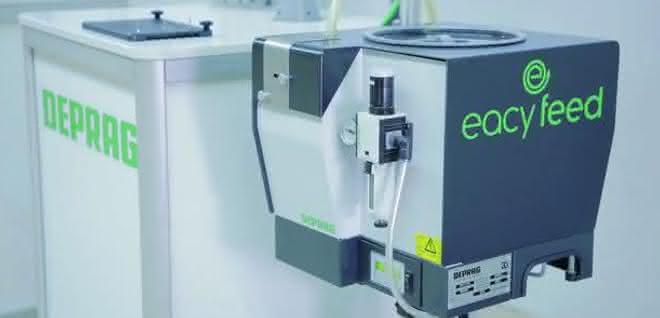
Deprag offers a solution for the efficiency aspect with the Eacy Feed vibratory bowl feeder: the control and drive of this feeder are based on a 24 V DC power supply. This is sufficient to set the feed bowl in its periodic oscillating motion by means of oscillating magnets, thereby achieving energy savings of around 80 percent. With a wide-range power supply unit, the device can be used anywhere in the world without conversion. The PFC100 control unit also enables individual settings to be made without time-consuming mechanical intervention. If assembly is to be automated to the highest possible degree, but the quantity does not justify fully automatic feeding, screw feeders are an inexpensive and quick-to-implement solution; they can be converted to the required screw size in just a few steps, feed gently, are hand-held and stationary and can be operated independently thanks to the integrated controller.
The global market is dynamic and demands flexible manufacturing solutions with short response times, as is the case in hybrid assembly systems, for example, where manual and automated processes are linked. Here, man and machine need to be coupled, as they do not constantly work at the same speed. The solution to this is buffer zones, such as linear conveyors. They can be used to bridge larger distances and control the flow of parts. Depending on requirements, the conveyors provide parts buffers or functionally separate the flow of parts. Modular system concepts with standardized components are another measure for flexibility. Deprag offers sensor-controlled screwdrivers, feed systems and control systems from a single source. pb


You might also be interested in
Nomination Products of the Year 2024
Schrempp: Intelligent function handles with IO-Link interface
Nominated in the handling, assembly and production logistics category in the competition for the products of the year 2024 are the function handles with integrated signal surface and/or configurable keypad and feedback LEDs with IO-Link interface...
 read more...
Norelem supports VDI Racing Camp
Mastering the challenges of e-mobility
Promoting young talent has been a priority at Norelem for many years: the company supports young talents with components and the necessary know-how and provides schools with illustrative material.
read more...Three-point internal rapid action switch
High-precision internal measurements on drill holes
Feinmess Suhl has expanded its product range with the new 8480 three-point internal rapid probe. The probe has been specially developed for high-precision internal measurement of through and blind bores.
read more...Standardized machine elements
Flexibility is required in mechanical engineering for the rubber industry. Rubicon Gummitechnik und Maschinenbau uses standard and operating parts from Norelem for this purpose.
read more...Carry out cutting work with precision
Schukat now stocks all cutting pliers from the Electronic Super Knips series from the German manufacturer Knipex.
read more...Secure locking
Heinrich Kipp has added a series of snap locks to its range that are designed for flush installation in doors, flaps or drawers.
read more...Cobot for final aircraft assembly
The collaborative colleague works on the airplane fuselage
Together with Fraunhofer IGP and aircraft manufacturer Airbus, Tox Pressotechnik investigated the question of how final aircraft assembly can be made more productive and ergonomic.
read more...Industrial vacuum cleaner with a long service life
A powerful vacuum cleaner for coarse, fine, flammable and moist materials is in demand across all industries. Easy handling and a long service life are the most important criteria for regular use.
read more...Enough space for a cool head
What to do when an ergonomic lifting aid is required but the room height is too low for conventional crane systems? Schmalz has a modular flat jib made of aluminum in its product range that is used by Erkodent, a manufacturer of dental thermoforming...
read more...