

Ring rotary indexing tables
Automate assembly without lead times
A new series of indexing tables from Nexen offers greater flexibility through its customized drive end, which supports the assembly of numerous motors and gearboxes with output shafts, and can be delivered in just three to four weeks.
Over the last decade, studies have shown that permanently installed automation systems have increased significantly compared to manual assembly processes in production facilities. This upswing may be pleasing for system integrators, but there is a catch: lead times for indexing tables, linear drives, robot systems and other components have increased. "The lead time for some product groups doubled last year," says the purchasing manager of a system integrator. "This is extremely problematic for us. We work without stock, and punctual supply chain delivery is essential."
New indexing table ready for dispatch in just a few weeks
The new CRD-MR series from Nexen builds on the CRD series of precision ring-and-pinion indexing tables. In addition to new advantages, it continues to offer all the benefits of the roller-pinion drive: zero backlash, precision and torque capabilities as well as acceleration, smooth running and hardly any maintenance requirements.
One of the new features is flexibility: until now, CRD rotary indexing tables were available in three versions, depending on the application, for high speeds or for high torques or for both: the CRD PL has a precise, low-backlash planetary gear for high torques and speeds and a flexible gear ratio; the CRD HG has a backlash-free harmonic gear for high torques and low speeds and a high gear ratio; the CRD DD has a backlash-free direct drive motor for high speeds and medium torques.
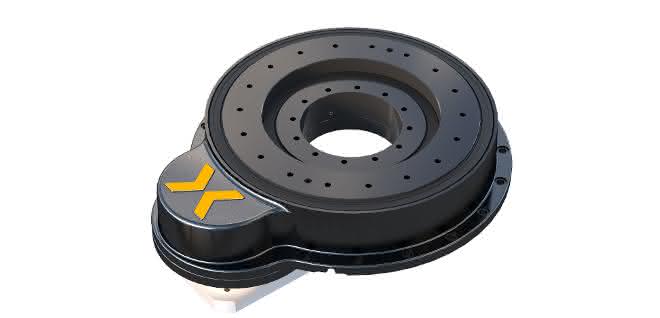
The CRD-MR series offers a fourth option: a separate motor or gearbox for the drive. On the one hand, this reduces costs. On the other hand, the ring indexing table can be delivered in just three to four weeks, half the time required for a conventional cam-driven version. "The customized drive side of the CRD-MR solution supports the assembly of a variety of motors and transmissions with output shafts," says Broc Grell, application engineer at Nexen.
Due to the high transmission ratio between the roller pinion and the gear rim, the system can be driven directly via a servo motor or with a stepper motor. This eliminates the cost of a reduction gearbox. For high-load applications, a gearbox and a motor can be used to drive the system. In addition, the loads resulting from the roller pinion gear drive are fully absorbed, which means that the motor or gearbox shaft is not subjected to any radial forces. This eliminates the need for a powerful and cost-intensive design of the reduction gearbox in high-load applications. The result is shorter design and assembly times.
The new models have a large central opening so that cable feed-throughs, robot systems, inspection cameras and other devices can be provided in the middle of the turntable. This reduces the installation space and results in an efficient, clear machine design. Alternatively, the center opening can also remain free. "One current project involves several work stations arranged on the outside. Once the workpiece is finished, it is fed into the center," says Isaac Klaehn, Nexen's design manager for motion control products. "A conveyor belt underneath takes care of the transport to a packaging line."
Three models, three sizes
With bolt circle diameters of 150, 250 and 350 millimetres, three sizes are available for the CRD-MR series, the latter two as replacement units for the original CRD 250 and CRD 350 models. With the precision ring drives, the product portfolio in the indexing table range now covers diameters from 500 to 1,500 millimetres.
The series consists of three models: The CRD MRS is fully sealed and comes with IP65 protection. The CRD MRG is protected but not sealed. Despite reduced internal protection, it offers less overall resistance than a fully sealed system and greater efficiency; the motor also has to apply less torque. The CRD MRO is for applications that do not require sealed or protected units. "Thanks to the new product series, you only have to buy what you actually need," says Klaehn.
Depending on the size, the maximum speed for all three models is between 161 and 304 revolutions per minute. High switching precision is achieved with a unidirectional positioning accuracy of 59 to 31 arcsec (angular seconds) and a unidirectional repeat accuracy of 9.8 to 5.2 arcsec. In contrast to other drive systems, there is no play between the motor and the driven load.
Applications
The CRD MR systems are usually mounted horizontally to support an applied load. They are suitable for precise rotary indexing applications such as machine tools, semiconductor production, robotic systems, automatic welding, pharmaceutical packaging, assembly and cutting systems. The rotary indexing tables are even used in non-industrial applications, such as stage technology. A pharmaceutical company uses a CRD MR 150 rotary indexing table to quickly and easily position vials under a dosing device, and a machine shop uses a CRD MR model to precisely position parts for external processing.
Unlike indexing tables from other manufacturers, Nexen's ring drive products can be mounted in an inverted position or vertically to accommodate a suspended load, including the CRD MR series, which is used as a pivot pin for positioning parts in a robotized welding system, for example. The center opening also comes into play here. The welding gun passes through it to create a weld seam inside the rotating assembly device.
Advantage of a ring drive
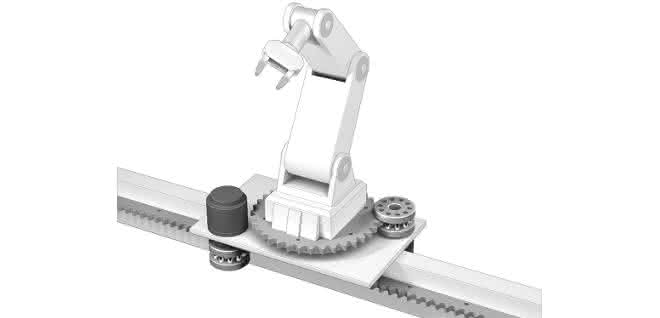
The key factor is the roller-pinion system RPS, which was originally designed for linear motion systems. The RPS converts rotary motion into linear motion. It further develops the previous rack-and-pinion concept and replaces the spur gear toothing with rollers mounted on bearings that mesh with the rack in a unique tooth profile. Instead of the sliding friction of conventional pinion-gear systems, the rollers ensure smooth rolling friction and convert rotary motion into linear motion with 99% efficiency. as


You might also be interested in
Helu makes its first trade fair appearance under a new brand name
Helu Kabel will be presenting itself as Helu for the first time at Hannover Messe 2026, showcasing system solutions, Heluchain cables and new industrial luminaires.
 read more...
Strategic realignment with brand relaunch
In future, Helukabel will trade as Helu
The Helukabel Group is parting with part of its name: in future, the company will only operate under the Helu brand. With this step, the specialist for electrical connection technology is underlining its strategic development from a classic cable...
read more...Modular plant construction for corrugated board
Insight into the production of corrugators at BHS Corrugated: Automated, modular and equipped with Helukabel components.
read more...Best quality for the steel
Conditions in the steel industry are harsh and inhospitable. The machines used must be able to withstand the demanding environmental conditions in order to deliver the best quality at all times.
read more...If the standard cable is not sufficient
Lapp offers cables for countless applications - but not for all of them. From time to time, the developers have to modify a standard cable or develop a special cable.
read more...Slight decline in sales, strong investments
The Lapp Group has not been spared from the weakening global economy. However, the company only recorded a slight loss in the past 2024 financial year.
read more...Electrical connection technology
Cables and wires for industrial automation
Heukabel offers system solutions for cable routing from a single source. The subsidiary EKD Systems specializes in tailor-made cable drag chains made of steel, stainless steel and plastic, which are used in moving machines and systems as well as in...
read more...Lapp relies on Ultramid from BASF
Mobile charging of electric vehicles
The automotive industry is currently undergoing the biggest transformation in its history. The boom in battery electric vehicles in particular is presenting the industry with major challenges. Lapp, as a supplier of cables and connection...
read more...Cable handling application
At this year's Motek, ArtiMinds Robotics is showcasing a robot-based automation solution for the sensor-assisted assembly of flexible cables in connector housings.
read more...