

Assembly workstations
Partial automation with robots
At Automatica, Promess will be showcasing its modular individual workstations and how these can be partially automated with robot support. The servo press manufacturer will also be providing information about the latest features of its Revolution X press control system.
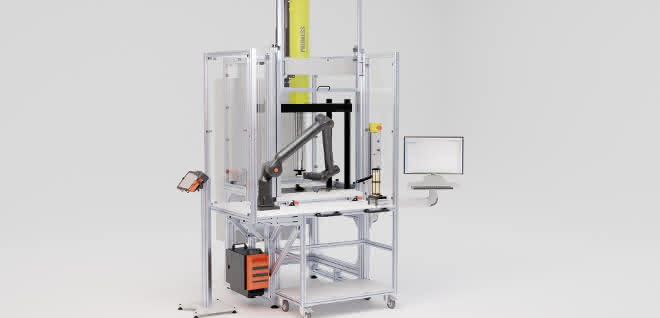
Assembly workstations with NC joining systems are suitable for the production of small and medium-sized series, sample and prototype construction or material testing. They can be used for quality-controlled assembly of industrial products or process-related testing with maximum precision and repeat accuracy. The modular system of individual workstations from Promess ensures maximum flexibility. At Automatica, trade fair visitors will learn how easy it is to expand the individual workstation with robot support for partial automation at a low investment cost. Simple retooling enables the integration of a robot that takes over pick-and-place tasks, for example. This gives the user the option of processing smaller series manually and using a robot for larger series at short notice. A mobile enclosure ensures the necessary safety in semi-automated operation.
Modular system
The modular system also offers further configuration options for the individual use of the assembly workstations. The centerpiece is the UFM universal joining module, which is tailored to the customer's requirements in terms of size and specification. It is available in the force range from three to 1,000 kilonewtons. The configuration of the other components, such as the control cabinet or frame, is based on the selection of the joining module. The selection of the desired safety device completes the workstation. With the individual workstation with NC joining system, the position, speed and acceleration of the press ram can be freely programmed. Maximum positioning and repeat accuracy is guaranteed over the entire press stroke. The integrated force-displacement monitoring enables seamless monitoring of the joining process and the traceability of every joined part. The process data can be saved and evaluated so that each process sequence can be individually monitored and adapted. Expansion options such as the integration of external sensors, a barcode scanner or additional inputs and outputs are available for further customization of the workstation.
Revolution X joining system
In addition to the modular individual workstations, Promess will be presenting its Revolution X NC joining system to visitors at several stations. Visitors to the trade fair can experience how several axes can be coupled and moved synchronously. In this way, components can be pressed and monitored in parallel instead of one after the other. Simultaneous pressing of components into an assembly from different sides is also possible, for example in the production of battery stacks. A total of up to four axes can be moved synchronously with one controller and the press-fitting processes can be monitored and evaluated.
At another station, Promess will demonstrate the possibility of monitoring several sensors individually. With the RX joining system, it is possible to read out up to twelve sensor signals and four probes simultaneously. This is implemented, for example, when pressing electromagnets into a rotor housing in parallel. Here, ten sensors are controlled simultaneously with just one RX controller. The individual force-displacement curves are visualized via the web-based RX software, monitored and evaluated using window or envelope curve technology. They are also written to a database and can be analyzed. Joining programs and sequences are also created intuitively using the RX software.
The Revolution X system is a joining system that is intuitive to use and easy to integrate into the customer's environment. It is suitable for both simple and complex assembly and joining processes; its multi-axis and multi-sensor capability are just two examples of its capabilities.
Hall A6, Stand 328


You might also be interested in
Further simplify assembly processes
In addition to the proven racks with a length of one meter, Wittenstein alpha now offers optional two-meter racks for linear systems. They are particularly suitable for use in short axes, for example, in order to simplify assembly even further.
 read more...
Hiwin manufactures its own shaft gearboxes
Have you ever waited several months for an urgently needed corrugated gearbox? Hiwin has too. That's why the Offenburg-based drive specialist has decided to produce its own space and weight-saving reduction talent.
read more...Human-robot interaction at the trade fair
Sumitomo Drive Technologies is presenting its drive solutions for automation and robotics at Automatica 2023 together with the Lafert Group. The company will be showcasing two different applications of the Tuaka drive system for robot applications...
read more...A new benchmark for collaborative robots
At this year's Automatica, Denso Robotics will be showcasing its innovations in the field of robotics. The collaborative Cobotta Pro product family will be the focus of the presentations. Visitors to the trade fair can see all variants in various...
read more...Clamping system for a new milling machine
Investments in machinery often lead to further purchases - as is the case at Joma-Maschinenbau, whose modern production facility has recently been supplemented by a 5-axis milling machine.
read more...Schunk wants to simplify processes in automated production
The declared aim of automation specialist Schunk is to make its customers' processes comprehensible, simple and efficient. Data transparency plays an important role in this. It enables reliable processes and provides the basis for resource-saving...
read more...Festo and Hahn Automation develop battery tester for greater safety
The success and reputation of electric vehicle manufacturers depend on the safe and flawless functioning of batteries. Hahn Automation has therefore developed a battery tester that performs a fully automated 100% test of mobile energy storage...
read more...SPN Schwaben Präzision presents gearbox solutions for automation and industrial robotics
Short cycle times, robust technology, wear-free surfaces and compact designs have always been relevant for automation and robotics solutions. This year's Automatica trend topics include "Sustainable production" and "Digitalization and AI". SPN aims...
read more...Measure energy consumption, avoid wear and tear
Analyze the energy consumption per cycle directly in the drive - without external sensors. Baumüller demonstrates this with Smart Energy Monitoring. In times of rising energy costs, solutions are needed to determine energy requirements and then...
read more...