

Longitudinal transfer system
Assembly in the river
It is always a fundamental decision that the special machine manufacturer Fischer Innomation has to make for its projects: Round transfer or longitudinal transfer system? The company designs both types of assembly system - depending on which is more suitable and fits into existing structures. With a longitudinal transfer system, Fischer was able to serve a customer who wanted to meet high demands in terms of material flow and accessibility for complex assembly tasks.
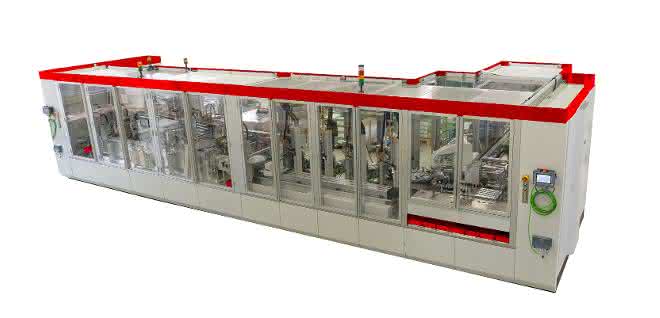
The project involved the continuous assembly of eleven individual parts in the shortest possible time. In addition, a downstream inspection station was to inspect the product 100 percent and sort it according to possible defects. The assembled parts were then to be processed in different product groups. "We started with a comprehensive analysis of the existing processes and tried to find the optimal way," explains Andreas Gebele, sales representative at Fischer Innomation. The team drew on the Fischer process system for advice. The company introduced the principle of continuous improvement back in the 1990s. The aim is to avoid waste and increase added value. "We develop efficient, lean processes together with the customer and thus have a good basis for designing our systems," reveals Gebele. Targeted and detailed analysis makes it possible to avoid bad investments and meet customer expectations.
Longitudinal transfer systems versus rotary transfer systems
The high level of vertical integration and the requirements in terms of space, material flow and accessibility spoke in favor of a longitudinal transfer system. Based on the experience of previous years, Fischer developed its own system with a robust design and high flexibility. It can be individually configured and used according to requirements.
The reasons in favor of a longitudinal transfer system were obvious: the assembly systems are space-saving and modular, can be set up and rearranged according to process requirements and can be expanded as required. Material and process are clearly separated - independent optimization measures can be carried out in each segment. In addition, individual production steps can be flexibly lined up within a longitudinal transfer system and offer optimum use of space. These assembly systems also have advantages in terms of maintenance: Maintenance measures are easy to carry out because system operators can intervene at any point in the assembly process; all process sections are easily accessible. Due to the long life cycle of the product and the high quantities to be produced, the project team opted for a highly automated system solution.
A part is ready in eight seconds
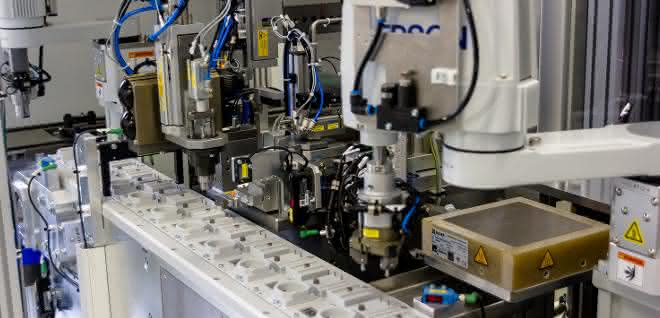
Fischer started with the planning and design and built the system on its own premises. Due to the long life cycle, a highly automated system solution that can be operated by one person was the obvious choice. The initial commissioning was promising: "The system produces continuously without any problems," says Andreas Gebele. The machine assembles eleven individual parts in eight seconds and produces around two million parts per year. Five Scara robots from Epson are installed in the assembly system, which join and lock the individual parts. Grease is automatically dispensed and applied. O-ring assembly is automated, as is screwing. The autonomy of the system is 4.5 hours.
Industry 4.0 put into practice
Complete process monitoring of the individual assembly steps takes place in the system. These are monitored using a wide variety of sensors and three integrated image processing systems. The results are saved and transferred to a host computer system via an interface. Additional add-ins, such as wear counters, monitor the function of the system. A remote maintenance system is integrated in the event of a fault.
Extensive quality checks characterize this system: Four test stations are integrated. The finished products are subjected to a leak test, checked for movement - by determining forces and torques - and measured values and pressure curves are checked. The results of the quality test are passed on to a higher-level master computer and evaluated. Finally, flawless products are marked using a laser system. pb


You might also be interested in
Predictive maintenance in retrofit
Predictive maintenance pays off. This is because early detection of impending failures means that systems can be serviced in a targeted manner before production downtime occurs. But how complex is it to integrate such a maintenance concept into an...
 read more...
Maintenance instead of replacement
The circular economy starts with the machinery
Sustainability in industry starts with machines, says our guest author from Deguma: How maintenance, modernization and the 5R strategy save resources, energy and CO₂.
read more...3D printing for unplanned requirements
The material fails and the machine suddenly stops? Then you need to take the right measures to be able to resume production quickly. Material failure in the form of faulty components or material wear in the frame are a risk for any production.
read more...High demands in terms of safety, application and robustness
Demanding work in the electrical trade and energy supply as well as smooth processes in production require innovative and customized measurement technology that scores points for safety, ease of use and resilience.
read more...Car meets e-bike: riding with lubrication-free polymer bearings
Studies show that the proportion of pedestrian and bicycle traffic is increasing in urban areas. With the JetBike, JetBike GmbH from Braunschweig presents a mixture of e-bike and car and relies on lubrication-free polymer bearings from Igus.
read more...Hydraulic hub for more efficient servicing
Bosch Rexroth presents a digital toolbox for service and maintenance. With a comprehensive range of digital services, the Hydraulic Hub simplifies and accelerates the service and maintenance of hydraulic products and increases machine availability.
read more...Arnold Umformtechnik expands after-sales...
Faster help with VR glasses
Arnold Umformtechnik is expanding the after-sales service for its machines to include digital remote services. The focus is on data security, simple operation and clear processes.
read more...147,000 euros per hour: high costs for German companies due to unplanned downtime
According to the "Value of Reliability" study, 67% of industrial companies in Germany experience unplanned downtime at least once a month. This costs the German economy 147,000 euros per hour. Nevertheless, reactive maintenance concepts are not...
read more...Maintenance starts with a maintenance planner
Legal requirements stipulate that machines and systems must be serviced regularly. The maintenance work serves to ensure occupational safety and economic efficiency.
read more...