
Automated object recognition
AI supports skilled workers during assembly
The start-up Kimoknow, which was founded at the Karlsruhe Institute of Technology (KIT), has developed a technology to automatically train AI systems to recognize objects. The first use case: a digital assembly assistant for contactless collaboration between people and machines.
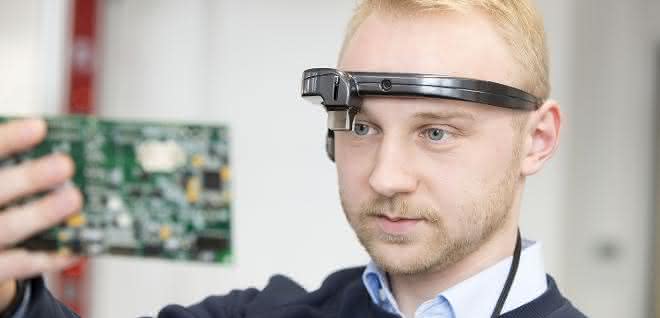
Artificial intelligence makes it possible for machines to recognize objects. This requires large amounts of high-quality image data with which the algorithms are manually trained. "Training AI systems to recognize objects is still time-consuming, inflexible, expensive, highly dependent on the environment and requires a lot of computing power," explains Kimoknow co-founder Lukas Kriete. The KIT start-up therefore uses image data that is already generated for all objects in computer-aided development processes (CAD) and production data management (PDM). Among other things, they provide information about the material, geometry and position of the respective object. The CAD and PDM data is extracted and used for the automated training of the AI.
The object recognition system trained in this way can be used in a variety of ways, including in augmented reality (AR) glasses. They detect relevant objects in the user's field of vision in real time and also have the necessary contextual information about the object in question.
Use case for AR glasses
Kimoknow has developed an assistance system as the first use case for AR glasses of this kind, which is designed to support skilled workers in the assembly of complex devices. The virtual assistant guides users through the entire assembly process, visualizes the assembly instructions step by step without an additional display and thus shows in which order which part is processed with which tools and assembly materials. It repeats individual steps if errors occur and documents the process. The fitter has both hands free and communicates with the system via eye contact, hand signals or voice commands. "The assembly assistant makes the process more efficient, more productive, faster and more cost-effective while improving quality," says Kriete.
The assistant is suitable for all industries in which highly complex products are manufactured in small quantities. The prototype is used for the final assembly of highly specialized measuring devices and is currently being tested in cooperation with Elabo at the Center for Artificial Intelligence Talents (CAIT) at the Institute for Information Management in Engineering (IMI) at KIT.
Kimoknow is a spin-off of IMI and was launched on May 13, 2020 as an entrepreneurial company (limited liability). In addition to Lukas Kriete, the founding team includes Roman Wiegand, Aaron Boll, Michael Grethler and Vesa Klumpp. as


You might also be interested in
The AKIMI Research Project at WZL
Agent-Based AI Aims to Simplify Robotics for Small and Medium-Sized Businesses
The AKIMI research project is developing an agent-based AI designed to significantly simplify the setup, programming, and reconfiguration of robotic systems for small and medium-sized enterprises. The goal is to make robotics more flexible and...
 read more...
BS Rollen Strengthens Its Presence in North Rhine-Westphalia
With the groundbreaking ceremony, BS Rollen is launching the construction of a new company facility in Hückeswagen. The new building will house administrative offices, an assembly line, and a high-bay warehouse, and is intended to facilitate further...
read more...Intelligent brownfield networking
Many industrial companies are struggling with established plant structures and proprietary interfaces. Stefan Klaus' presentation will show in a practical way how brownfield environments can be efficiently networked with open technologies and made...
read more...Factory-X in practice
How can set-up processes in highly variant production be automated efficiently? Markus Benndorff from soffico shows how Factory-X, industrial data rooms and modular architectures create new possibilities for flexible production concepts.
read more...Mechanical engineering | Case study
Cordless in brush production
The machine manufacturer Wöhler Bohemia is integrating wireless HMI panels from Keba into its brush production systems. The background to this is the need for flexibility, robotics integration and new market strategies.
read more...International product approvals as a strategic competitive advantage in the global market
Which certificates are valid worldwide? Christian Latte, Head of Technical Compliance and Approval Officer at Hummel AG, explains this in an interview. He provides insights into product approvals and explains why early approval strategies shorten...
read more...Foundry modernizes plant park with continuous wire belt shot blasting system
The Spanish foundry Funosa is modernizing its equipment fleet with an RDGE 1250 wire belt continuous shot blasting machine from Rösler. Focus: sand removal from heavy iron castings, energy efficiency, ease of maintenance and ESG strategy.
read more...How bridging steps, stairs and catwalks are changing processes in production and logistics
At Logimat 2026, Munk Günzburger Steigtechnik will be showcasing modular bridging steps, stairs, platform and walkway systems for production, warehousing and logistics. With online configurators, distances can be efficiently shortened, processes...
read more...Drilling cycles optimized
A new replaceable head drill from Walter can reduce machining time in series production thanks to its patented interface and screwless design.
read more...