

Digital workflow
Ready for series production thanks to open standards
"Out of the niche, into series production" is the motto of additive manufacturing. However, in some places there is still a lack of connection between the technology and the world of automation for this development step. Open standards are needed here.
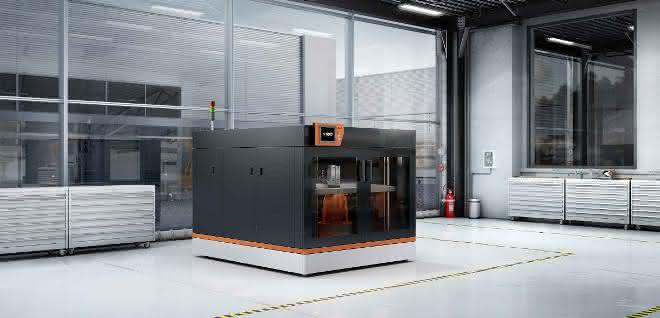
Additive manufacturing is no longer just used in prototype or small series production. However, for the next development step, making the technology usable for series production, there is still a lack of connection to the world of automation in some places. Big Rep and Bosch Rexroth have now joined forces to drive forward the potential of additive manufacturing.
For Dr. Stephan Beyer, CEO of Big Rep, a manufacturer of large-format, series-produced 3D printers (FFF segment), the collaboration with Bosch Rexroth explains: "Our industrial customers in all markets expect reliable, controllable and efficient 3D printers for the production of high-quality workpieces from industrial-grade materials. Open CNC solutions from Rexroth, which we have integrated into our new Big Rep Pro 3D printer, open up a whole new dimension for additive manufacturing." The advantage of the controllers is that they are already being used in highly automated machine tools. What's more, the industrial controllers already include the corresponding functions, from handling to robotics and quality control. Compared to other manufacturing processes, the proportion of manual work in 3D printing is still very high. "In the medium term, additive manufacturing will not be able to avoid adapting to the standards of established production processes," emphasizes Thomas Fechner, Head of New Business at Bosch Rexroth. Automation means that processes become reproducible and traceable. In order to establish the technology on a broad basis, it must also be easily accessible.
Establishing digital processes
In order for additive manufacturing to make the leap into series production, a holistic understanding of the entire process from data creation to quality assurance must be developed. According to Fechner, the goal is a fully digital workflow. "The data must be able to flow seamlessly from the customer order to the CAD software and simulation environments through to the actual machine movements and quality assurance," he emphasizes. In addition, machine manufacturers and end users must agree on uniform open standards such as OPC UA and OpenAPI. "Then we will have created the conditions for anchoring 3D printing as a key element for Industry 4.0 applications and exploiting the technology's potential," adds Beyer.
Beyer also brings up another point: For example, individual components or spare parts could in future be printed directly on site as required and would not have to be kept in stock. "3D printing is redefining supply chains. Manufacturing companies will benefit from lower investments, faster market entry and shorter time-to-market," says Beyer.
According to documents from Bosch Rexroth / ag


You might also be interested in
Fraunhofer IOSB Opens Humanoid Robots Lab
The Fraunhofer IOSB is opening a Humanoid Robots Experience Lab in Karlsruhe, Lemgo, and Ilmenau. Companies and organizations can use these facilities to test potential applications for humanoid robots and develop pilot projects.
 read more...
Artificial Intelligence in Manufacturing
Trumpf and IPAI Are Expanding a European AI Network for Industry
The high-tech company Trumpf is an official partner of the IPAI AI network in Heilbronn. Together, the partners aim to exchange experiences, develop new AI applications for industrial use, and advance the development of artificial intelligence in...
read more...Case Study: Networked Manufacturing Platform for Toolmaking
Using a networked manufacturing platform, Escha GmbH & Co. KG, a manufacturer of industrial fastening technology, has comprehensively modernized its toolmaking operations.
read more...Barcelona Declaration on Robotics and...
Robotics Associations Adopt Global Automation Strategy
The global robotics industry is stepping up its collaboration. The associations AER Automation, A3, IFR, and VDMA Robotics + Automation have formed a long-term alliance by signing the “Barcelona Declaration on Robotics and Automation 2026.” The...
read more...Jane Heffner is the new president of the International Federation of Robotics
Jane Heffner is the new president of the International Federation of Robotics. Adrien Brouillard has been appointed vice president of the global federation.
read more...Greater Transparency in the Robotics Market
RoboFinder Launches as an Independent Comparison Platform
Launch at Gitex Europe: 'RoboFinder' aims to bring more transparency to the professional service robotics market. In this interview, founder and CEO Brian Engels discusses market potential, challenges, and the goals of the new platform.
read more...Artificial Intelligence for the Physical Space
Alibaba Expands Qwen Model Family with a Robotics Suite for Physical AI
Alibaba is expanding its Qwen model family with a robotics suite for Physical AI. The three models—for manipulation, navigation, and simulation—are designed to assist autonomous robots with complex tasks in real-world environments.
read more...International Federation of Robotics
U.S. Robotics Industry Sees Double-Digit Growth
In the U.S., sales of industrial robots rose by 11% compared to the previous year: 38,000 units were newly installed in 2025. This significant recovery is driven by robust growth in the food industry and other non-manufacturing sectors. However, the...
read more...Development Collaboration for Humanoid Robotic Hands Launched
Schunk is entering into a new development partnership with Robert Bosch Robotics. Their shared goal is to develop an industrial-grade robotic hand that can be integrated into various humanoid robot systems.
read more...