
3D printing materials
Nylon prototypes and end applications
MakerBot, a subsidiary of Stratasys, has added nylon to its growing portfolio of materials. In total, there are now eight materials available for MakerBot's Method platform. The company continues to promote the spread of industrial additive manufacturing.
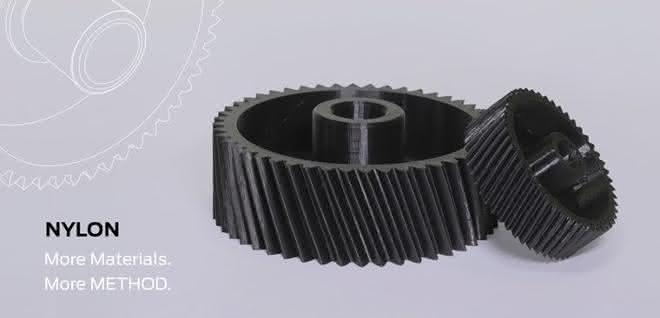
Nylon is extremely resistant to abrasion and is often used for the production of prototypes and end applications. Due to its high flexural, tensile and impact strength, the material has excellent mechanical properties and is ideally suited for applications that require repetitive motion or force application. These include the manufacture of tools and devices, articulated components, snap-fit connections, bending hinges, gear wheels and air intakes. These components often generate high levels of heat due to abrasion, so the material must be flexible in order to interact with other components. It also has good thermal properties and is heat-resistant up to 180 °C.
Nylon is sensitive to moisture and can easily absorb water from the air. This tendency of the fibers can lead to warped and deformed components even in a slightly damp environment. The Method's sealed material chambers protect the material from damaging moisture. With a new element for drying bobbins, customers can also dry nylon bobbins that have absorbed moisture in the Method X's heated build chamber.
A series of built-in sensors also ensures that materials are stored in the optimum environment. In addition, complex geometries can be printed with the water-soluble PVA support material from MakerBot. The nylon material is expected to be available from early 2020 and will be available in black.
Formnext, Hall 1.1, Stand F99


You might also be interested in
Intelligent sensor technology for the packaging industry
At Interpack 2026, Sick will be showcasing its portfolio of sensor, automation and AI-supported solutions for secure and digitally networked packaging processes in the consumer goods, healthcare and pharmaceutical industries.
 read more...
Sales growth in a turbulent market environment
Thanks to innovations and a focus on strategic industrial markets, Sick was able to moderately increase its sales in the 2025 financial year. In a turbulent market environment, the company was able to maintain its position and gain market share with...
read more...Photonic microchips with 3D connector
How a 3D system makes photonic chips industrially viable
A research team from Heidelberg is developing a 3D-printed "connector" for photonic microchips. The solution promises a low-loss, standardized coupling of glass fibre and chip - and could fundamentally simplify the production of photonic integrated...
read more...Advanced material retrieval system
Steute shows nexy wireless network with extended connectivity
Steute's Leantec division is presenting an enhanced version of the nexy wireless network with improved connectivity and additional cybersecurity functions. The background to the further development is the increasing use of automated guided vehicles...
read more...Detecting air bubbles in liquids
EBE is launching a capacitive bubble sensor on the market that reliably detects air bubbles and liquid breakages, regardless of the liquid and the condition of the hose.
read more...Miniature acceleration sensors
Structural tests on printed circuit boards
The Z22198 family consists of very small triaxial accelerometers from Kistler that measure vibrations in three orthogonal axes.
read more...Positive development in sensor and measurement technology
In the first quarter of 2025, the sensor and measurement technology industry recorded sales growth of three percent compared to the previous quarter - according to the results of the quarterly member survey conducted by the AMA Association for...
read more...Sick extends contract with CEO
The Supervisory Board of Sick has extended the contract of CEO Dr. Mats Gökstorp by 5 years. The company also announced that Feng Jiao has resigned from his position as Chief Sales Officer at his own request. Markus Scaglioso has been appointed to...
read more...Kistler and Keller Pressure deepen partnership in China
The Kistler Group is intensifying its cooperation with Keller Pressure. By signing the agreement, the two companies are reaffirming their commitment to strengthening synergies and developing the Chinese market in a targeted manner.
read more...