

FDM technology
Fast throughput times for customer-specific components
Continental is converting production for the automotive industry with additive FDM technology from Stratasys and highly specialized materials.

Continental offers a broad portfolio of solutions, including the production of automotive parts, connectivity, automated driving and mobility services through its Continental Engineering Services (CES) division. Cost-effectiveness and speed are key to its production success, and this has led the company to the use of additive manufacturing.
The company has its own Additive Design and Manufacturing (ADaM) Competence Center. Both internal and external customers receive a wide range of additively manufactured samples, mechanical components and solutions for series production with metal or plastic assemblies. The ADaM Competence Center is home to an industrial-grade, FDM-based Stratasys Fortus 450mc 3D printer. This produces final components, prototypes and, above all, tools and devices for the company's own production machines.
Individual components made from modern materials
Crucial to the company's production capacities are various specialized additive manufacturing materials with which the team can produce individual solutions for the production line - for example Ultem 9085 Resin and the ESD-compliant ABS-ESD7 from Stratasys.
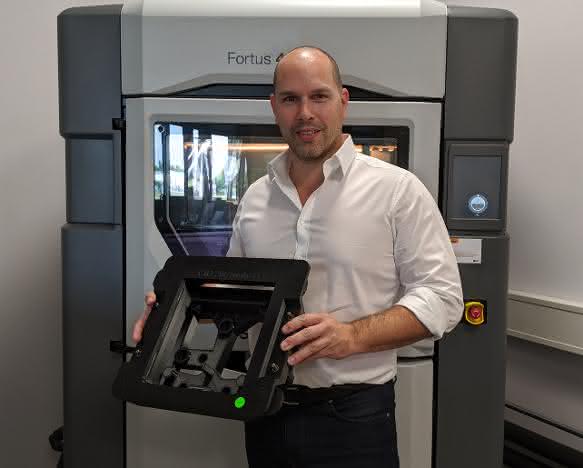
"In our Competence Center, we carefully select high-performance additive manufacturing technologies so that we have as many application options as possible," explains Stefan Kammann, Head of Samples and Mechanical Solutions, Continental Engineering Services. "The Fortus 450mc is a great addition to our portfolio because it gives us access to highly specialized materials that allow us to meet the needs of demanding production applications in our plant. It is our only 3D printer that can produce ESD-compliant production parts in the shortest possible time."
When manufacturing automotive parts and solutions for customers, Continental Engineering Services works with a large number of electronic parts and components in production. Antistatic properties are therefore of paramount importance for all machine parts that come into contact with electronic components. It prevents static discharges that can damage products, impair their performance or even lead to an explosion or fire. For the many tools and fixtures manufactured in-house at Continental, the ABS-ESD7 material meets the necessary standards for electrostatic discharge when handling sensitive electronic components, while offering durability and stability.
One of these applications is car displays. "We can produce the bonding device for the car display using 3D printing from the ABS-ESD7 material from Stratasys. This gives us a fast, safe and ESD-compliant in-house solution that can be customized," says Kammann. "This not only ensures continuous fast production, but also shows how we look for the best technology to solve the manufacturing problems we face."
For Continental, the production speed of the Fortus 450mc is a valuable asset in speeding up the process and ensuring continuous automotive production. Tools and components can be produced on demand in a matter of hours - the team can set print jobs to run overnight and have the finished parts available the next morning. This allows Continental to produce more flexibly, especially for spare parts.
"With the Fortus 450mc, we are able to quickly manufacture replacement production tools and components from high performance thermoplastics that deliver the same performance we would expect from a traditionally manufactured equivalent," says Kammann. "Importantly, this avoids the lengthy production times associated with traditionally manufactured tools and bypasses costly machine downtime associated with waiting for spare parts. Instead, we can ensure continuous production and have little or no machine downtime."
Yann Rageul, Head of Manufacturing Business Unit, EMEA and Asia at Stratasys comments: "The current global economic situation continues to be problematic. Additive manufacturing plays a key role in the much-needed efficiency of companies' product development process. More and more materials are now available. This allows manufacturers to meet the high demands of challenging traditional production applications and add further customization benefits to the process. It's great to see companies like Continental using additive manufacturing in their operations to overcome production issues while ensuring that service quality is maintained for customers. From a strategic perspective, this is essential for our customers and most companies right now."


You might also be interested in
ESD protection in electronics production
Work voltage-free
Electrostatic discharge (ESD) is an everyday phenomenon and usually harmless to humans. However, sensitive electronic components can be damaged or even destroyed as a result.
 read more...
Protection against electrostatic discharge
StoFloor ESD KU 614 from StoCretec: dissipative flooring with the latest technology meets all ESD standards, is economical, extremely durable, mechanically and chemically resistant. The surface can be adjusted to be slip-resistant. The system is...
read more...A new benchmark for collaborative robots
At this year's Automatica, Denso Robotics will be showcasing its innovations in the field of robotics. The collaborative Cobotta Pro product family will be the focus of the presentations. Visitors to the trade fair can see all variants in various...
read more...Four decades of robotics
Epson, manufacturer of Scara robots, will present the new Scara GX-B series at Automatica, the latest generation of high-performance Scara robots based on the existing GX series.
read more...Controlling machines more intelligently
At embedded world, Bopla Gehäuse Systeme will be presenting new HMI systems for customized machine control in the field of printed electronics. The focus is on complex interfaces via USB or RFID as well as an ultra-flat design and cost-effective...
read more...Process control with traceability through soldering tips with microchips
RS has added a new 300 W manual soldering platform to its range with the WXsmart from Weller. The station combines all soldering applications in a single device and comes with a new range of intelligent soldering tips. In this way, the WXsmart...
read more...Florian Becker is the new Managing Director at Krieg
Generation change at Krieg in Heimsheim: Andreas Krieg handed over the management of the company to Florian Becker on October 1, 2022. The company, which specializes in workplace systems and office furnishings, intends to focus even more strongly on...
read more...The fuel cell under control
The fuel cell is a serious solution for emission-free mobility. Having disappeared from the scene for a long time, it is now establishing itself as a viable option for zero-emission strategies.
read more...The modular system for pure production
Designing pure process environments quickly, modularly and safely - Item showed how this can be done at Cleanzone in Frankfurt. The company has added numerous components to its modular system.
read more...