
Additive manufacturing in toolmaking
Lighter and more efficient tools
Additive manufacturing, in particular the Laser Powder Bed Fusion (LPBF) process, opens up new avenues in toolmaking thanks to its great design freedom. The Fraunhofer Institute for Machine Tools and Forming Technology IWU is tapping into this potential in two research projects - "AdTopoTool" and "EWAM". The aim is to develop and manufacture more efficient tools for hot sheet metal forming and injection molding more quickly. This also benefits the quality of the components, which can be produced in less time with such tools.

AdTopoTool
Conventional manufacturing processes and experience-based designs are still used in many toolmaking companies today. This is usually accompanied by geometric restrictions and a very high tool weight. As a result, production times and component quality often suffer from inadequate temperature management.
In the AdTopoTool research project, the project partners Fraunhofer IWU, Werkzeugbau Winkelmühle GmbH and H+E Produktentwicklung GmbH were able to prove that additively manufactured tools with topology- and cooling channel-optimized geometries offer considerable added value - despite high demands on the thermomechanical load capacity and temperature management of the tool.
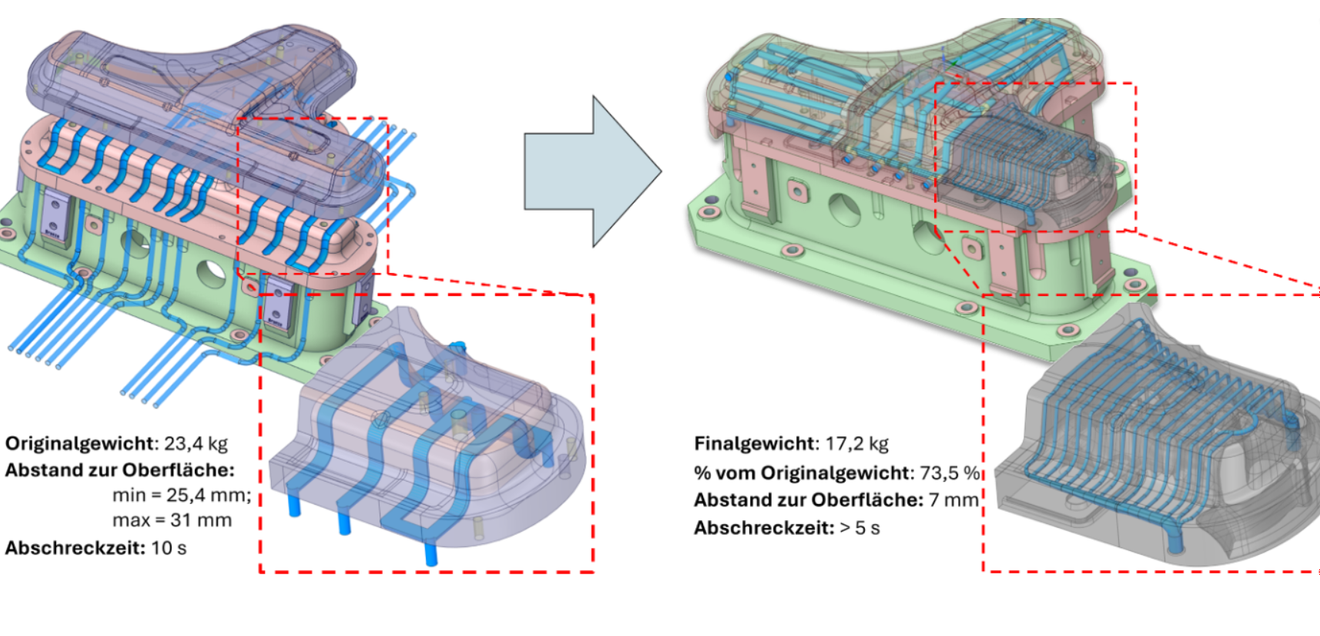
Topology optimization means designing the tool for minimum weight and maximum rigidity at the same time through intelligent material distribution or with the help of an improved geometric design of cooling channels.
Efficient material distribution in the tool reduces the weight by around 30 percent
Using the production processes of injection molding and press hardening as an example, a numerical method was developed to reliably predict the load and structural behavior of thermally highly stressed tools. This method was used to optimize the topology and design the cooling channels of one demonstrator tool each for injection moulding and press hardening. The researchers also validated the optimized and additively manufactured tool geometries on a laboratory scale.
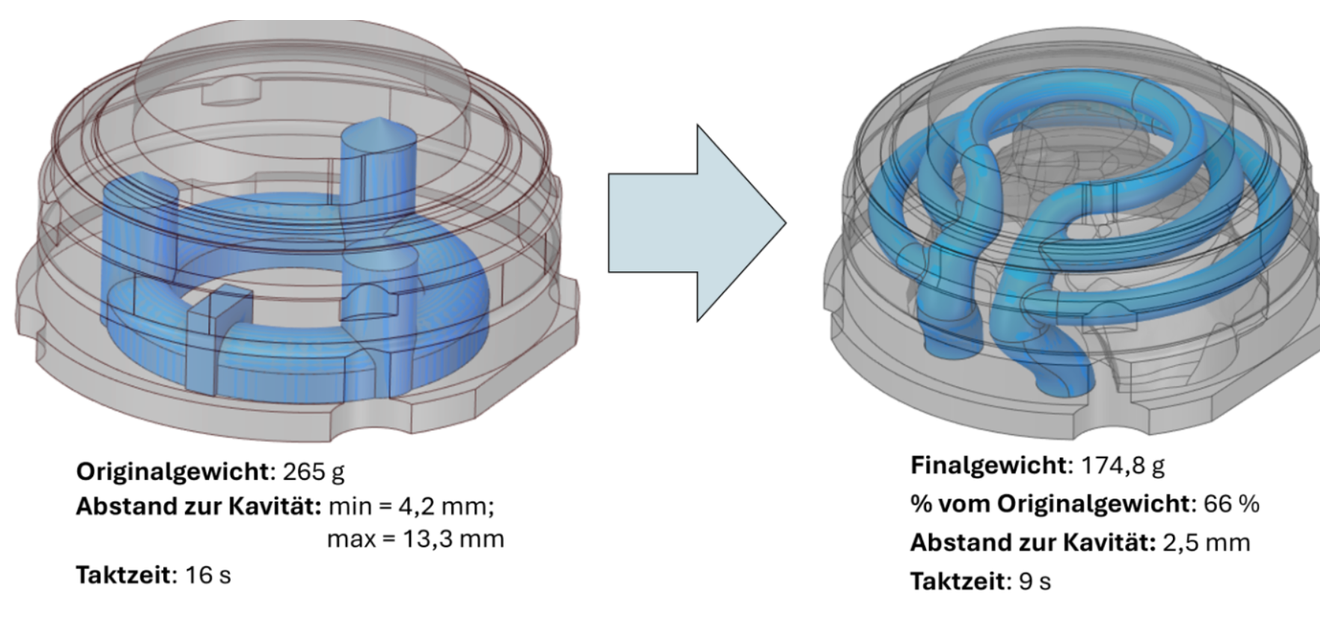
The result: a weight reduction of the injection mold by approx. 34 percent and of the press hardening tool segment by approx. 28 percent, without compromising the requirements for dimensional stability.
More efficient temperature control systems can reduce the cycle times of injection-molded components by 60 percent and the heat treatment of press-hardened components by almost half. In some cases, the quality and dimensional accuracy of the end products can even be improved.
EWAM (Efficient Toolmaking with Additive Manufacturing)
A lack of experience with additive manufacturing, a complex design of the temperature control systems and incomplete design guidelines have so far stood in the way of the widespread use of this technology.
To overcome such hurdles, Fraunhofer IWU is developing a script-based, automatic temperature control design in the current EWAM (Efficient Toolmaking with Additive Manufacturing) project. Less manual effort and a shorter development time for the tool should lead to a significant increase in efficiency.
Automatic temperature control channel design for additively manufactured tools
The aim is to develop a software plug-in for the automatic design of additive temperature control systems, taking into account the specifications of additive manufacturing and the results of thermal, fluidic and load analyses. The plug-in will be created in a universal programming language and will be compatible with various 3D CAD programs so that it can be distributed quickly after its market launch.
The use of the laser powder bed fusion process, an optimized tool geometry that takes actual process loads into account and intelligent tool cooling create real added value for medium-sized tool manufacturers. The Fraunhofer IWU is committed to setting new standards for quickly implementable, resource-efficient and high-quality tool solutions.
Source: Fraunhofer IWU


You might also be interested in
Large-format metal printing for industrial applications
Gefertec is presenting its latest developments in the field of Wire Arc Additive Manufacturing (WAAM) at this year's Formnext. The process pushes the boundaries of 3D printing of metallic components. With WAAM, large and complex components can be...
 read more...
Additive manufacturing for series production
As a full-liner in the additive manufacturing of metallic components, DMG Mori will be demonstrating how these processes can be further optimized at the upcoming Formnext from 18 to 21 November 2025 in Frankfurt.
read more...Research into additively manufactured steel
Why additively manufactured steel requires special attention
How does additively manufactured steel behave in combination with traditionally manufactured steel? How can they be optimally processed together? A doctoral student at Osnabrück University of Applied Sciences is researching this. She is...
read more...How SMEs can benefit from 3D printing
Additive manufacturing processes not only offer production opportunities for prototyping, but also economic and ecological potential for small and medium-sized enterprises. The new brief analysis by the VDI Center for Resource Efficiency (VDI ZRE)...
read more...Sustainability Through Simulation
Digital material selection reduces CO2 emissions by 40 percent
The use of digital material simulations can significantly reduce CO₂ emissions during the development and manufacturing of components. A real-world project by Schunk and Cadfem demonstrates how data-driven material selection can yield savings of up...
read more...New Resin Opens Up 3D Printing for the Optics Industry
With BMF Clear, Boston Micro Fabrication has introduced an optically transparent photopolymer resin for micro-precision 3D printing that achieves a light transmittance of over 90 percent at layer heights of 10 micrometers or more and is suitable for...
read more...Wire Arc Additive Manufacturing
WAAM: How Additive Metal Manufacturing Is Becoming Suitable for Industrial Use
With Wire Arc Additive Manufacturing (WAAM), the focus is no longer on technical feasibility. At the third WAAMathon in Berlin, experts discussed primarily certification, standardization, and integration into industrial production processes.
read more...UltiMaker Doubles Speed in Industrial 3D Printing
With the Factor 4 Plus, UltiMaker is introducing a new version of its industrial desktop 3D printing platform, which operates at up to twice the print speed of the standard model. The platform is designed for use in manufacturing and defense...
read more...Stratasys takes over MarkForged
Stratasys is acquiring MarkForged from Nano Dimension for USD 42.5 million, thereby expanding its portfolio in the field of fiber-reinforced composites. The acquisition also strengthens the company's software and materials expertise in industrial 3D...
read more...