
New vision sensor
Adaptable image processing
The flexible and configurable CS-60 vision sensor from di-soric is suitable for a wide range of handling, assembly and inspection tasks in all industrial sectors.
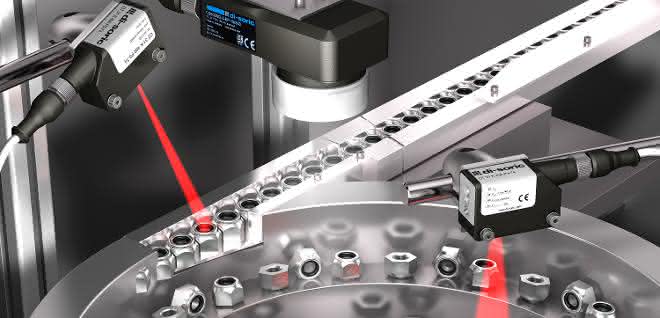
With interchangeable M12 lenses and integrated high-performance LED lighting, the CS-60 vision sensor offers high-quality image results. Software-loadable tools turn the basic version into a multifunctional vision system that is precisely tailored to your requirements. If fine details are important, sensor variants with 1456 x 1088 pixels are available.
Functional aspects and the efficient, space-saving interlinking of individual production and assembly units are the top priorities when designing new systems or converting existing ones. Only when it is clear where and to what extent process and quality control measures need to be taken do image processing systems come into focus. The transport, handling and assembly applications are usually set at this stage, and vision sensor technology has to come to terms with the given framework conditions.
Simple vision sensors with liquid lenses and autofocus sometimes reach their limits when it comes to demanding object detection tasks, for example in connection with high travel speeds, large distances to the object or the effects of ambient light. With the CS-60 vision sensor, the Urbach-based sensor and image processing specialist di-soric has developed a new type of sensor for demanding inspection tasks that is currently unique on the market in terms of its flexibility, intuitive operation and price-performance ratio. "With its four interchangeable lenses, the CS-60 vision sensor solves almost any inspection task and offers enormous flexibility in terms of distance, field of view and resolution.
If fine details need to be processed in an image processing task or even the smallest errors need to be detected, detailed images are essential. The BM3X type CS-60 vision sensors achieve a resolution of 1456 x 1088 pixels with the new sensor technology of the Sony IMX273 sensor. With a larger inspection area, this type of sensor achieves four times the resolution of the standard version.
Even the basic version of the device can localize, detect and count," emphasizes Patrik Drexel, Product Manager Lighting & Vision Sensors at di-soric. Additional functions, such as measuring or detecting and reading 1D/2D codes, are simply loaded onto the sensor as required. "This means you only stock one type of sensor, which is kept up to date via regular upgrades and supplemented with the required function as required. This means you only pay for what you actually need," adds Patrik Drexel.
Vision sensors are used in numerous systems and applications across all industries. For example, in the context of parts handling, quality and end-of-the-line testing. Typically, a vision sensor detects the type, size and position of a product and transmits this information to a computer unit that instructs a downstream pick-and-place application. This now knows how to grip the object and position it correctly in a packaging tray or workpiece holder. When used in an inspection and measuring station, the sensor determines whether a workpiece is present, complete and has the required properties. The "Measure" tool can be used to determine angles, diameters, distances and clearances. If the "Read code" tool is loaded, the sensor records the ID codes attached to components almost incidentally and forwards them to the central computer unit.
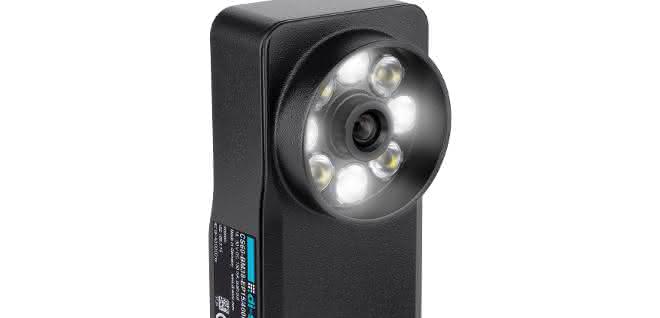
The new Vision Sensor CS-60 offers users a high degree of flexibility and productivity: with four interchangeable S-mount M12 standard lenses (with focal lengths of 3.6 mm, 8 mm, 16 mm and 25 mm as well as variable focus adjustment via the fixed pinhole apertures 4 and 8), a wide range of tasks with very different requirements in terms of distance, image detail, resolution and depth of field can be optimally solved. With the integrated, switchable flashed LED high-power illumination in white and red, the Vision Sensor CS-60 stands for excellent image results. Even at large distances from the object, extraneous light is not a nuisance. The installation of appropriate color and blocking filters in the lens cover additionally supports the Vision Sensor's independence from ambient light. This means that even demanding tasks, such as quality inspection of highly reflective objects or changing ambient light, can be performed reliably even at high speeds. The compact sensor (85 x 45 x 34 mm) can be integrated into almost all system concepts, even in confined installation situations. Protected by a robust IP67 housing, the CS-60 vision sensor works reliably even in extremely dirty production environments.
"The decisive factor in the development of the CS-60 vision sensor was the idea of bringing a compact, robust and versatile basic device with the basic functions of localization, detection and counting to the market," says Patrik Drexel. Building on this, users will be able to expand the required functions, such as measuring and recognizing/reading 1D/2D codes, as needed via simple software uploads after prior licensing. In this way, the new CS-60 vision sensor offers users an unprecedented level of flexibility: if the application requirements change, this no longer necessarily results in a change of sensor. Stocking just one type of sensor saves money; additional costs only arise when further functionalities are required and the corresponding tools are loaded.
The new CS-60 vision sensor stands for ease of use. It is based on the PC-based nVision-i software developed by di-soric. The CS-60 vision sensor can be configured, commissioned and expanded as required via a self-explanatory, intuitive user interface. Users enter the desired parameters for search criteria or limit values for evaluation criteria via the user interface. Inspection units can be inserted and moved using simple drag & drop. The user interface displays measured values, test results and status displays graphically and clearly. Object images can be checked and analyzed during operation via corresponding displays and with the support of drawing tools. The versatile Profinet connection to the existing PLC module rounds off the flexibility of the CS-60 vision sensor. In combination with the nVision-isoftware, the CS-60 vision sensor provides a flexible and expandable basis for customized vision solutions. On request with an individually designed user interface in the company's typical look and feel.
"Like the software developed by di-soric, the C-60 vision sensor is practically one hundred percent made in Germany. Once the sensors have been installed, they only need to be replaced in exceptional cases. Regular version updates keep them up to date. Operators can extend their capabilities by downloading appropriate tools," summarizes Patrik Drexel. If customer requirements go beyond the scope of standard tools, di-soric also develops specialized and highly complex solutions based on the nVision-i software, which can simply be downloaded in the same way as a standard tool.
Wolfgang Zosel


You might also be interested in
ebm-papst is growing again thanks to AI and data centers
ebm-papst returned to a growth trajectory in fiscal year 2025/26. Air Technology, data center applications, and artificial intelligence are driving revenue and investment.
 read more...
SPE on the Verge of a Market Breakthrough
Single Pair Ethernet (SPE) has moved beyond the conceptual phase and is increasingly being implemented in industrial settings. The focus here is not only on higher data rates and simplified cabling, but above all on the issue of system integration...
read more...More than 900 exhibitors already registered
Around six months before the start of the trade fair, more than 900 companies have registered for SPS 2026 in Nuremberg. The trade fair focuses on industrial AI, cyber security and digital transformation.
read more...Virtual PLCs in practice: How vPLCs make production systems more flexible and scalable
The increasing networking of IT and OT is fundamentally changing industrial automation. The IT/OT Integration Summit shows how modern technologies can make production environments more efficient, flexible and future-proof. The event will focus on...
read more...Sales growth in a turbulent market environment
Thanks to innovations and a focus on strategic industrial markets, Sick was able to moderately increase its sales in the 2025 financial year. In a turbulent market environment, the company was able to maintain its position and gain market share with...
read more...Siemens presents new AI agent
Siemens is launching 'Eigen Engineering Agent', an AI for automation technology. The solution is integrated into the TIA Portal, has been tested with over 100 companies and is designed to significantly accelerate engineering processes.
read more...Schaeffler keeps sales almost stable
Schaeffler generated revenue of EUR 23.5 billion in 2025 and increased EBIT before special items to EUR 936 million. At 266 million euros, free cash flow was significantly above the prior year and forecast. Net income remained negative due to high...
read more...Advancing artificial intelligence together
Helukabel is stepping up its activities in the field of artificial intelligence and is now a member of the IPAI. The innovation and collaboration platform for companies, research facilities, institutions and administration has set itself the goal of...
read more...New impetus for ifm sales
Two new positions were filled at ifm at the start of 2026: Markus Wolf becomes Managing Director Sales Germany, Sven Quant takes over the position of Central Managing Director in the Process Sensors division within the ifm Group.
read more...