
Industrial image processing
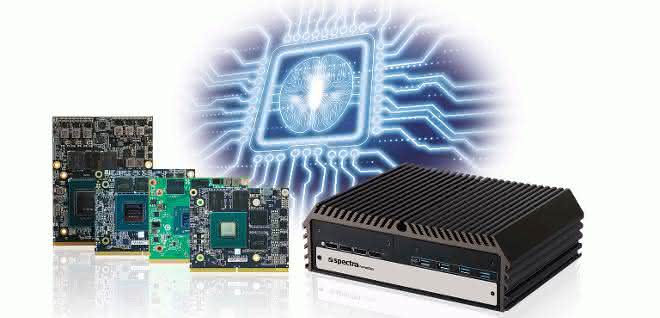
Edge AI server with MXM GPU modules
Industrial image processing ranges from simple applications in environmental perception such as the positioning, measurement, identification and sorting of objects to more complex image processing-controlled automation functions.
With this range of applications, a flexibly configurable embedded system helps the system integrator to both guarantee the necessary performance and avoid unnecessary investments.
The high-performance Edge AI servers of the Spectra PowerBox 500 series offer this possibility. They are highly scalable - the integrated Intel C246 chipset supports more than 20 different 8th and 9th generation Intel processors from Celeron to Xeon. The outstanding graphics performance is achieved by the graphics controller integrated on the chip. The required storage capacity is provided by two 2.5" SATA drives and can be expanded using several mSATA and NVME SSD slots.
The real flexibility is provided by the integrated MXM interface for additional GPU expansion. The new Quadro MXM GPU modules MXM-RTX3000 and MXM-T1000 are available. They use the Nvidia Quadro Turing GPU architecture based on the latest 12 nm process.
There is no need to compromise when it comes to computing power and performance. The MXM-RTX3000 features 1920 Cuda cores, 5.3 TFLOPs of peak FP32 high-end computing power, parallel integer execution, AI computing tensor core and specialized RT core for ray tracing. Together, these fully integrated GPU capabilities provide everything needed to handle complex visual image calculations. The MXM-T1000 features 896 Cuda cores, 2.6 TFLOPs of peak FP32 computing power and only 50W power consumption for low-power, high-speed computing.
Both models support GDDR6 memory. The MXM-RTX3000 has a single card capacity of up to 6 GB and a memory bandwidth of 336 GB/s. The MXM-T1000 has a capacity of 4 GB and a memory bandwidth of 192 GB/s. The fast memory smoothes the reading of data and multiplies the computing power.
A highly effective cooling concept enables fanless operation. This is achieved through the thermal separation of CPU and GPU and additional copper heat pipes in the aluminum housing, which ensure even better heat dissipation. If the processor and GPU module are expanded to the maximum, an external cooling system can easily be connected.


You might also be interested in
Plagiarius 2024 negative prize
On January 26, 2024, the Plagiarius campaign awarded its dreaded "Plagiarius" negative prize for the 48th time to manufacturers and retailers of particularly brazen counterfeits and fakes.
 read more...
Ivalua honors winners of the Generative AI...
AI-supported "add-ons" for buyers within 48 hours
Ivalua, provider of cloud-based spend management solutions, announced the winners and innovations of the first Generative AI Innovation Cup. The competition took place in December 2023. It was open to all Ivalua partners and employees - more than...
read more...Efaflex celebrates 50 years of high-speed...
The emphasis is on "fast"
Since day one, Efaflex has wanted to use new technologies as early as possible and drive progress in the industry. This year, the family business is celebrating its 50th anniversary under the motto "Fast Forward".
read more...Security of supply even during power outages
In the winter of 2022, Germany was worried about energy shortages. The drugstore retailer dm did not paint any horror scenarios, but nevertheless saw the possibility of controlled, temporary, regional power cuts (brownouts).
read more...Safety technology in mechanical engineering
Modules with new functions
Euchner's product highlights at EMO 2023 include the communication-capable solenoid interlocks.
read more...Transforming the paper industry towards climate neutrality
Together with partners from industry and research, Voith is developing a project for the optimization of energy and material flows in paper production. The aim of the research project is to develop a digital framework that enables effective process...
read more...Up to 95 percent less flue gas thanks to direct extraction
The requirements for occupational safety measures and safety technology are also constantly increasing in welding technology. The Technical Rules for Hazardous Substances (TRGS) stipulate that welding fumes and harmful substances must be extracted...
read more...Competitive advantages with large machines
Whether 3D-printed components for machines and systems, prototypes or aids for design: additive manufacturing is almost indispensable for modern companies in mechanical and plant engineering and automation if they want to play in the premier league.
read more...Transport technology from the modular system
Many transport tasks can be realized with the help of linear technology. Pre-configured solutions are available to simplify the interaction between the linear unit, motor, gearbox and controller. This minimizes the effort required for research and...
read more...