
3D image processing
IIoT in the third dimension
High-resolution 3D stereo camera systems with up to 12 megapixel sensors and an integrated projector enable new Industry 4.0 applications.
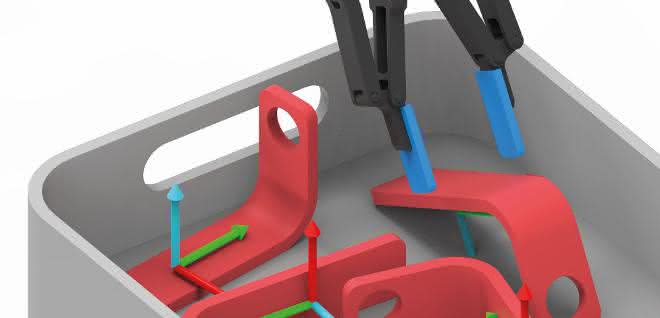
Machine vision is experiencing a sustained boom due to the requirements of new IIoT applications. It is well known that Industry 4.0 thrives on use case scenarios, and these in turn are spurred on by technological innovations. Matrix Vision, a brand of sensor and automation specialist Balluff, knows the requirements of plant and mechanical engineering inside out and is constantly developing high-performance hardware and software for industrial image processing.
The company is now expanding its portfolio with two 3D stereo cameras, one with 1.2 and one with 12 megapixel resolution. "Our camera systems help machine and plant manufacturers to avoid complex feeding kinematics when distributing individual parts from a large quantity, which are often technically complex and costly and usually require a lot of space," explains Fabian Furtner, the product manager responsible. "Bin picking is often used, in which an industrial gripper robot is guided by image processing to pick parts from a box. The use of camera systems for such Industry 4.0 applications reduces the technological effort, saves space and protects the environment."
It all depends on the perspective
The 3D cameras are based on stereo technology: images of a scene are captured slightly offset to each other via two camera lenses. The image processing goes far beyond that of conventional digital cameras, as depth information is also calculated as a third dimension. The smaller camera system from Matrix Vision has an "eye distance" of 65 mm, the larger one 160 mm. In addition, there is an Nvidia board that calculates a 3D image directly in the camera by correlating structures in the left and right camera image.
This technology is particularly interesting for logistics and robotics. In addition to the localization of objects in a planar (X-Y) surface, the Z-direction also plays a role, for example to determine the position of an object relative to the observer in order to control a gripping process. But what are the benefits of the ten times higher resolution of 4,096 x 3,008 pixels and a depth measurement range of 0.5 m to 4.0 m of the large system? "The high-resolution 3D camera system allows objects to be determined from a greater distance and much smaller objects to be recognized. You don't have to be so close to the scene with the camera, which is an advantage if there are unfavorable conditions such as high temperatures or if the robot needs to be given sufficient freedom of movement," explains Furtner.
Structure of the high-end system
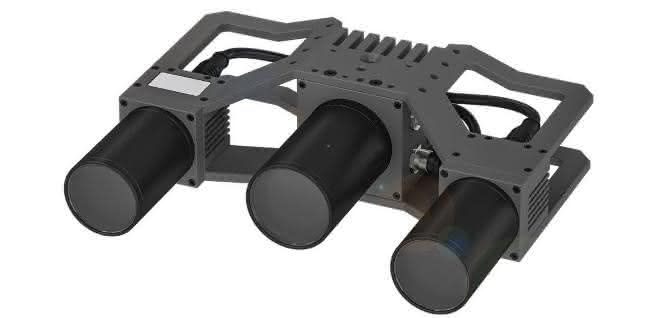
With 12 million 3D data points, the camera captures every detail - and at a frame rate of up to 9 Hz. The challenge here is that a lot of data has to be processed, which requires high-performance hardware. However, the fact that a very good GPU-based evaluation unit from Nivida is used means that this is not a problem, the product manager assures us. A GigE Vision interface allows users to create their own 3D applications based on the camera data. This is made easier by the software library included in the scope of delivery, so that the 3D calculation can be outsourced to the graphics card. This reduces the load on the camera CPU.
The compact system with a resolution of 1.2 megapixels does not require an extra PC. The evaluation unit is built into the 3D camera as an "all-in-one". In Industry 4.0 terms, this is therefore a "smart product". This reduces operating costs, partly because it is maintenance-optimized.
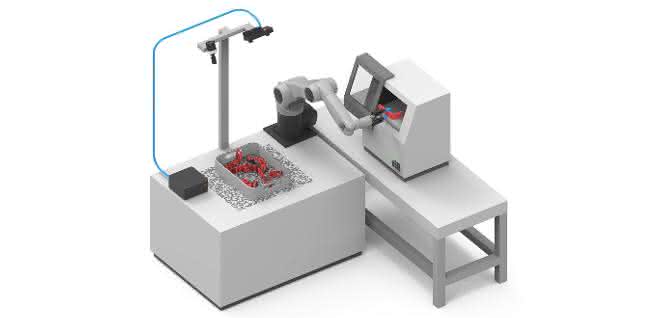
There are various software modules for detecting objects, which are optimized for different applications. Some require 3D models on which the algorithm is trained, while others only require a few settings in the camera's web interface. But this is done relatively quickly, says Fabian Furtner.
There is a certain amount of overlap in the target groups addressed. The low-resolution camera system is aimed at robot system integrators and machine builders, for example. Thanks to the user-friendly and simple software, the system can also be integrated without any particular expertise in the field of industrial image processing. The 12 megapixel system also offers the possibility of complex application development. This is usually not carried out directly by the machine manufacturer, but by a development partner. What both systems have in common is their robust and professional design.
SPS: Hall 5, Stand 210 and Hall 7A, Stand 303


You might also be interested in
ebm-papst is growing again thanks to AI and data centers
ebm-papst returned to a growth trajectory in fiscal year 2025/26. Air Technology, data center applications, and artificial intelligence are driving revenue and investment.
 read more...
SPE on the Verge of a Market Breakthrough
Single Pair Ethernet (SPE) has moved beyond the conceptual phase and is increasingly being implemented in industrial settings. The focus here is not only on higher data rates and simplified cabling, but above all on the issue of system integration...
read more...More than 900 exhibitors already registered
Around six months before the start of the trade fair, more than 900 companies have registered for SPS 2026 in Nuremberg. The trade fair focuses on industrial AI, cyber security and digital transformation.
read more...Virtual PLCs in practice: How vPLCs make production systems more flexible and scalable
The increasing networking of IT and OT is fundamentally changing industrial automation. The IT/OT Integration Summit shows how modern technologies can make production environments more efficient, flexible and future-proof. The event will focus on...
read more...Sales growth in a turbulent market environment
Thanks to innovations and a focus on strategic industrial markets, Sick was able to moderately increase its sales in the 2025 financial year. In a turbulent market environment, the company was able to maintain its position and gain market share with...
read more...Siemens presents new AI agent
Siemens is launching 'Eigen Engineering Agent', an AI for automation technology. The solution is integrated into the TIA Portal, has been tested with over 100 companies and is designed to significantly accelerate engineering processes.
read more...Schaeffler keeps sales almost stable
Schaeffler generated revenue of EUR 23.5 billion in 2025 and increased EBIT before special items to EUR 936 million. At 266 million euros, free cash flow was significantly above the prior year and forecast. Net income remained negative due to high...
read more...Advancing artificial intelligence together
Helukabel is stepping up its activities in the field of artificial intelligence and is now a member of the IPAI. The innovation and collaboration platform for companies, research facilities, institutions and administration has set itself the goal of...
read more...New impetus for ifm sales
Two new positions were filled at ifm at the start of 2026: Markus Wolf becomes Managing Director Sales Germany, Sven Quant takes over the position of Central Managing Director in the Process Sensors division within the ifm Group.
read more...