

Asti-FTS at Vacom
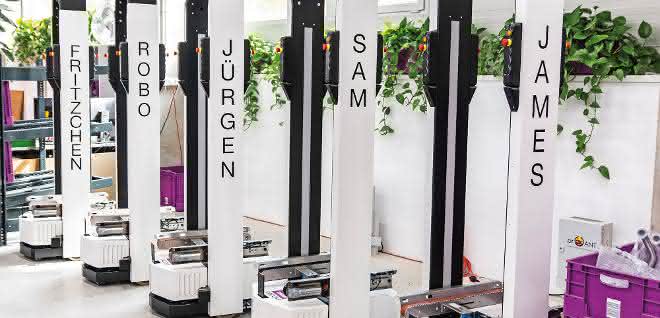
Six men provide supplies
At Vacom, five transport robots and an autonomously navigating pallet vehicle from Asti Insystems transport the components to the 45 workstations. The vehicles are embedded in the production logistics, which enables transparent monitoring and documentation or just-in-time transport deliveries.
Vacom is a provider of vacuum mechanical measurement technology and optics and employs around 350 people. At the end of August 2019, the family business, which was founded 25 years ago, opened a modern factory building at its site in Großlöbichau (Thuringia). The aim was to closely interlink logistics and production using Industry 4.0 applications and thus create the conditions for a smart factory.
The automated guided vehicle system therefore not only had to transport material and components autonomously between the 45 workstations, but also communicate with the in-house production and logistics software in order to contribute to maximum quality and process reliability. This linking of all machines and control systems is particularly necessary due to the complex products, some of which consist of more than a hundred components and are manufactured to customer specifications in batch sizes of 1 to 1,000 units.
There is no classic line production. Vacom therefore decided to work with Asti Insystems. The company ordered five Proant 436 transport robots, which can handle loads of up to 50 kilograms and navigate flexibly. As larger loads of up to 400 kilograms are also regularly handled, Vacom also integrated the Proant 576, which specializes in transporting pallets (measuring 1,200 x 800 x 1,000 millimetres).
Before the integration of the AGV, transportation between the individual workstations was carried out manually. In addition, there was no tracking of the processes. In some cases, it was unclear where the individual materials were at any given time. It was difficult to react to customer changes, such as a change in quantity, and new production requirements. Employees spent a lot of time searching for components and bringing them to their workstations. At least one member of the team was even assigned to this task each shift.
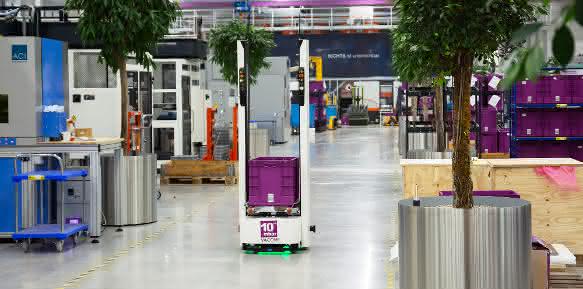
Today, the Proant transport robots move around a 112 meter long and 35 meter wide factory environment. There are 45 work stations where different tasks such as welding, hardening or polishing are carried out. There is an individual work plan and different batch sizes for each product.
The transport robots are embedded in a complex warehouse and production logistics system, for which Vacom uses the Hydra Manufacturing Execution System (MES) from MPDV and the Viadat Warehouse Management System (WMS) from Viastore Software. In turn, orders are generated in SAP. SAP generates production folders with parts lists and transfers them to the MES. The MES is responsible for all detailed planning and determines which machine, which tool, which material and which employee is required. The parts list and scheduling are sent to Viadat (WMS), which coordinates the replenishment orders for the respective requirements per work cycle. The replenishment orders are buffered in the supermarket warehouse in the production hall, which reduces the intermediate storage space at the individual work stations. Immediately before processing, a transport command is triggered by the WMS and a transport robot is instructed to transport the material to one of the workstations. Each work station is located in a separate room, in which there is a rack for incoming crates (incoming station) and a rack for outgoing crates (outgoing station). Once the worker has completed his order, the finished order is scanned and placed in the outgoing station. This communicates information to Viadat so that a robot can then take the goods to the supermarket warehouse or to the next work station.
The transport robots are equipped with a barcode scanner. The Proant 436 transport robots also have an extra high lift of 1.50 meters. On their way through the production hall, the vehicles pass through various automatic doors with which they can communicate.
The fleet of transport robots is flexibly scalable. For example, it is currently being considered to connect the three halls at the site with another autonomous transport robot for route trains in the outdoor area.


You might also be interested in
Robotics and autonomous order picking
Locus Robotics acquires Nexera Robotics and expands autonomous warehouse logistics
Locus Robotics takes over Nexera Robotics and may have taken a decisive step towards truly universal warehouse automation. A new gripping technology should now make possible what was previously considered difficult to automate.
 read more...
How bridging steps, stairs and catwalks are changing processes in production and logistics
At Logimat 2026, Munk Günzburger Steigtechnik will be showcasing modular bridging steps, stairs, platform and walkway systems for production, warehousing and logistics. With online configurators, distances can be efficiently shortened, processes...
read more...Highly automated warehouse for...
SSI Schaefer implements highly automated warehouse for CERP in France
SSI Schaefer and CERP are building a highly automated logistics center for pharmaceutical logistics in Wissous with shuttle storage, A-Frame, robotics and WAMAS software.
read more...Start of construction for new production hall
Mayr Antriebstechnik invests in its home base and internationally
Mayr Antriebstechnik strengthens location and international logistics: Construction of a new hall in Mauerstetten - parallel expansion of the plant in Poland as a logistics hub.
read more...Conveyor systems that adapt
Modern conveyor systems must reliably transport different product sizes, shapes and materials. The new modular product system from Kipp offers flexible, modular solutions for this: Adjustable side guides ensure precise alignment and gentle...
read more...Focus on sustainability and AI at the trade fair
With more than 120,000 square meters of exhibition space, LogiMAT 2025 will once again occupy all ten halls of the Stuttgart exhibition grounds. From March 11 to 13, global players, medium-sized companies and start-ups will provide an overview of...
read more...Workstation system for shipping and logistics
With Sintro Packing, Karl is launching a workstation system that is designed to meet the specific requirements of shipping and logistics. It is characterized by modular adaptability and ergonomic efficiency.
read more...Deutsche Messe announces Robotics Award
On the occasion of Hannover Messe 2025, Deutsche Messe is once again presenting the Robotics Award after a break of several years. Prizes will be awarded for robot-supported automation and logistics solutions. Companies and institutions from Germany...
read more...Micro motors as the driving force behind intralogistics
Suitable transport structures in intralogistics are a prerequisite in all industries in order to withstand competitive pressure in the future. The basis for this is comprehensive automation, which would be inconceivable without an armada of powerful...
read more...