
Driverless transport vehicle
Paper rolls from A to B and back
An AGV transports paper rolls safely through a production hall.
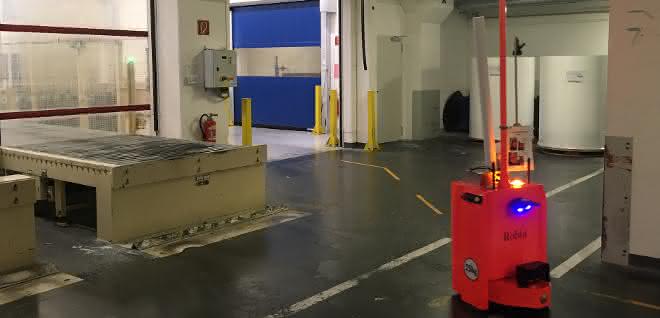
Asti Mobile Robotics has developed a driverless transport system for the transportation of sample paper for Schoeller Technocell. The Felix Schoeller Group is a manufacturer of specialty paper. The new automated guided vehicle (AGV) is an important step in the automation of logistics.
In production, sample paper rolls with a length of 1 to 2 m and a weight of up to 30 kg regularly have to be transported between the coater and the central laboratory. By integrating the proANT 485 AGV, the company hopes to achieve an automated transport process that will reduce the workload on employees. Only the material transfer is still carried out manually at the defined positions. Previously, the rolls were transported manually. The employees had to cover a distance of 220 meters. This involves passing through three high-speed gates. To make matters worse, the transport route falls into a highly frequented area where people and, in some sections, manned forklift trucks and electric trolleys move around.
The proANT 485 is a customer-specific production. The vehicle was equipped with a spotlight and is painted in a signal color. The headlamp generates a blue light cone that creates a spot on the ground approximately 4 m in front of the AGV. This allows the approaching AGV to be recognized at an early stage, especially in intersection areas. Furthermore, a signal light was attached to a pole on the AGV to make it additionally recognizable.
Doors open automatically
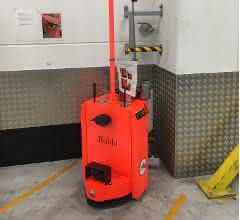
As both people and industrial trucks are on the transport route, orange flashing beacons have been installed at four points in the hall. As long as the AGV is in this area, these are switched on automatically. A potential-free contact is required to operate automatic doors. This opens the door and keeps it open until it is pressed again. Transmission can take place via LAN or WLAN. For transmission via LAN, a network cable must be available at the respective control points. The transmitted signal triggers the opening of the corresponding door. The AGV sends the signal to the network modules to control the respective components. Two positions - one at the coater, the other in the central laboratory - are equipped with a charging station. The AGV only moves between these two points. If the AGV is at one of the points, a button on the AGV can be used to generate an order to the other point. An existing order can be deleted via the AGV's web interface. The journey ends at the two destination points with the connection to the charging station. Charging at both points eliminates the need for complex battery management.
To familiarize employees with the new technology, Schoeller first rented a proANT AGV as a test vehicle. The company then organized a training course for the workforce on how to use the new robot.


You might also be interested in
Robotics and autonomous order picking
Locus Robotics acquires Nexera Robotics and expands autonomous warehouse logistics
Locus Robotics takes over Nexera Robotics and may have taken a decisive step towards truly universal warehouse automation. A new gripping technology should now make possible what was previously considered difficult to automate.
 read more...
How bridging steps, stairs and catwalks are changing processes in production and logistics
At Logimat 2026, Munk Günzburger Steigtechnik will be showcasing modular bridging steps, stairs, platform and walkway systems for production, warehousing and logistics. With online configurators, distances can be efficiently shortened, processes...
read more...Highly automated warehouse for...
SSI Schaefer implements highly automated warehouse for CERP in France
SSI Schaefer and CERP are building a highly automated logistics center for pharmaceutical logistics in Wissous with shuttle storage, A-Frame, robotics and WAMAS software.
read more...Start of construction for new production hall
Mayr Antriebstechnik invests in its home base and internationally
Mayr Antriebstechnik strengthens location and international logistics: Construction of a new hall in Mauerstetten - parallel expansion of the plant in Poland as a logistics hub.
read more...Conveyor systems that adapt
Modern conveyor systems must reliably transport different product sizes, shapes and materials. The new modular product system from Kipp offers flexible, modular solutions for this: Adjustable side guides ensure precise alignment and gentle...
read more...Focus on sustainability and AI at the trade fair
With more than 120,000 square meters of exhibition space, LogiMAT 2025 will once again occupy all ten halls of the Stuttgart exhibition grounds. From March 11 to 13, global players, medium-sized companies and start-ups will provide an overview of...
read more...Workstation system for shipping and logistics
With Sintro Packing, Karl is launching a workstation system that is designed to meet the specific requirements of shipping and logistics. It is characterized by modular adaptability and ergonomic efficiency.
read more...Deutsche Messe announces Robotics Award
On the occasion of Hannover Messe 2025, Deutsche Messe is once again presenting the Robotics Award after a break of several years. Prizes will be awarded for robot-supported automation and logistics solutions. Companies and institutions from Germany...
read more...Micro motors as the driving force behind intralogistics
Suitable transport structures in intralogistics are a prerequisite in all industries in order to withstand competitive pressure in the future. The basis for this is comprehensive automation, which would be inconceivable without an armada of powerful...
read more...