

KMP 600-S diffDrive from KUKA
A compact powerhouse
With the second generation of the KMP 600-S diffDrive, KUKA is expanding its portfolio in the field of mobile platforms and opening up new avenues for intralogistics.
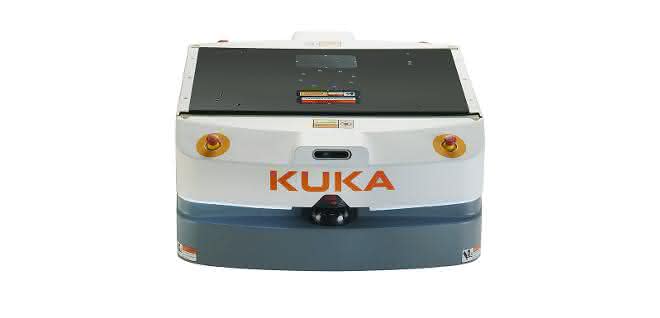
The new generation of the KMP 600-S diffDrive expands KUKA's range of mobile platforms. At up to two meters per second, the KMP 600-S diffDrive is not only fast, but also safe thanks to laser scanners and 3D object recognition. A collision-free colleague that is set to take the consumer goods industry in particular to a new level.
The KUKA Mobile Platform KMP 600-S diffDrive is a new driverless transport system that supports production intralogistics quickly and with a payload of up to 600 kilograms. Thanks to its IP 54 design, it works reliably even under adverse conditions, such as splash water and dust.
Safe and flexible
KUKA's mobile platforms offer employees great freedom of movement without safety fences. The KMP 600-S diffDrive is no exception. Laser scanners attached to the front and rear of the machine enable high cycle times when required.
"Safety is key for us," says Jakob Brandl, Portfolio Manager at KUKA. The KMP 600-S diffDrive can be extended with 3D object detection. This enables it to detect obstacles that are between 50 millimetres and 2.10 meters above the floor.
The KMP 600-S diffDrive can link and deliver several workstations. For example, it acts as a top-load AGV ("Automated Guided Vehicle") and can lift pallets or cartons up to 60 millimetres using the integrated lifting device. The KMP 600-S diffDrive is commissioned via a manual controller and applications can be programmed via JAVA.
KUKA.NavigationSolution for navigation and fleet management
Each KMP 600-S diffDrive has an operating time of around eight hours and can be recharged in two hours. The KUKA.NavigationSolution monitors the fleet: it recognizes the battery charge level and which vehicles are connected to the WLAN. After the initial learning of the environment using a slam algorithm, the software solution takes over the localization in the room and the coordination of the vehicles. The fleet manager uses parameters such as distance and speed to determine the best route on the road network - without collisions, of course.


You might also be interested in
Plagiarius 2024 negative prize
On January 26, 2024, the Plagiarius campaign awarded its dreaded "Plagiarius" negative prize for the 48th time to manufacturers and retailers of particularly brazen counterfeits and fakes.
 read more...
Ivalua honors winners of the Generative AI...
AI-supported "add-ons" for buyers within 48 hours
Ivalua, provider of cloud-based spend management solutions, announced the winners and innovations of the first Generative AI Innovation Cup. The competition took place in December 2023. It was open to all Ivalua partners and employees - more than...
read more...Efaflex celebrates 50 years of high-speed...
The emphasis is on "fast"
Since day one, Efaflex has wanted to use new technologies as early as possible and drive progress in the industry. This year, the family business is celebrating its 50th anniversary under the motto "Fast Forward".
read more...Security of supply even during power outages
In the winter of 2022, Germany was worried about energy shortages. The drugstore retailer dm did not paint any horror scenarios, but nevertheless saw the possibility of controlled, temporary, regional power cuts (brownouts).
read more...Safety technology in mechanical engineering
Modules with new functions
Euchner's product highlights at EMO 2023 include the communication-capable solenoid interlocks.
read more...Transforming the paper industry towards climate neutrality
Together with partners from industry and research, Voith is developing a project for the optimization of energy and material flows in paper production. The aim of the research project is to develop a digital framework that enables effective process...
read more...Up to 95 percent less flue gas thanks to direct extraction
The requirements for occupational safety measures and safety technology are also constantly increasing in welding technology. The Technical Rules for Hazardous Substances (TRGS) stipulate that welding fumes and harmful substances must be extracted...
read more...Competitive advantages with large machines
Whether 3D-printed components for machines and systems, prototypes or aids for design: additive manufacturing is almost indispensable for modern companies in mechanical and plant engineering and automation if they want to play in the premier league.
read more...Transport technology from the modular system
Many transport tasks can be realized with the help of linear technology. Pre-configured solutions are available to simplify the interaction between the linear unit, motor, gearbox and controller. This minimizes the effort required for research and...
read more...