
Production logistics
Frame transport in the modular system
The manufacturer SEW-Eurodrive has expanded its Maxolution system.
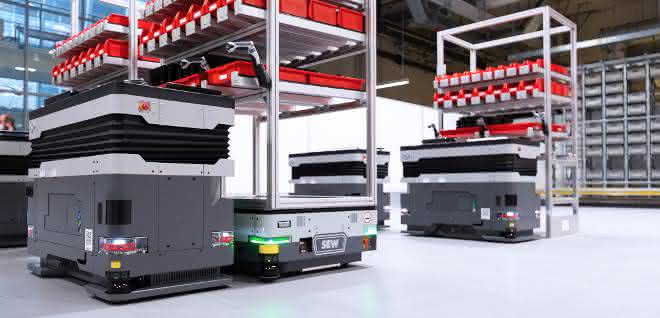
Flexibility, adaptability, networking and self-sufficient modules are the buzzwords for the design of factories. Companies are constantly faced with the challenge of expanding and reorganizing production lines depending on the number of units or portfolio. By breaking down traditional production lines into individual production modules, units are created that can be flexibly expanded or rearranged to meet changes in demand. The spatial decoupling of logistics and the networking of production facilities using mobile assistance systems increase flexibility by 25 percent.
Customized mobile systems can be configured from the extensive modular system of SEW-Eurodrive's Maxolution System Solutions business unit, tailored to the application. The areas of application for mobile systems as transport vehicles, logistics, assembly or handling assistants are diverse, for example for transporting pallets, boxes and crates in production and distribution logistics. Or as tugger trains for internal goods transportation - as an alternative to forklifts - as well as for linking and expanding conveyor systems. Another area of application is the provision of components on assembly lines or as a moving, ergonomic workbench in the assembly process. System solutions from SEW-Eurodrive are also used as mobile cobots for pick-and-place activities, in order picking environments or with cooperative capabilities for assembly and joining processes. And finally, they are optimized for use in production and distribution logistics for transporting a wide variety of racks and shelves.
Product diversity and e-commerce as drivers of logistics
The logistics sector is the largest economic sector in Germany after the automotive industry and retail, ahead of the electronics and mechanical engineering sectors. The general conditions and prospects for the logistics sector remain favorable despite - or perhaps because of - the COVID-19 pandemic. The primary drivers include the steady growth in e-commerce and food retail. More and more logistics processes also need to be managed in manufacturing companies, particularly due to increasing product diversification. According to statistics, around a third of manufacturing costs are caused by logistical expenses. The optimization of logistics processes through the use of driverless transport vehicles and intelligent, autonomous logistics assistants offers correspondingly great potential.
Intelligent concepts increase safety
The mobile assistants replace rigid conveyor units or conventional, manned forklifts in many places, simplifying the internal material flow and a wide range of processes in production, warehouse and distribution logistics. With the help of the vehicle, process modules are linked autonomously and cooperatively. Innovative navigation methods and energy infrastructure concepts allow the mobile systems to move freely in space in two dimensions, offering maximum design freedom and flexibility in the factory. Intelligent concepts increase process, plant and personal safety and ensure trouble-free production processes. The logistics assistants and transport vehicles can be used in warehouse pre-zones or picking areas via defined software interfaces to storage and retrieval machines, lifters and shuttles.
Customized superstructures are possible
The MAXO-MS-RA006 mobile system was specially developed for the transportation of various load carriers such as pallets, racks or customer-specific superstructures. In this way, material on the racks can be loaded centrally at the warehouse and then transported filled to the consumption station. There, the rack can be placed at fixed stations or a rack flexibly equipped with rollers can be delivered to transfer stations. Empty shelves and racks are also returned at the same time. With the help of its precise positioning capabilities, the vehicle drives under load frames, racks and shelves and is able to lift them using the built-in lifting module. Its stable design allows the loaded lift to be moved in and out while the vehicle is in motion. This improves the transportation process time.
Thanks to the secure load carrier identification, different rack sizes and rack types can be reliably identified. Thanks to this function, it is possible to transport different racks with one vehicle. Thanks to the fine positioning, tilted racks can still be picked up perfectly, even without additional centering devices on the floor. The built-in anti-slip mats ensure that the load has optimum grip on the lifting module. In addition, spring-loaded stops ensure that Euro mesh boxes are held securely in place. Thanks to the spring mounting of the stops, they can be retracted so that other load carriers, such as pallets, can also be transported without any problems. The sensor system installed in the lifting module uses ultrasonic sensors to identify whether a load transfer point is occupied or not. This function ensures that the use of a load transfer point does not lead to a collision.
High maneuverability in the factory
Another advantage is the MAXO-MS-RA006's area-moving driving mode, which allows the vehicle to be used even in complex and compact factory layouts. With the help of this driving mode - the ability to move the vehicle in any direction at any time - it is possible for the mobile logistics assistant to maneuver safely through various racks in very confined spaces. This makes it possible, for example, to create area buffers with shelves and to sort the shelves in the tightest of spaces.
Innovative communication solution
As a special feature, the vehicle can also communicate with third-party controllers via the VDA 5050 AGV communication interface in addition to the SEW fleet controller. This enables full integration of vehicles and LOG controllers - without an intermediate control level. The interface was developed in cooperation between the German Association of the Automotive Industry (VDA) and the VDMA Materials Handling and Intralogistics Association.
Thanks to the open VDA 5050 standard used, the interface descriptions and systems are not manufacturer- or communication protocol-specific. The LOG controllers collect the local I/Os, interpret and link the signals and make them available to the host computer level. At the same time, the LOG controllers serve as visualization and diagnostic units. This enables vehicles to interact with other driverless transport systems via external fleet managers or the SEW fleet manager. In addition, the intelligent energy concept with Movitrans contactless energy transmission and energy storage modules enables maximum flexibility.


You might also be interested in
Hamburg Regional Court issues preliminary injunction against Elite Robots Germany
In the copyright dispute between Teradyne Robotics and Elite Robots Germany, the Hamburg Regional Court has issued an interim injunction. The distribution of the software and products concerned is prohibited, and there is also a comprehensive...
 read more...
Schunk founds tech spin-off for humanoid robot hands
Schunk is bundling its activities in humanoid robotics by founding its own spin-off at the beginning of January. The aim of the new company is to develop modular humanoid robot hands for industrial applications.
read more...Partnership for humanoid robotics
Schaeffler and Neura Robotics jointly develop humanoids
Schaeffler and Neura Robotics will work together in the future to develop and supply key components for humanoid robots. The systems will also be integrated into Schaeffler's global production network.
read more...Yaskawa at the Automatica 2025
AI meets robotics
At this year's Automatica, everything at Yaskawa revolves around AI-based robotics solutions for the smart factory and beyond. As a trade fair highlight, the manufacturer is presenting its new Motoman Next product concept.
read more...Kassow Robots at the Automatica
7-axle vehicle in action
At Automatica, Kassow Robots will be presenting a wide range of industrial applications for production and logistics tasks that provide new impetus for efficiency and flexibility in industrial automation.
read more...Robotics and automation in six exhibition halls
From June 24 to 27, 2025, Automatica, the trade fair for intelligent automation and robotics, will bring industry and research together in six exhibition halls. Preparations are in full swing.
read more...Interview with Jörg Rommelfanger
Robotics in 25 years
The annual IFR report shows that the number of industrial robots is steadily increasing worldwide. They have already played an important role in ABB's portfolio for decades. In an interview with INDUSTRIAL Production, Jörg Rommelfanger, Head of...
read more...Reliable end effector for cobots
Collaborative robots are now widely used for a wide range of handling tasks. SMC offers three versions of the RMH pneumatic gripper for this purpose; it is compatible with cobots from a total of twelve companies.
read more...7-axis cobots with controller in robot base
With the Edge Edition, Kassow Robots has launched the world's first 7-axis cobots with a controller integrated into the robot base.
read more...