

Autonomous mobile robots
AMR optimize the material flow
Mobile robots can be used for various transportation tasks with the help of flexible add-on modules. Depending on requirements, possible applications range from the automation of individual process steps to fully automated applications. Five typical applications already cover a wide range of transport processes.
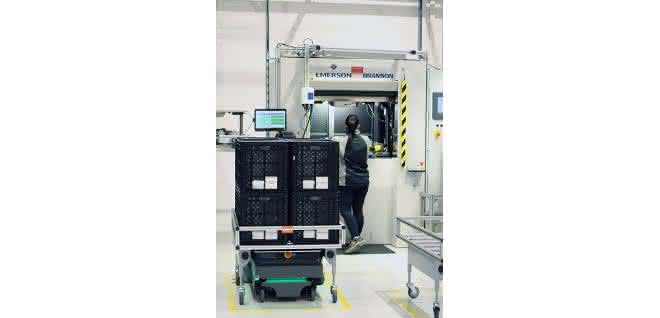
Autonomous mobile robots (AMR) are on the rise. In its 2020 annual report, the industry association IFR (International Federation of Robotics) forecast annual sales growth of at least 40% for the market for logistics robots. The mobile transport assistants have been helping companies to achieve a more efficient material flow for several years now, but the coronavirus pandemic is opening up new potential: as mobile disinfection solutions, for example, they can thoroughly clean even large offices, storage areas and factory halls in the shortest possible time. They also keep production logistics running, even when fewer employees than usual are on duty due to hygiene regulations, quarantine measures or illness.
The advantage of flexibility
The special thing about AMR is its flexibility. In contrast to traditional automated guided vehicles (AGVs), they do not require additional infrastructure such as rails or magnetic strips embedded in the floor. With the help of integrated sensors and cameras as well as intelligent software, they navigate safely and independently even in busy production halls. They reliably detect people, tugger trains or racks so that they can brake or take evasive action in good time. They can also be quickly reprogrammed for new tasks if work processes change or new orders need to be completed. This enables them to cope with the variable requirements of modern production and logistics operations and deliver added value from day one. The robots from Mobile Industrial Robots (MiR) are designed as an open platform that can be equipped with customized add-on solutions as required. The most common applications include combinations with shelf attachments, transport trolleys, Karakuri systems, conveyor belts or pallet lifters. This means that a large number of processes can already be automated.
Shelf attachment
Shelf attachments are a popular and simple solution for automating material transport between the warehouse and assembly line. The shelf structure can be attached to a robot using just four screws. The application is then ready for use. Such attachments are usually used in semi-automated applications in which a human calls the robot to them via a tablet. They then manually load the mobile helper with parts and send it on its way again at the touch of a button. Once it arrives at its destination, another employee unloads it manually.
Transport trolley
In this application, the robot is equipped with an attachment that it uses to pick up and transport trolleys as an underride solution. For example, the robot brings a loaded trolley from the warehouse to the production area, where it uncouples it and then brings an empty trolley back to the warehouse. Alternatively, it can also transport trolleys back and forth between the production lines.
Karakuri system
For fully automated solutions, mechanical Karakuri systems that work with the aid of gravity are ideal. Goods can be automatically unloaded onto or from the robot via the various shelf levels. In this way, a Karakuri system can load and unload assembly lines fully automatically. If the mobile robot is integrated into an ERP system, for example, humans no longer have to do anything. The robot is called automatically and connects to the Karakuri system installed on site, where the goods transfer takes place.
Conveyor belts
Equipped with a conveyor belt module, mobile robots can also be used to bridge or extend stationary conveyor belts. In this function, they are often used in fully automated applications, for example when assemblies need to be moved between production lines. In this way, production processes can be designed more flexibly, as mobile robots can change their position in space quickly - in contrast to stationary conveyor technology.
Pallet lifter
Autonomous transport robots with a high load capacity can also automate pallet transport. With the help of a lifting module on the robot and stationary pick-up devices, they can pick up, transport and set down pallets without human intervention. This helps companies that want to reduce the use of forklift trucks. These are considered a source of danger and repeatedly cause accidents at work. Autonomous mobile robots are not only a safe alternative, but also do not require the manpower of qualified specialists, as is the case with forklift trucks.
Flexible solution for every need
In addition to these applications, there are numerous other options for equipping mobile robots as required. For example, they can be combined with a robot arm that can pick or commission goods. They can also be combined with pulling systems that enable the robots to transport trolleys.
In this way, mobile robots offer solutions for every level of automation. While the automation of a single transport route may be worthwhile for smaller companies, a fully automated solution makes sense for others. For such purposes, mobile robots can be integrated into existing MES, ERP or WMS systems. In this way, they are automatically notified when a production line or cell requires material replenishment, for example. Just-in-time delivery allows companies to optimize their inventories and reduce the need for temporary storage of materials, which saves space. At the same time, this helps to keep production processes agile. Integrated solutions of this kind also allow process data to be recorded more accurately and processes to be designed more efficiently on this basis.
The robots also make it easier for their user companies to implement ergonomic working standards: By transporting assemblies, workpieces or finished goods from A to B, they save employees from having to walk for miles every day. They can also save the workforce from bending down and heavy lifting if they are equipped with the right attachment modules.


You might also be interested in
Basler acquires 76% of Indian image processor
Basler, supplier of image processing components for computer vision solutions, has acquired 76% of the Indian sales partner Alpha TechSys Automation.
 read more...
Process monitoring and fault detection
Cameras ensure quality during laser melting
Powder bed-based laser melting (PBF-LB/M) opens up new possibilities in additive manufacturing. Modern camera systems provide crucial process data to further increase quality and efficiency.
read more...Vision Sensor is three times faster than its predecessor
The 'CS-62' vision sensor from di-soric is around three times faster than its predecessor, the 'CS-60'. In combination with the 'nVision-i 25.1' software, it enables image processing solutions that were previously reserved for smart cameras.
read more...Thermal imaging cameras for quality control
Automated thermal imaging cameras are often suitable for quality control applications where temperature plays a role. However, while there are various solutions on the market for slow processes, it is challenging to select a camera that reliably...
read more...Easy entry into industrial VGA thermography
Reliable temperature measurement is a prerequisite for the success of many industrial processes. Berlin-based manufacturer Optris presents the Xi 640 infrared camera, a new member of its Compact Line, which enables non-contact temperature...
read more...Powder bed-based laser melting optimized
Aconity3D has set itself the goal of optimizing the stability of the manufacturing method of powder bed-based laser melting and thereby promoting its use in a wide range of industries. By using high-speed industrial cameras from SVS-Vistek, the...
read more...INDUSTRIAL Production Products of the year...
2nd place, category handling, assembly and production logistics: SICK
safeVisionary2 is the first 3D time-of-flight camera with Performance Level c safety certification. It enables safe three-dimensional environmental detection and won 2nd place in the competition for Product of the Year 2024 in the handling, assembly...
read more...Nomination Products of the Year 2024
SICK: Camera systems safeVisionary2
safeVisionary2 is the first 3D time-of-flight camera with Performance Level c safety certification. It enables safe three-dimensional environmental detection and has been nominated in the 2024 Product of the Year competition in the handling,...
read more...AI vision brings additional opportunities
The seamless integration of AI into the consumer sector has helped to improve our quality of life and make interactions with technology more efficient. In industry, AI vision with machine learning opens up new possibilities that are not covered by...
read more...