
Water protection
Solution for water protection
Wherever water-polluting media can contaminate water and soil, strict requirements apply by law, ordinance and regulations. They specify the type and scope of protective measures required.
When handling water-polluting liquids, the complete protection of water bodies must be ensured. A comprehensive set of regulations standardizes this area of responsibility in all its eventualities. Any operation of facilities for the storage, filling and transfer (LAU facilities) and for the production, treatment and use (HBV facilities) of substances hazardous to water is affected.
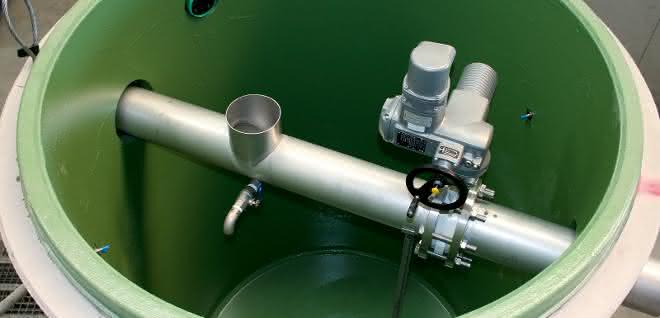
One product for retaining water-polluting liquids in LAU systems is the NeutraSab safety containment basin. It consists of an earth-filled reinforced concrete tank which, depending on the water-polluting liquid, is given a suitable configuration of the components used to ensure chemical resistance. A through-pipe with overflow nozzle and a butterfly valve with swivel drive are integrated. It closes the flow pipe before a filling or transfer process so that the water-polluting liquid flows into the collection basin via the overflow nozzle in the event of an accident. In normal operation, on the other hand, rainwater flows unhindered into the waste water sewer if it accumulates on the storage, filling or handling area.
Three variants are available for sealing the inner surface of NeutraSab, depending on the requirements of the water-polluting liquid: in addition to a dissipative coating in accordance with WHG System 2, internal sealing with PE or stainless steel is also possible. The pipe is then made of PE, PP or stainless steel as appropriate. It thus offers chemical resistance to a large number of water-critical media. The butterfly valve can be equipped with electric or pneumatic automatic switching, and a float switch is used for liquid detection. ATEX test certificates are available for all electrical equipment. If required, a completely conductive version of the built-in parts is possible. The control unit is housed in a splash-proof control cabinet. Tom Kionka / dsc


You might also be interested in
Plagiarius 2024 negative prize
On January 26, 2024, the Plagiarius campaign awarded its dreaded "Plagiarius" negative prize for the 48th time to manufacturers and retailers of particularly brazen counterfeits and fakes.
 read more...
Ivalua honors winners of the Generative AI...
AI-supported "add-ons" for buyers within 48 hours
Ivalua, provider of cloud-based spend management solutions, announced the winners and innovations of the first Generative AI Innovation Cup. The competition took place in December 2023. It was open to all Ivalua partners and employees - more than...
read more...Efaflex celebrates 50 years of high-speed...
The emphasis is on "fast"
Since day one, Efaflex has wanted to use new technologies as early as possible and drive progress in the industry. This year, the family business is celebrating its 50th anniversary under the motto "Fast Forward".
read more...Security of supply even during power outages
In the winter of 2022, Germany was worried about energy shortages. The drugstore retailer dm did not paint any horror scenarios, but nevertheless saw the possibility of controlled, temporary, regional power cuts (brownouts).
read more...Safety technology in mechanical engineering
Modules with new functions
Euchner's product highlights at EMO 2023 include the communication-capable solenoid interlocks.
read more...Transforming the paper industry towards climate neutrality
Together with partners from industry and research, Voith is developing a project for the optimization of energy and material flows in paper production. The aim of the research project is to develop a digital framework that enables effective process...
read more...Up to 95 percent less flue gas thanks to direct extraction
The requirements for occupational safety measures and safety technology are also constantly increasing in welding technology. The Technical Rules for Hazardous Substances (TRGS) stipulate that welding fumes and harmful substances must be extracted...
read more...Competitive advantages with large machines
Whether 3D-printed components for machines and systems, prototypes or aids for design: additive manufacturing is almost indispensable for modern companies in mechanical and plant engineering and automation if they want to play in the premier league.
read more...Transport technology from the modular system
Many transport tasks can be realized with the help of linear technology. Pre-configured solutions are available to simplify the interaction between the linear unit, motor, gearbox and controller. This minimizes the effort required for research and...
read more...