
Wearable on the skin
Compostable displays for sustainable electronics
KIT researchers have developed a printed display whose biodegradability has been independently tested and confirmed.
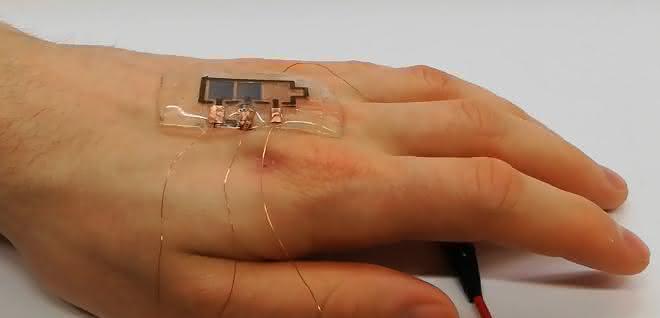
In the coming years, the increasing use of electronic devices in everyday objects and new technologies in connection with the Internet of Things threaten to increase the production of electronic waste. More environmentally friendly production and a more sustainable life cycle are crucial here in order to save resources and minimize waste. Scientists at the Karlsruhe Institute of Technology (KIT) have succeeded for the first time in producing displays whose biodegradability has been independently tested and confirmed. Their results have been published in the "Journal of Materials Chemistry".
"With our development, we were able to show for the first time that it is possible to produce sustainable displays from predominantly natural materials using industrially relevant production methods. They therefore do not contribute to electronic waste after use, but on the contrary can be composted. In combination with recycling and reusability, this could help to minimize or completely prevent some of the environmental impacts of electronic waste," says Manuel Pietsch, first author of the publication and researcher at KIT's Light Technology Institute (LTI) at the InnovationLab in Heidelberg, describing the advantages of the new development.
Low energy consumption, simple component architecture
The function of the display is based on the so-called electrochromic effect of the organic base material used. If a voltage is applied to it, this leads to a change in the absorption of light and thus to a color change in the material. Electrochromic displays are characterized by low energy consumption and a simple component architecture compared to commercially available displays such as LEDs, LCDs and e-paper. Another advantage is that these displays can be produced using the inkjet printing process, enabling customized, cost-effective and material-efficient production. This process is also suitable for scaling processes with high throughput. The materials used are mainly of natural origin or biocompatible. Sealing with gelatine also makes the display adhesive and adaptable, allowing it to be worn directly on the skin on various parts of the body.
Indicator for sensors or simple displays
The display is generally suitable for short-lived applications as an indicator for sensors or simple displays in various areas. Particularly in diagnostic applications, where hygiene plays an important role, the sensors and their indicators have to be laboriously cleaned or disposed of after each use. In the case of the newly developed display, this does not result in electronic waste, but can simply be composted. The display could also be used as a compact display for quality-monitoring sensors in the area of food packaging, which must not be reused. The digital printing process also enables individual adaptation to people or complicated shapes without expensive process redesign, which again saves resources.
"The first demonstration of an inkjet-printed, biodegradable display, as far as we know, can therefore encourage sustainable innovations in other electronic components and thus pave the way for more environmentally friendly electronics," says Gerardo Hernandez-Sosa, Head of the Printed Electronics Group of the LTI at the InnovationLab in Heidelberg.
Original publication:
Manuel Pietsch, Stefan Schlisske, Martin Held, Noah Strobel, Alexander Wieczorek, Gerardo Hernandez-Sosa: Biodegradable inkjet-printed electrochromic display for sustainable short-lifecycle electronics. Journal of Materials Chemistry, DOI: 10.1039/d0tc04627b


You might also be interested in
Intelligent sensor technology for the packaging industry
At Interpack 2026, Sick will be showcasing its portfolio of sensor, automation and AI-supported solutions for secure and digitally networked packaging processes in the consumer goods, healthcare and pharmaceutical industries.
 read more...
Sales growth in a turbulent market environment
Thanks to innovations and a focus on strategic industrial markets, Sick was able to moderately increase its sales in the 2025 financial year. In a turbulent market environment, the company was able to maintain its position and gain market share with...
read more...Photonic microchips with 3D connector
How a 3D system makes photonic chips industrially viable
A research team from Heidelberg is developing a 3D-printed "connector" for photonic microchips. The solution promises a low-loss, standardized coupling of glass fibre and chip - and could fundamentally simplify the production of photonic integrated...
read more...Advanced material retrieval system
Steute shows nexy wireless network with extended connectivity
Steute's Leantec division is presenting an enhanced version of the nexy wireless network with improved connectivity and additional cybersecurity functions. The background to the further development is the increasing use of automated guided vehicles...
read more...Detecting air bubbles in liquids
EBE is launching a capacitive bubble sensor on the market that reliably detects air bubbles and liquid breakages, regardless of the liquid and the condition of the hose.
read more...Miniature acceleration sensors
Structural tests on printed circuit boards
The Z22198 family consists of very small triaxial accelerometers from Kistler that measure vibrations in three orthogonal axes.
read more...Positive development in sensor and measurement technology
In the first quarter of 2025, the sensor and measurement technology industry recorded sales growth of three percent compared to the previous quarter - according to the results of the quarterly member survey conducted by the AMA Association for...
read more...Sick extends contract with CEO
The Supervisory Board of Sick has extended the contract of CEO Dr. Mats Gökstorp by 5 years. The company also announced that Feng Jiao has resigned from his position as Chief Sales Officer at his own request. Markus Scaglioso has been appointed to...
read more...Kistler and Keller Pressure deepen partnership in China
The Kistler Group is intensifying its cooperation with Keller Pressure. By signing the agreement, the two companies are reaffirming their commitment to strengthening synergies and developing the Chinese market in a targeted manner.
read more...