

Tested in salt spray
Stainless steel locknuts corrosion-protected
Corrosion-protected locknuts are indispensable in many demanding areas of application, such as fluid technology, packaging machines, pumps, automation and handling, to ensure the long-term safe operation of machines and systems. They must meet high requirements in terms of process reliability, precision, efficiency and ease of maintenance.
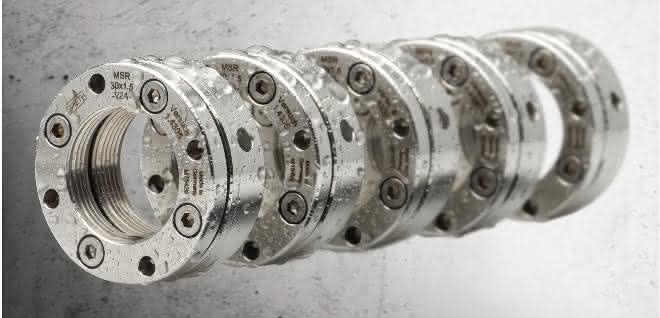
For these applications, Spieth offers locknuts with (scalable) corrosion protection individually tailored to the customer's requirements - in various coating types and in stainless steel. Spieth has examined the corrosion resistance and functionality of the individual versions in extensive salt spray tests in accordance with DIN EN ISO 9227-NNS in the research laboratory. Based on the detailed results, customers can be advised even more specifically and better with regard to the optimum corrosion protection for their particular application.
Scalable corrosion protection
Due to the ecological disadvantages and the restrictions on compatibility with the REACH regulation for coating materials, both the availability of and demand for components with yellow chromating will decrease. In some areas, this type of coating is even prohibited. As a result, more and more customers are signaling a need for products that meet these special corrosion protection requirements.
Spieth has now expanded its range and offers locknuts in various coatings (blue chromate, zinc-nickel) as well as stainless steel versions, which demonstrate very high resistance in salt spray tests. Precision nuts with "scalable" corrosion protection are available for mechanical and plant engineering, tailored to demanding applications and also available in special designs.
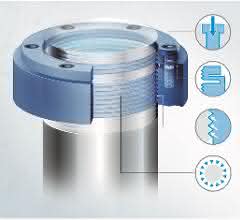
Each corrosion-protected locknut is based on the proven Spieth principle: according to the company, the ability to set the thread backlash to zero ensures optimum alignment on the thread, the best possible locking values and high breakaway torques. This should also be accompanied by high axial rigidity, very good concentricity properties and greater functional reliability, even with heavy loads and high dynamics. The locknuts are suitable for high speeds, offer high axial run-out accuracy, less wear and are quick and precise to install.
Tough test conditions in the test
In an extensive series of salt spray tests in accordance with DIN EN ISO 9227-NSS, the manufacturer tested locknuts in various coating variants through to stainless steel locknuts, both with and without clamping screws, for corrosion and functionality. An extremely corrosive environment was simulated in "fast motion" for a total of 8 x 20 nuts. The maximum test duration was 1,000 hours. Intermediate tests were carried out at seven time intervals, after which nuts were removed: after 96 hours, 192 hours, 336 hours, 432 hours, 504 hours, 672 hours and 1,000 hours.
The corrosion test in such a "time-lapse" cannot, of course, be a 1:1 reproduction of the respective installation situation in the corrosive environment of the customer application, but it does provide a detailed indication of how the product would behave in the respective coating variants over a defined period of time. This makes it easier to estimate which product is suitable for the installation situation and in which version.
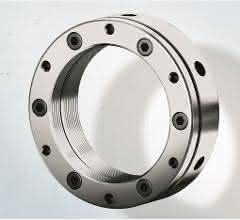
The evaluation is carried out according to precisely defined evaluation criteria in accordance with DIN EN ISO 10289 (degree of protection Rpundappearance RA) at a very high level of competence. After seven time intervals, the percentage defect area (according to protection grade Rpundappearance RA) is differentiated and the degree of deterioration is assessed in detail. For this purpose, the condition of the end faces, holes and bolts are examined in the laboratory. Locknuts with a base metal corrosion or defect area of >50 percent do not pass this test - they do not meet the high standards set by Spieth. This is because a key aspect of the evaluation is that the source of the corrosion formation (end face, holes, clamping screws) was precisely localized and analysed for the various combinations tested - locknuts with and without clamping screws - in order to make appropriate optimizations, such as the use of other screws.
Based on the test series with over 150 tested components, very detailed statements can now be made about the corrosion behavior of the individual coating types and designs.
Stainless steel locknuts last over 1,000 hours
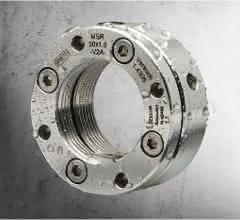
The winner of the test series is the stainless steel locknut. In the salt spray test, even after 1,000 hours under the harshest environmental conditions, it still showed no base metal corrosion and no significant defect areas - the clamping screws, the axial and radial bore as well as the end face and the functionality of the locknut were all in order.
Stainless steel locknuts are indispensable in extremely corrosive environments or in the food industry. However, appropriately coated locknuts are often sufficient and are then the more economical solution. The results for blue chromated locknuts with blue chromated screws were 192 hours. Zinc-nickel locknuts with blue chromated screws lasted up to 432 hours. All coatings offer at least the corrosion protection that customers are familiar with from Spieth products with yellow chromating.
Exact tolerances: layer thickness and materials matched
Each coating changes the tolerance of the locknut due to the corresponding coating thickness. The precisely defined thickness of the subsequent coating is therefore already taken into account during the manufacturing process at Spieth. The coating and materials of the locknut are precisely matched to the requirements, resulting in precision products with the lowest manufacturing tolerances and the best dimensional accuracy. "By optimizing our processes, the results show very little variation. The layer thicknesses and the materials used are very precisely defined," explains Dr. Heiko Alxneit, Head of Product Management at Spieth. "It is very important to us to offer customers a range of product alternatives that meet Spieth's high quality standards and also offer a significant increase in corrosion protection, such as the stainless steel version."


You might also be interested in
Atlas Copco takes over long-standing sales partner
Atlas Copco has taken over Heide-Pumpen. The specialist for mobile pumps has been working closely with Atlas Copco in sales and service for a long time, especially for surface pumps for construction site dewatering and wastewater detour or in the...
 read more...
Lutz Pumpen at the Achema 2024
New mobile drum pump with battery drive
The new B3 Battery from Lutz Pumpen promises mobile and safe working with aggressive liquids without having to compromise on pumping performance compared to wired versions. The battery-powered drum pump will be on display at Achema, the world's...
read more...Maintenance and Pumps&Valves in February
Final preparations are underway in Dortmund: On February 21, 2024, maintenance will start as the leading trade fair for industrial maintenance and with it Pumps&Valves as the trade fair for industrial pumps, fittings and valves.
read more...Liquid separator keeps pumps dry
Vacuum clamping minimizes distortion and enables five sides to be machined in one clamping operation. The use of cooling lubricants poses a challenge: If they get into the vacuum generator, they can cause serious damage.
read more...Spring clutches for construction machinery
Spring clutches from Torsion Control Products (TCP) are ideal for use in construction machinery where modern diesel engines are used.
read more...Protection against cooling lubricant
Liquid separator from Schmalz keeps pumps dry
Anyone clamping with a vacuum during CNC machining must protect the pump from cooling lubricant. The NLS liquid separator from Schmalz separates the cooling lubricant and returns it to the running process - without interrupting the vacuum.
read more...Which clutch for what?
Mechanical engineering and its applications are multifaceted. Every application is special and requires a perfect machine design. Individual components in the system must also be optimally designed.
read more...Energy efficiency needs electrical engineering and IT
The energy crisis makes one thing clear: it is not enough to simply screw a photovoltaic system onto your roof or purchase green electricity. Industry is faced with the challenge of reducing consumption in order to counter the rise in energy prices,...
read more...Solutions for a networked and climate-neutral industry
At the world's leading trade fair for industry, around 4,000 companies from the mechanical engineering, electrical and digital industries as well as the energy sector will be showcasing solutions for the production and energy supply of the future.
read more...