
Ventilation
Semi-centralized ventilation system
Fans and the cloud-based Building Connect platform from ebm-papst provide fresh air in the urbanharbor efficiently and in line with demand.
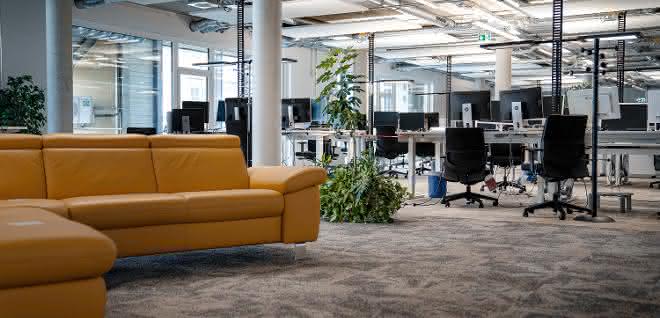
Europe's first climate-neutral urban quarter is being built in Ludwigsburg. Instead of building new buildings, old production halls are being transformed into new office buildings. One of the first semi-centralized ventilation systems in Europe ensures the supply of fresh air to the rooms.
The halls of the 200,000 square meter industrial area in Ludwigsburg's Weststadt district used to house production lines for refrigerators, among other things. Today, they house modern offices for start-ups in the region. The urbanharbor uses a house-in-house concept that requires 75 percent lessCO2 than a comparable new building. This creates an air cushion between the exterior and interior façade, which serves as additional insulation.
Europe's first semi-centralized ventilation system
Hall 8 with 10,000 square meters went into operation in summer 2021. The fresh air supply to the rooms is ensured by the new concept of semi-centralized ventilation - including fans from ebm-papst and the cloud-based Building Connect platform developed by ebm-papst neo. Around 300 RadiCal fans supply the air to the individual usage zones individually and as required, and do so particularly quietly.
They are located in sound-insulated housings where the volume flow controllers used to be. Thanks to the house-in-house concept, only 30 centimetres of space remained between the interior and exterior façades for the supply and exhaust air. Thanks to GreenIntelligence, the fans also emit a fault warning if their temperature values deviate too much from the setpoint. This fail-safe feature is important, as the fresh air supply is only guaranteed via the fans.
Sensors supply data to Building Connect platform
The cloud-based real-time data platform receives its data from sensors in the office building, processes it in the ebm-papst cloud and forwards commands to the fans. In addition to values for temperature, humidity, TVOC (chemical compounds) and particulate matter, the sensors measure theCO2 content in the air - the basis for controlling the ventilation system. The algorithms working in the background learn from user behavior, building characteristics and environmental conditions and thus continuously improve the entire building ecosystem.
First climate-neutral city district by 2030
In the future, all data will be sent to the urbanharbor cloud for cross-sector control. This cooperation will create the climate-neutral urban quarter of tomorrow. In addition to efficient air and building technology, fast-charging stations for electric cars, heat pumps and a photovoltaic system on the roof will contribute to making urbanharbor the first climate-neutral urban district in Europe by 2030.


You might also be interested in
ESTIA aims to strengthen Europe's cloud
New tech alliance for EU sovereignty
Twelve companies, including Dassault Systèmes, are founding the European Sovereign Tech Industry Alliance (ESTIA). The initiative aims to strengthen Europe's technological independence and define requirements for sovereign cloud services. The start...
 read more...
Deutsche Telekom and Nvidia launch one of Europe's largest AI factories
With the Industrial AI Cloud in Munich, Deutsche Telekom and NVIDIA are creating one of the largest AI factories in Europe. Companies can train AI models, carry out simulations and access 10,000 GPUs.
read more...Leveraging data potential with AI and streaming
Huge data treasures are still lying dormant in many manufacturing companies. And yet it is high time that these treasures were unlocked. There is often a lack of resources and capacity to make data usable in real time. Streaming production data can...
read more...More awareness of noise
Dematic offers solutions that are tailored to different cloud environments and reduce environmental impact through reduced material consumption and improved energy efficiency.
read more...Generative AI in the automation environment
The mechanical engineering and automation industry is undergoing profound change. This transformation is being driven by more volatile global trade, geopolitical crises and increasing market pressure, which demands greater agility, technological...
read more...Rigid data structures have had their day
The traditional data center is no longer the center of data. A hybrid cloud storage approach enables manufacturing companies to both meet the current requirements of data-intensive processes and future-proof their infrastructure.
read more...Software as a service in three stages
CIM Database Cloud is a new out-of-the-box solution from Contact for end-to-end digital product development.
read more...How production can benefit from AI
Together with AI technology, IIoT networking makes it possible to better control machine parameters and optimize quality with predictive quality. Downtimes and set-up times can also be further minimized. Cloud platforms also make these technologies...
read more...More expertise for digital engineering
Altair, a computational science and artificial intelligence (AI) company, has acquired OmniV, a technology from Michigan, USA-based software company XLDyn.
read more...