
Segment conveyor
Automatic alignment and separation
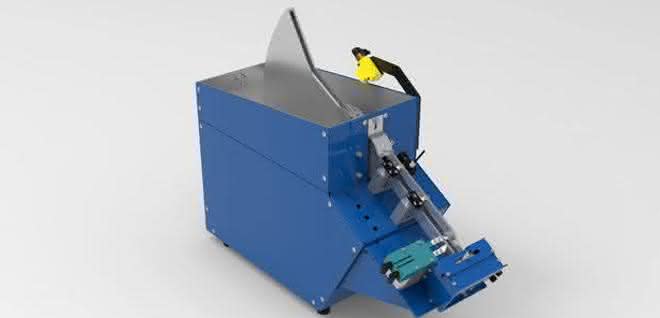
Bringing screws into the correct position and separating them is a challenge faced by many partially and fully automated productions. Vibratory conveyors are a widely used solution here. However, their operation is often associated with high noise levels and the vibrations also cause abrasion on the conveyed screws. With its segment conveyors, Arnold Umformtechnik offers an alternative to this technology. Here, screws are not separated and aligned by vibration, but by the upward and downward movement of a segment blade.
A segment conveyor supplies up to two press-fit heads simultaneously. These can be located both in the pressing tool and in the C-frame or an automatic C-frame system. If several press-fit heads are required, additional segment conveyors can be integrated into the system.
Segment conveyors that are gentle on screws are used wherever screws need to be automatically placed in the correct position and fed individually to a joining process. High cleanliness requirements are another argument for their use, as less abrasion also means less contamination, which can be a weighty argument for sensitive production areas. Automotive production is therefore a typical area of application.
The right position wins
The screws are sorted into the correct position via the segment of the segment conveyor by means of up and down movements in the segment tray and conveyed to the accumulation rail. To position the screws, their cylindrical end slides into a guide groove at the lowest point of the segment tray and gets caught on its head. Elements that are not in the correct position are removed by a scraper during the upward movement of the segment blade. Correctly positioned screws slide into the accumulation section of the transport unit, are separated and fed to the processing unit by compressed air.
A sensor permanently monitors the fill level of the accumulation section. If it is empty, the segment blade is moved up and down until the section is refilled. As segment conveyors can only hold a certain number of screws at any one time due to their function, regular refilling is necessary. This is done by a special belt conveyor with a storage hopper that can hold a larger number of screws.
Automatic refilling of the screws
A laser light sensor detects the screw fill level in the segment conveyor and signals the need to the belt hopper, which then automatically refills with new screws. The segment conveyor is then refilled with screws or other elements via the storage hopper.
If the sensor fill level becomes free, the belt hopper starts to refill elements into the segment conveyor as soon as the segment blade is in the lower end position. The segment blade remains in the lower end position until the belt hopper stops refilling. The light barrier of the belt conveyor signals when it is empty. An indicator light then signals to the operator that new screws need to be filled.
According to documents from Arnold Umformtechnik


You might also be interested in
Plagiarius 2024 negative prize
On January 26, 2024, the Plagiarius campaign awarded its dreaded "Plagiarius" negative prize for the 48th time to manufacturers and retailers of particularly brazen counterfeits and fakes.
 read more...
Ivalua honors winners of the Generative AI...
AI-supported "add-ons" for buyers within 48 hours
Ivalua, provider of cloud-based spend management solutions, announced the winners and innovations of the first Generative AI Innovation Cup. The competition took place in December 2023. It was open to all Ivalua partners and employees - more than...
read more...Efaflex celebrates 50 years of high-speed...
The emphasis is on "fast"
Since day one, Efaflex has wanted to use new technologies as early as possible and drive progress in the industry. This year, the family business is celebrating its 50th anniversary under the motto "Fast Forward".
read more...Security of supply even during power outages
In the winter of 2022, Germany was worried about energy shortages. The drugstore retailer dm did not paint any horror scenarios, but nevertheless saw the possibility of controlled, temporary, regional power cuts (brownouts).
read more...Safety technology in mechanical engineering
Modules with new functions
Euchner's product highlights at EMO 2023 include the communication-capable solenoid interlocks.
read more...Transforming the paper industry towards climate neutrality
Together with partners from industry and research, Voith is developing a project for the optimization of energy and material flows in paper production. The aim of the research project is to develop a digital framework that enables effective process...
read more...Up to 95 percent less flue gas thanks to direct extraction
The requirements for occupational safety measures and safety technology are also constantly increasing in welding technology. The Technical Rules for Hazardous Substances (TRGS) stipulate that welding fumes and harmful substances must be extracted...
read more...Competitive advantages with large machines
Whether 3D-printed components for machines and systems, prototypes or aids for design: additive manufacturing is almost indispensable for modern companies in mechanical and plant engineering and automation if they want to play in the premier league.
read more...Transport technology from the modular system
Many transport tasks can be realized with the help of linear technology. Pre-configured solutions are available to simplify the interaction between the linear unit, motor, gearbox and controller. This minimizes the effort required for research and...
read more...