
Sustainability
More efficient axial fan
Quiet fans allow heat pumps to perform better even at partial load at night.
Heat pumps are becoming increasingly popular for heating systems. However, in addition to the benefits they offer in terms of reducingCO2 emissions, they also create additional sources of noise.
In order to comply with noise protection limits, the majority of heat pumps must therefore be operated at partial load overnight (night setback). However, electricity consumption increases when the heat pump runs at reduced output and more of the required heat has to be generated electrically. The fan is mainly responsible for the noise emissions of the heat pump. For functional reasons, it can only be fitted with sound insulation at great expense.
Air-to-water heat pumps
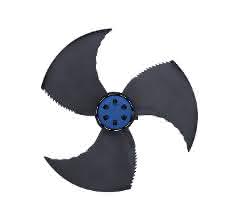
With the FPowlet, Ziehl-Abegg has a new axial fan in its range that has been specially developed to meet the requirements of air-to-water heat pumps for residential and commercial buildings. The specific installation conditions in heat pumps, such as disturbances in the supply air flow or short nozzle geometries, require measures to solve the problems identified. In addition to improving the air flow rate, the development focused in particular on noise reduction through the fan blade.
Inspired by bionic developments, a "blade" with a special blade shape was created. This enables quieter operation with the same volume flow compared to conventional fans. This means that a higher air and therefore thermal output can be achieved when the sound immission threshold is reached. In other words: with the same air flow and the same thermal output, the fan is quieter than fans currently in use - by up to 4.5 dB(A) depending on the device and installation situation. This means that more heat output is available during night-time operation, which also improves the annual coefficient of performance (COP) of the heat pump.
Coordinated drive
For maximum system efficiency, all components of a system must fit together perfectly. The fan is therefore driven by an EC motor, which is matched to the fan blade with demand-controlled speed and modern communication interfaces. In addition to quieter operation, this also improves energy efficiency. In addition to the measurable volume, the tonality emitted by the fan is also an important factor. A tonal noise is dominated by one frequency, which can be perceived as particularly annoying. During the development of the FPowlet, particular emphasis was placed on reducing such disturbing noises as much as possible.
The optimum interaction between heat pump and fan is crucial. It therefore makes sense to include the fan in the development stage of new appliances. At Ziehl-Abegg, appliances are measured and analyzed on the air side. The installation of the fan is thus optimally adapted to the heat pump according to the problem. Experience has shown that you should not just rely on calculations. A test often reveals the true spectrum of noise behavior. The new FPowlet axial fans are available in various sizes (450-630) for heat pumps. Other fan series are available for more powerful systems.


You might also be interested in
Plagiarius 2024 negative prize
On January 26, 2024, the Plagiarius campaign awarded its dreaded "Plagiarius" negative prize for the 48th time to manufacturers and retailers of particularly brazen counterfeits and fakes.
 read more...
Ivalua honors winners of the Generative AI...
AI-supported "add-ons" for buyers within 48 hours
Ivalua, provider of cloud-based spend management solutions, announced the winners and innovations of the first Generative AI Innovation Cup. The competition took place in December 2023. It was open to all Ivalua partners and employees - more than...
read more...Efaflex celebrates 50 years of high-speed...
The emphasis is on "fast"
Since day one, Efaflex has wanted to use new technologies as early as possible and drive progress in the industry. This year, the family business is celebrating its 50th anniversary under the motto "Fast Forward".
read more...Security of supply even during power outages
In the winter of 2022, Germany was worried about energy shortages. The drugstore retailer dm did not paint any horror scenarios, but nevertheless saw the possibility of controlled, temporary, regional power cuts (brownouts).
read more...Safety technology in mechanical engineering
Modules with new functions
Euchner's product highlights at EMO 2023 include the communication-capable solenoid interlocks.
read more...Transforming the paper industry towards climate neutrality
Together with partners from industry and research, Voith is developing a project for the optimization of energy and material flows in paper production. The aim of the research project is to develop a digital framework that enables effective process...
read more...Up to 95 percent less flue gas thanks to direct extraction
The requirements for occupational safety measures and safety technology are also constantly increasing in welding technology. The Technical Rules for Hazardous Substances (TRGS) stipulate that welding fumes and harmful substances must be extracted...
read more...Competitive advantages with large machines
Whether 3D-printed components for machines and systems, prototypes or aids for design: additive manufacturing is almost indispensable for modern companies in mechanical and plant engineering and automation if they want to play in the premier league.
read more...Transport technology from the modular system
Many transport tasks can be realized with the help of linear technology. Pre-configured solutions are available to simplify the interaction between the linear unit, motor, gearbox and controller. This minimizes the effort required for research and...
read more...