
Product development
Making decisions when quality criteria are incompatible
In the supplier industry, the execution of commissioned developments is complex and cost-driven. A tool from Fraunhofer IGD makes it easier for engineers to select the optimum design and links this with transparent price-performance comparisons.
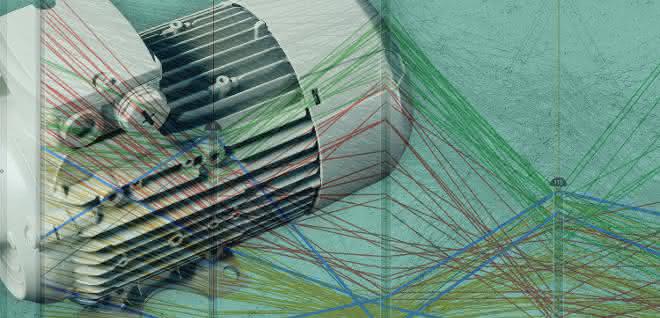
Decisions are rarely made lightly, especially when criteria are in conflict. Visualizing the alternatives helps to put thoughts in order. A tool from Fraunhofer IGD makes it easier for engineers to select the optimum design for a commissioned product and creates transparent and easy-to-understand price-performance comparisons that lead to shorter coordination paths.
For example, an engineer develops an electric motor that meets the nominal values ordered by the customer. Her assumption that a different material or a change in geometry could have an additional positive effect on the motor performance is confirmed in the simulations. But how does she report this to the customer, who is critical of the associated higher costs?
The solution is a clear visualization of the alternatives, in which the preferred design candidates can be quickly narrowed down using combinable filters. For example, if you use a slider to increase the costs you are prepared to pay, the visualization seamlessly displays the effects on the other properties of the engine. This allows the advantages and disadvantages of certain models to be recognized at a glance - without in-depth specialist knowledge.
The customer and engineer decide depending on the area of application. For example, if efficiency is less critical, a more cost-effective motor variant may be chosen. The interactive levers of this visualization application make decision-making visually easy to understand and significantly shorten coordination paths in multi-criteria cost-benefit considerations.
Interactive visualization focuses on the decision-maker
For a visualization to effectively support a human analysis process such as decision-making, the real operating conditions must be taken into account. To this end, the specific problem, workflows and needs of the domain experts are analysed and visualization requirements are derived from this. Only then can suitable visualization approaches be selected and adapted to the domain.
The visualization described above was developed in close cooperation with engineers from the Linz Center of Mechatronics over a period of 1½ years. This collaboration made it possible to develop a tailor-made problem solution that fits seamlessly into existing work and analysis processes. In their design study "PAVED: Pareto Front Visualization for Engineering Design", the researchers show how this user-centric process was successfully implemented and what needs to be taken into account.
The research work was funded by the EU project CloudiFacturing. The aim of the programme is to optimize production processes with the help of cloud/HPC-based modelling and simulation. The computationally intensive production technology and simulation as well as data analysis tools are to be made available as cloud services in order to facilitate accessibility and make their use more affordable.


You might also be interested in
ESTIA aims to strengthen Europe's cloud
New tech alliance for EU sovereignty
Twelve companies, including Dassault Systèmes, are founding the European Sovereign Tech Industry Alliance (ESTIA). The initiative aims to strengthen Europe's technological independence and define requirements for sovereign cloud services. The start...
 read more...
Deutsche Telekom and Nvidia launch one of Europe's largest AI factories
With the Industrial AI Cloud in Munich, Deutsche Telekom and NVIDIA are creating one of the largest AI factories in Europe. Companies can train AI models, carry out simulations and access 10,000 GPUs.
read more...Leveraging data potential with AI and streaming
Huge data treasures are still lying dormant in many manufacturing companies. And yet it is high time that these treasures were unlocked. There is often a lack of resources and capacity to make data usable in real time. Streaming production data can...
read more...More awareness of noise
Dematic offers solutions that are tailored to different cloud environments and reduce environmental impact through reduced material consumption and improved energy efficiency.
read more...Generative AI in the automation environment
The mechanical engineering and automation industry is undergoing profound change. This transformation is being driven by more volatile global trade, geopolitical crises and increasing market pressure, which demands greater agility, technological...
read more...Rigid data structures have had their day
The traditional data center is no longer the center of data. A hybrid cloud storage approach enables manufacturing companies to both meet the current requirements of data-intensive processes and future-proof their infrastructure.
read more...Software as a service in three stages
CIM Database Cloud is a new out-of-the-box solution from Contact for end-to-end digital product development.
read more...How production can benefit from AI
Together with AI technology, IIoT networking makes it possible to better control machine parameters and optimize quality with predictive quality. Downtimes and set-up times can also be further minimized. Cloud platforms also make these technologies...
read more...More expertise for digital engineering
Altair, a computational science and artificial intelligence (AI) company, has acquired OmniV, a technology from Michigan, USA-based software company XLDyn.
read more...