
IT experts
Knowledge as a service
Whether engineering firms or freelancers, they offer the same service: expertise. In the course of the digital transformation and the shortage of skilled workers, the importance of external services is increasing, as shown by studies and the offerings of personnel service providers and companies.

The digital transformation is constantly presenting companies with new challenges. Industry 4.0 brings with it numerous new regulations, laws and requirements for companies that often have nothing to do with their core competencies. This confronts them with the question of whether they should develop this newly required expertise themselves, for example in the area of big data and software development, or whether they should buy in the knowledge in the form of freelancers or development partners.
Big data increases demand for IT experts
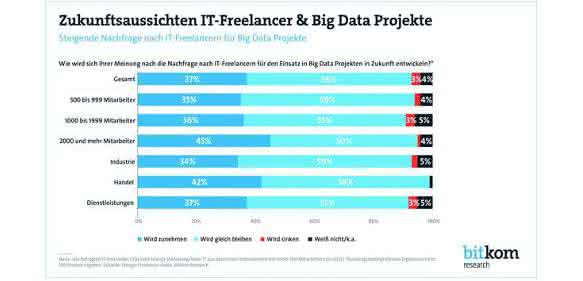
Big data is an absolute hot topic in the wake of Industry 4.0 and Industrial IoT. As a result of this trend, the demand for well-trained IT specialists is growing continuously. This is the result of the Etengo Freelancer Index, or ETX for short, a representative company survey designed as a long-term analysis that Bitkom Research conducts every six months on behalf of the personnel service provider Etengo. According to this survey, four out of ten large German companies (37%) anticipate a steadily growing demand for IT freelancers, while more than half (56%) expect at least a constant development. The larger the company, the more important freelance big data experts are: 45% of companies with at least 2,000 employees expect demand to increase. Big data is an important topic for the majority of companies across all sectors. Nine out of ten companies (87%) have already implemented at least one big data project, are already planning one or are currently implementing one. The majority of companies assume that the new General Data Protection Regulation (EU GDPR), which will come into force in May 2018, will facilitate big data projects thanks to the clear regulations within the EU (57%) and will not restrict the opportunities offered by big data (62%).
IT freelancers are most important in the industrial sector (75 percent), followed by the services (72 percent) and retail (66 percent) sectors. The study also clearly shows that IT freelancers will continue to be in high demand in the future: More than half (59 percent) assume that their importance will continue to increase over the next six months.
The importance of the expertise of external freelancers is demonstrated by the number of hours they worked in the second half of 2017: Accordingly, they account for almost a quarter (23 percent) of the working hours of the total IT project volume - and the trend is rising. Nikolaus Reuter, CEO of Etengo (Deutschland) AG, explains the result: "In the age of digitalization, the German economy is increasingly reliant on highly specialized IT knowledge in order to keep up the pace of innovation. This must be available at lightning speed in order to achieve initial results quickly, for example in the context of pilot projects. It is foreseeable that this permanently growing, additional demand can only be met through flexible forms of deployment in the course of project work."
Due to the increasing level of automation in production, growing networking and the products and solutions used in manufacturing, the programming effort is also growing. When purchasing new products, users are therefore increasingly looking at the associated services, for example the integration of the new robot into an existing system.
Robotics-as-a-Service, or RaaS for short, is a buzzword here. This is a concept that is primarily used by manufacturers who do not sell their robots, but rather make them available to the user as a full service within the framework of leasing with an already implemented solution. According to the market research institute ABI Research, these leasing concepts are becoming increasingly popular: the number of RaaS units is expected to rise from 4,442 in 2016 to 1.3 million by 2026. The advantage for the user lies on the one hand in the tax area (investment expenditure vs. operating costs) and on the other hand in the services and programming services. ag


You might also be interested in
Conrad continues to grow
Conrad Electronic now generates 80% of its sales with business customers and has successfully developed from a traditional technology retailer into a B2B procurement platform. The company aims to become Europe's leading procurement platform for...
 read more...
AI finds its way into automotive customer service
In addition to computer solutions for vehicle diagnostics, Getac now also offers AI-based digital tools that support customer contact in service operations.
read more...SMC: "Preferred Supplier" from Bosch
The technology and service company Bosch has recognized SMC for the performance of its automation technology in factory and process automation and awarded it the status of "Preferred Supplier" in the material group "Standardized Pneumatic Devices".
read more...Combined ERP forces
The medium-sized ERP providers Step Ahead Software, Godesys and Informing merge to form the Step Ahead Group.
read more...Cybersecurity for asset-intensive companies
Forge Cybersecurity Platform, the new software platform from Honeywell, has been developed for the cybersecurity of asset-intensive companies and critical infrastructures. The platform is available in three versions.
read more...Automated machine tool as a success factor
Industry 4.0 is the hot topic of the moment. For small and medium-sized companies and contract manufacturers, it holds great potential for increasing production efficiency step by step. The focus here is on efficient and user-specific automation...
read more...Nemo hand vacuum lifts all materials
A new addition to the Eurotech portfolio is the battery-operated Nemo vacuum cleaner, which is suitable for handling almost all surfaces.
read more...Future-oriented cobot projects
Three pillars of successful cobot initiatives
What is important if cobot projects are to be future-oriented? Automation and robotics expert Omron has identified three aspects for human-machine collaboration.
read more...Short-stroke linear actuator instead of pneumatic cylinders
The new short-stroke linear actuator from Ketterer Antriebe and halstrup-walcher is characterized by high dynamics and a large stroke in a compact size. Thanks to the integrated electronics, the drive is easy to control compared to pneumatic...
read more...