

Applications in the automotive sector
Heating wires thinner than hair
Heatable, flexible surfaces open up interesting possibilities for the industry. New Albea has launched an innovative heating module on the market that can not only heat parts of the vehicle body, for example, but also interior surfaces in conjunction with conductive paints.
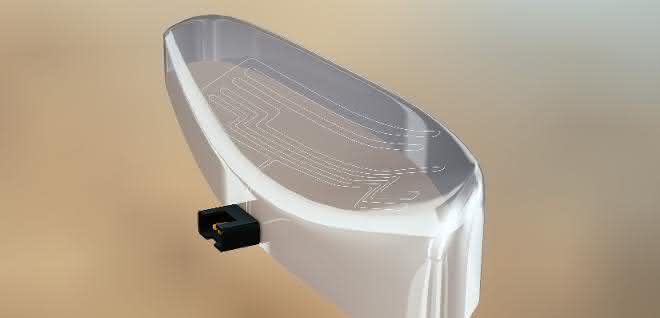
This makes them predestined for applications in the automotive sector, especially with regard to current topics such as electromobility and autonomous driving. However, the conductive wires or printed tracks embedded in plastic can also be used in other fields of application.
3D geometries possible
One of the special features is the flexibility of the surface heating. Due to the extremely thin structure with a thickness of 0.250 to 0.375 mm - the embedded heating wires are thinner than human hair - the film can also be shaped into a 3D geometry. Conductive printed surfaces or webs are also possible instead of heating wires. This means that it can be adapted to the contour of the surface to be heated and can also be back-molded. To prevent moisture from penetrating the system, New Albea has developed a patented contacting solution in which the outside of the film remains closed. Different connector and contacting variants are available depending on customer requirements.
Versatile applications conceivable in the automotive sector
In order to ensure the functional safety of autonomous driving systems, surfaces behind which important sensors are installed must be kept free of ice during winter operation. The heating module can be used to heat three-dimensional contours or radomes without interfering with the radar signal. The technology can also help to keep the interior at a pleasant temperature. As there is no engine heat to heat the electric car, the heating foil can be used to heat interior surfaces such as armrests or door panels.


You might also be interested in
Intelligent sensor technology for the packaging industry
At Interpack 2026, Sick will be showcasing its portfolio of sensor, automation and AI-supported solutions for secure and digitally networked packaging processes in the consumer goods, healthcare and pharmaceutical industries.
 read more...
Sales growth in a turbulent market environment
Thanks to innovations and a focus on strategic industrial markets, Sick was able to moderately increase its sales in the 2025 financial year. In a turbulent market environment, the company was able to maintain its position and gain market share with...
read more...Photonic microchips with 3D connector
How a 3D system makes photonic chips industrially viable
A research team from Heidelberg is developing a 3D-printed "connector" for photonic microchips. The solution promises a low-loss, standardized coupling of glass fibre and chip - and could fundamentally simplify the production of photonic integrated...
read more...Advanced material retrieval system
Steute shows nexy wireless network with extended connectivity
Steute's Leantec division is presenting an enhanced version of the nexy wireless network with improved connectivity and additional cybersecurity functions. The background to the further development is the increasing use of automated guided vehicles...
read more...Detecting air bubbles in liquids
EBE is launching a capacitive bubble sensor on the market that reliably detects air bubbles and liquid breakages, regardless of the liquid and the condition of the hose.
read more...Miniature acceleration sensors
Structural tests on printed circuit boards
The Z22198 family consists of very small triaxial accelerometers from Kistler that measure vibrations in three orthogonal axes.
read more...Positive development in sensor and measurement technology
In the first quarter of 2025, the sensor and measurement technology industry recorded sales growth of three percent compared to the previous quarter - according to the results of the quarterly member survey conducted by the AMA Association for...
read more...Sick extends contract with CEO
The Supervisory Board of Sick has extended the contract of CEO Dr. Mats Gökstorp by 5 years. The company also announced that Feng Jiao has resigned from his position as Chief Sales Officer at his own request. Markus Scaglioso has been appointed to...
read more...Kistler and Keller Pressure deepen partnership in China
The Kistler Group is intensifying its cooperation with Keller Pressure. By signing the agreement, the two companies are reaffirming their commitment to strengthening synergies and developing the Chinese market in a targeted manner.
read more...